Why I Ditched My Suitcase and Never Paid a Carry-On Fee Again
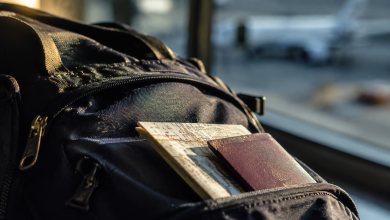
The Last Straw at Gate B7
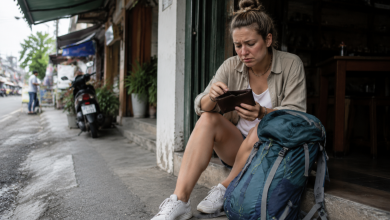
It was a Tuesday morning in October, somewhere between exhausted and furious, when I finally broke. I was standing at the gate in Atlanta, watching an airline agent measure my carry-on with the kind of practiced precision usually reserved for surgical procedures. The bag was an inch too tall. One inch. I knew what was coming before she even opened her mouth the flat, apologetic tone, the $75 fee, the humiliation of yanking my belongings out right there in front of a line of strangers.
I paid it. I always paid it. But something shifted in me that morning. I sat down at the gate, bag wedged between my knees, and started doing math I should have done years earlier.
What Luggage Is Actually Costing You
Here’s the number most travelers never bother to calculate: the full cost of owning and operating a suitcase.
There’s the bag itself a decent carry-on runs $150to $400, and the roller wheels on budget versions rarely survive two years of airport floors. There’s the checked baggage fees if you travel with a full-size suitcase, typically $35 to $45 each way on domestic flights, which on four round trips a year adds up to $280 to $360 before you’ve even thought about international travel. Then there’s the gate-check fees, the oversize fees, and as I learned the hard way the carry-on fees that budget carriers now charge on basic economy tickets.
Spirit, Frontier, Allegiant. Even American and United on their cheapest fare class. The landscape has completely shifted. A “free” carry-on is no longer a guarantee. It’s a perk, tiered and priced accordingly.
Beyond money, there’s time. Research consistently shows that passengers with checked bags spend an average of 30 to 45 minutes longer in airports per trip time at the check-in counter, time at the carousel, time waiting while the belt mockingly delivers every bag except yours. Over ten trips a year, that’s potentially eight hours of your life standing under fluorescent lights, watching strangers’ luggage go by.
I decided I was done paying in both currencies.
The Psychology of Overpacking
The honest reason most people overpack isn’t necessity. It’s anxiety.
We pack for the trip we fear rather than the trip we’re actually taking. A four-day business trip gets a week’s worth of clothing because what if there’s an unexpected meeting, what if something spills, what if the hotel laundry is too expensive. We bring the “just in case” blazer, the backup shoes, the toiletry kit stocked like a pharmacy.
I used to do all of it. My carry-on was always maximum weight, always stuffed with options I never exercised. I came home with shirts I hadn’t worn, bottles I hadn’t opened, a rain jacket I’d carried through four cities that saw nothing but sun.
The suitcase was enabling a fiction that I needed to be prepared for every possible version of the trip. What I actually needed was to trust myself to handle reality as it unfolded.
Switching to a single personal item a 40-liter backpack that fits under every seat on every airline forced me to confront what I actually use. The answer is: a lot less than I thought.
What I Actually Carry Now
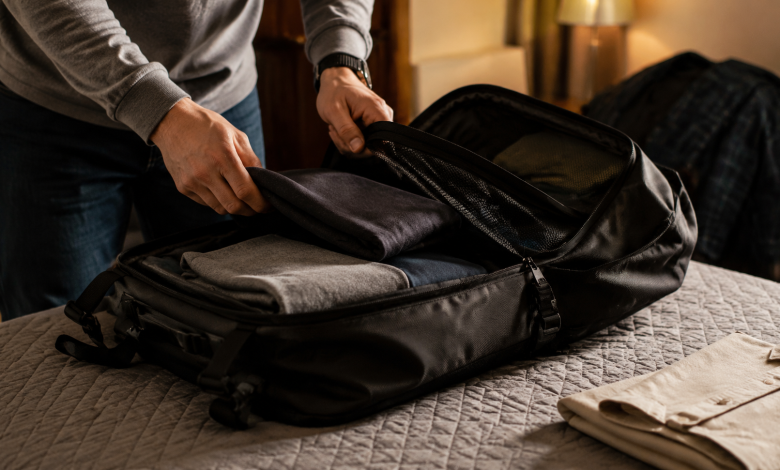
The transition wasn’t overnight, and it wasn’t painless. It required rethinking travel not just logistically but philosophically. The backpack I settled on is a 40-liter travel pack with a clamshell opening and a laptop sleeve intentionally designed to stay within personal item dimensions for major U.S. carriers.
For a five-day trip, I bring three shirts, one pair of pants, one pair of versatile shorts that can double as swimwear, five days of socks and underwear (the one category where I don’t compromise), a light merino hoodie, and a compact rain shell that compresses to fist-size. Shoes I wear on the plane are the bulkiest item, so I choose carefully something that can handle both walking and a dinner out.
Toiletries are the area where most people stumble. The 3-1-1 rule isn’t actually that restrictive once you stop treating travel-size as a foreign concept. Solid shampoo bars, a2-ounce moisturizer, a refillable 1-ounce cologne spray. The full kit fits in a quart bag with room to spare.
For longer trips, my approach shifts slightly not more stuff, but a different stuff. I swap the shorts for a second pair of pants and factor in one laundry session at a local laundromat, which in most cities runs $5 to $8 and doubles as a genuinely good way to spend an afternoon in an unfamiliar neighborhood.
The Airline Fee Game and How Backpacks Win It
What makes a backpack specifically powerful in the current airline economy is dimensional strategy. Airlines have cracked down on carry-on bins because the overhead space is genuinely limited and because they’ve discovered that carry-on fees are a reliable revenue stream. But personal items the bag that goes under the seat in front of you remain free on virtually every carrier, including the ultra-low-cost airlines that charge for everything else.
The magic numbers to memorize: most airlines define personal items as fitting within roughly 18 x 14 x 8 inches, though this varies slightly. A well-designed40-liter travel pack sits comfortably within those bounds. You’re not gaming the system you’re using it exactly as intended.
On a Spirit flight last spring, I watched passengers in the boarding line get charged $79 for carry-ons that hadn’t been purchased in advance. I walked on with my backpack, sat down, and spent the difference on two nights of accommodation.
There’s also something about the boarding process itself that changes. I no longer approach the gate with low-grade dread about whether the overhead bins will be full. I don’t lunge for early boarding. I sit until my group is called, walk on, slide my bag under the seat, and settle in. It’s a minor thing, but travel is built from minor things.
What You Actually Lose And Whether It Matters
I’d be dishonest if I pretended the transition is cost-free in every sense. There are genuine trade-offs.
You cannot bring a proper hair dryer. Most toiletries must be under 3.4 ounces, which means buying certain items at your destination if you’re staying longer than a week. Business travelers who need to bring physical materials product samples, printed documents, gifts face real constraints. And for anyone traveling to cold climates, bulky winter gear changes the math entirely. A ski trip to Colorado is a different equation than a week in Miami.
None of that is trivial. But for the majority of leisure travel and most business travel, the constraints are smaller in practice than they appear on paper. Hotels provide hair dryers. Pharmacies exist in every city. Printing can be done on-site. The list of things you genuinely cannot manage without a full suitcase is shorter than you think.
The deeper loss, which I took longer to acknowledge, is optionality. A suitcase lets you pack for multiple versions of your trip. A backpack requires you to commit. That shift from hedging to deciding is uncomfortable at first. Over time, it starts to feel less like sacrifice and more like clarity.
A Different Relationship with Travel Itself
There’s a version of this essay that stays purely practical a checklist, a gear guide, a financial breakdown. But that would miss what I actually noticed after a year of traveling this way.
Moving through airports without checked luggage changes your relationship to travel at a pace-of-mind level. You stop arriving at airports ninety minutes early out of obligation. You can take a later flight if the morning one is miserable, without the logistics of re-checking bags. You can take the train from the airport to the city center without worrying about the overhead rack. In some cities, you can check into your accommodation and immediately leave again with your full life on your back, unhurried.
Somewhere in Atlanta, at Gate B7, I thought I was solving a money problem. What I was actually doing was simplifying my relationship with movement itself stripping travel back to something lighter, faster, and quietly more free.
The suitcase is in my storage unit. It hasn’t moved in fourteen months. I don’t miss it at all.