Can Less Furniture Actually Help You Sleep Better?
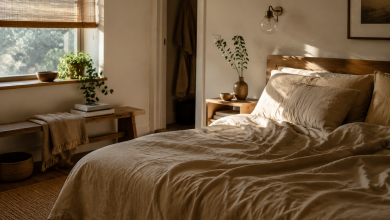
There’s a moment most people have had you walk into a hotel room, drop your bag, and immediately feel your shoulders drop. The room is clean, spare, almost austere. A bed, a nightstand, maybe a low dresser. And for some reason, you sleep better that night than you have in weeks. You write it off as exhaustion, or a change of scenery. But what if the room itself had something to do with it?
The relationship between your physical environment and sleep quality is something researchers have been circling for years. Most of the conversation lands on the usual suspects: light exposure, noise, temperature, screen time. Furniture rarely comes up. Yet the way a bedroom is arranged and how much is in it has a surprisingly direct line to how well your nervous system settles at night.
The Bedroom Isn’t Just Where You Sleep
Here’s the thing about furniture: it doesn’t just occupy space. It also occupies attention. A cluttered dresser, a chair draped with clothes that never quite made it to the closet, a bookshelf crammed past capacity these aren’t neutral objects. They’re low-level cognitive demands. Every item your eye lands on triggers a tiny, barely conscious response in the brain. Something along the lines of: that needs to be dealt with. Not now, maybe. But eventually.
This is what researchers sometimes call “visual noise.” The term sounds abstract until you realize it describes something you’ve almost certainly felt that vague, background restlessness that makes it hard to fully unwind even when you’re lying down and genuinely tired. Environmental psychologists have documented how high-stimulation spaces rooms with a lot of objects, varied textures, competing visual focal points correlate with higher reported stress levels and longer sleep onset times. The brain, in simple terms, has trouble switching off when it’s still processing a room.
Minimizing furniture doesn’t solve all of this. But it does reduce the surface area for that kind of visual noise. Fewer objects means fewer unfinished narratives competing for your attention.
What Happens to the Nervous System in a Sparse Space
Sleep onset isn’t purely a physiological event. It’s a psychological one. The transition from wakefulness to sleep requires a gradual loosening of the mental grip a process that psychologists call cognitive deactivation. Your thoughts need to slow, your sense of urgency needs to dissolve, your body needs to stop receiving signals that more doing is required.
Environments play an active role in this process. Research from the field of environmental psychology particularly work associated with Rachel and Stephen Kaplan’s Attention Restoration Theory suggests that spaces low in complexity and high in coherence help restore directed attention and reduce mental fatigue. Bedrooms that feel simple and ordered communicate, on a sensory level, that nothing requires your action. There is no problem to solve here. You can stop.
This isn’t mysticism. It’s closer to conditioning. When a space consistently looks and feels a certain way calm, undemanding, visually quiet your nervous system starts to associate it with rest. The inverse is also true: a bedroom that doubles as a home office, storage room, and laundry staging area trains your brain to stay alert there, because alert is what you are when you’re in it.
The Feng Shui Intuition Has a Scientific Counterpart
Long before sleep scientists started measuring sleep latency, feng shui practitioners were advising people to keep the area under the bed clear, to avoid mirrors facing the sleeping body, to limit what entered the bedroom at all. It’s easy to dismiss this as superstition. But the underlying intuition that physical arrangement affects the quality of rest turns out to be fairly sound.
One element that shows up in both traditional spatial philosophy and contemporary design research is the concept of “pathways.” When furniture blocks natural movement through a room, when you have to navigate around things to reach your bed, a subtle physical tension is introduced. Your body is rehearsing obstacle avoidance, not stillness. Conversely, open floor space around the bed something you can move through without thinking seems to register as physically safe and unencumbered. The body reads that openness.
A 2015 study published in Sleep found that people who described their bedrooms as “restful” and “neat” fell asleep more quickly and reported better sleep quality than those who described their spaces as “cluttered” even after controlling for factors like noise and light. The researchers didn’t manipulate the spaces; they simply asked people to describe them. The perception of order was enough to show a measurable correlation with sleep outcomes.
Less Furniture, or Just the Right Furniture
It’s worth drawing a distinction here, because the goal isn’t austerity for its own sake. A bedroom stripped of everything but a mattress on the floor isn’t automatically conducive to good sleep comfort still matters, and certain people find sparseness cold or anxiety-inducing rather than calming. The real question isn’t how little you can have, but whether what you have is serving the specific function of this room.
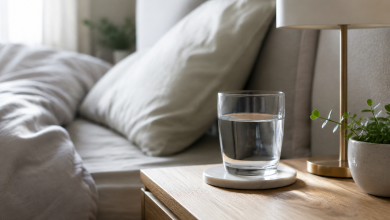
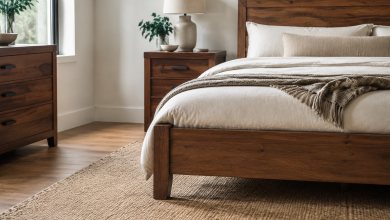
Consider what a bedroom actually needs: a place to sleep, a surface for the things you use at night (a lamp, a glass of water, a book), and somewhere to store clothes so they aren’t draped across every available surface. That’s genuinely not very much. The extras the exercise bike, the television armoire, the decorative shelving, the second desk because the office didn’t have room these are the things worth interrogating.
A designer who specializes in residential interiors once described it this way: most bedrooms are furnished as an afterthought, with everything that didn’t fit somewhere else. The living room gets the intentional choices; the bedroom gets the overflow. Given that you spend roughly a third of your life there, and given that the quality of what happens in that room affects every waking hour, that’s a fairly significant oversight.
Temperature, Air, and the Stuff That Gets in the Way
There’s also a more physical argument worth mentioning. Furniture has mass, and mass holds heat. A bedroom densely packed with upholstered chairs, a heavy wardrobe, thick rugs layered over carpet, and a pile of decorative pillows that come off the bed every night all of that affects thermal dynamics. Sleep researchers are consistent on one point: a cooler room supports deeper sleep. The body needs to drop its core temperature by a degree or two to initiate deep sleep stages, and an environment running warm interferes with that.
This isn’t an argument against having a rug or a wardrobe. But it does suggest that the density of a room has consequences beyond the visual. More stuff, in a sealed bedroom, often means a warmer bedroom. And a warmer bedroom, even slightly, is one where you shift position more often, surface from deep sleep more frequently, and wake up feeling less restored.
The Permission to Subtract
There’s a cultural hesitation around this idea. Furniture is associated with security, with having made it, with building a life that looks and feels established. An empty-looking room can register as unfinished, even impoverished. This is worth naming, because it’s often the real reason people don’t change their bedrooms even when they sense that something about the space isn’t working.
But sleeping well is not a luxury concern. It affects cognition, emotional regulation, immune function, metabolic health, and the degree to which you are actually present in your own life. If a room that holds less or holds only what genuinely belongs there gives your nervous system permission to fully let go, that’s not minimalism as aesthetic. That’s just good design with good consequences.
The hotel room that felt so easy to sleep in wasn’t special because it was expensive. It was special because nobody had filled it with anything that didn’t need to be there.