Designing a Bedroom That Honors the Art of Slow Living
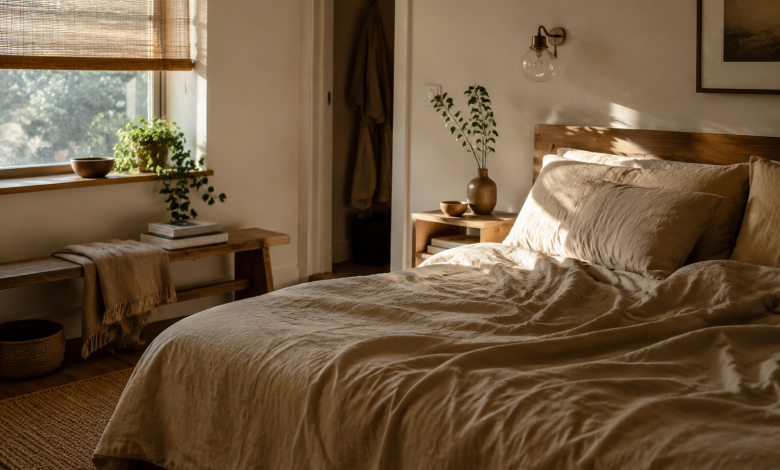
There’s a particular kind of exhaustion that modern life specializes in not the satisfying tiredness that follows physical effort, but the dull, low-grade depletion that comes from too many notifications, too many decisions, too many surfaces demanding your attention. The bedroom, for many people, has become just another arena in that same overwhelming world. A place where phones charge overnight and screens glow from the corner and the to-do list follows you to the pillow. Something has gone quietly wrong with how we think about sleep, rest, and the rooms meant to hold them.
Slow living, as a philosophy, pushes back against that erosion. It isn’t about doing less for its own sake or cultivating some performative simplicity that looks pretty on social media. It’s about restoring intention to the hours and spaces that modern life tends to colonize. The bedroom is the most logical place to begin that work not because it’s decorative, but because it’s foundational. What you encounter in those first minutes after waking and those last minutes before sleep quietly shapes the entire register of your day.
The Problem with Optimization Culture in the Bedroom
There’s a strange irony in the wellness industry’s obsession with “sleep optimization.” The very language optimization, tracking, performance belongs to the same productivity framework that’s draining people in the first place. A bedroom shouldn’t be a lab. It shouldn’t have a scoreboard. When someone buys a sleep tracker, installs blackout curtains with a thermal rating, and schedules their wind-down routine with the same precision as a board meeting, they haven’t embraced rest. They’ve just found a new project.
Slow living asks something more uncomfortable: what if the bedroom simply felt like enough? What if the design wasn’t about controlling every variable, but about creating conditions where the nervous system could voluntarily release its grip?
That requires a different vocabulary one drawn less from engineering and more from how spaces have historically been understood across cultures that took rest seriously. Japanese aesthetic principles like wabi-sabi, which finds beauty in imperfection and transience, or the Scandinavian concept of hygge, which centerscoziness as a genuine value rather than a luxury, both point toward the same underlying truth. Rest isn’t optimized. It’s invited.
Starting with Subtraction, Not Addition
Most people approach bedroom design as an additive process. They already have the furniture, the bedding, the lighting and now they’re thinking about what to add. A newrug. Better pillows. Curtains in a calmer color. But slow living design almost always begins by asking what to remove.
Visual noise is the first thing to audit. This doesn’t mean the room needs to be empty or cold. It means that every object in the space should earn its place by either serving a clear function or offering genuine beauty ideally both. The stack of books on the nightstand that hasn’t been touched in eight months? It’s not adding to the room’s sense of possibility; it’s creating a low-level pressure to catch up. The exercise equipment tucked into the corner “for morning motivation”? It’s importing the logic of productivity into the one space meant to be free from it.
Clutter operates below conscious awareness. Studies in environmental psychology have consistently found that visual complexity elevates cortisol levels even when people report being unaware of it. The slow bedroom isn’t sparse for aesthetic reasons. It’s spare for physiological ones.
Materials That Age Honestly
Once you’ve cleared enough space to think, the question of materials becomes central. And here, the slow living philosophy diverges sharply from the fast-furniture model that dominates most accessible home retail.
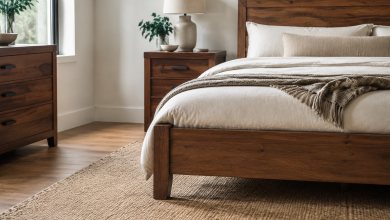
Slow design favors materials that change with time rather than degrade. Linen bedding that gets softer with every wash. A solid walnut dresser that deepens in color over years of use. A wool throw that develops character rather than pilling. These choices resist the disposability culture that has made most modern bedrooms feel like hotel rooms pleasant enough but somehow impersonal, as if no one truly lives there.
There’s a deeper principle embedded in this material preference. When you surround yourself with things that age honestly, you’re in a subtle daily conversation with time. The worn edge on a wooden frame, the gentle fade on a cotton duvet, the slight irregularity in handmade ceramic on a nightstand these are evidence of a life actually lived in a space. They’re the opposite of the pristine showroom aesthetic, which silently communicates that real life is something to be concealed rather than honored.
Natural materials also tend to be better for the body in ways that matter at night. Breathable fibers regulate temperature more effectively than synthetic alternatives. Wood and stone don’t off-gas the way plastics do. These aren’t marginal differences when you’re spending eight hours in close proximity.
Light as a Design Element, Not an Afterthought
The relationship between light and the slow bedroom is worth dwelling on because it’s where most room designs fail most obviously. Overhead lighting the default in most rooms is almost always wrong for a bedroom. It’s flat, it’s harsh, and it signals the same kind of ambient alertness that a classroom or an office might require. It’s functionally incompatible with the downregulation the body needs to prepare for sleep.
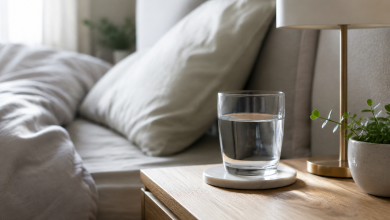
Good bedroom lighting operates in layers. There’s the soft ambient glow you might get from a salt lamp or a low-wattage pendant with a warm bulb. There’s the directed reading light that illuminates a page without flooding the room. And in the late evening, there might be nothing electrical at all just candlelight, which flickering flame has long provided in a way that no LED has yet convincingly replicated. The warmth, the slight unpredictability, the intimacy of a candle’s light does something to the atmosphere of a room that no smart bulb setting can fully approximate.
Natural light in the morning, handled correctly, is equally important. Heavy blackout curtains solve one problem but create another they replace the gradual, biological alarm of dawn light with the same abrupt awakening that an alarm clock provides, just a bit later. Layered window treatments that allow some morning light through while still dampening street noise and artificial glare are more aligned with the body’s actual rhythms.
What the Bed Actually Means
In many homes, the bed has been subtly demoted. It’s where people scroll through social media for twenty minutes before sleep. It’s where laptops open during a Sunday afternoon of catch-up work. It’s where the TV gets watched after the rest of the household goes quiet. None of this is a moral failing it’s just a gradual erosion of the bed’s original and specific purpose.
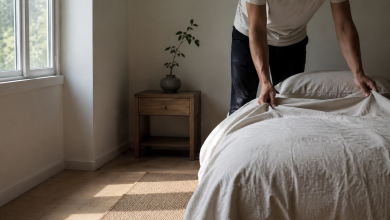
Slow living design takes the bed’s sanctity seriously. Not in a rigid or puritanical way, but in the same spirit that a dining table deserves to be used for actual shared meals rather than eaten over while standing at the counter. Spaces that serve only one or two purposes tend to serve those purposes better. The bed as a genuine rest space for sleep, for intimacy, for the kind of quiet reading that doesn’t involve a screen reclaims something that many people have lost without quite noticing.
The physical bed itself matters too. A mattress that fits your body rather than a trend. Pillows that are replaced when they’ve genuinely worn out rather than held on to out of inertia. Bedding with enough weight to feel grounding without trapping heat. These aren’t luxuries in the lifestyle magazine sense. They’re the infrastructure of good sleep, and good sleep is, in the most literal way, the infrastructure of everything else.
The Bedroom as a Practice, Not a Project
Perhaps the most important reframe slow living offers is this: the bedroom isn’t something you complete. It isn’t a design project with a finish line, after which you live in the ideal space and reap the promised benefits. It’s a practice one that requires ongoing attention, periodic re-evaluation, and a willingness to remove things that are no longer serving you even when they once seemed like a good idea.
That practice extends to how the room is used, not just how it looks. The habits of entering the bedroom putting the phone down, lowering your voice, slowing your movements slightly train the nervous system just as surely as any lighting choice or material selection does. A beautiful slow bedroom inhabited by frantic, distracted habits is still a frantic space. The design is only part of the equation.
What slow living ultimately asks of a bedroom is that it hold you. Not stimulate, not impress, not perform. Just hold you, in the oldest and most human sense of the word the way that a space shaped by genuine care and real materials and honest light can make a person feel, however briefly, that they are exactly where they should be.