Buying Furniture for Life: Why Quality Over Quantity Wins the Bedroom
The Bedroom You Keep Rearranging Isn’t the Problem
Most people have replaced a bedroom piece at least twice in the past decade. A dresser that warped after one humid summer. A bed frame that started squeaking six months in. A nightstand whose drawer simply stopped closing flush. None of these failures felt catastrophic at the time they were just inconveniences absorbed into the background noise of adult life. You move the lamp to cover the scratch. You tighten the same bolt every few weeks. You tell yourself you’ll deal with it eventually.
But here’s what rarely gets said: that cycle of tolerating, replacing, and tolerating again costs more in money, in time, in the quiet psychological weight of living inside a room that never quite feels right than buying well the first time would have.
The bedroom is where the argument for quality furniture is easiest to make and hardest to ignore.
Why the Bedroom Deserves a Different Standard
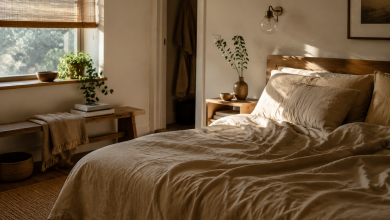
Every room in a home serves a function, but the bedroom serves something more intimate than function. It’s the first space you see when consciousness returns in the morning and the last thing your eyes register before sleep takes you. It carries the texture of your actual private life the books stacked on the nightstand, the way afternoon light falls across the duvet, the particular creak of the floorboard you’ve memorized by feel in the dark.
Cheap furniture interrupts that intimacy in ways that are hard to articulate until you’ve lived without the interruption. When a drawer slides open with resistance, when a headboard wobbles if you lean against it, when the surface of a dresser looks tired after two years these aren’t just aesthetic failures. They register subconsciously as a kind of low-level friction. The room never fully settles into itself.
Quality furniture, by contrast, disappears into the room. It stops being an object you manage and becomes part of the architecture of your daily life. That disappearing act is the whole point.
What “Quality” Actually Means in Bedroom Furniture
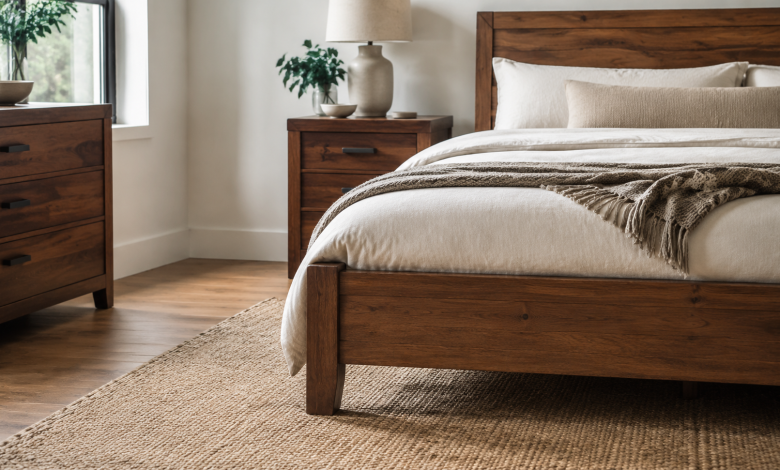
The word quality gets used so loosely in furniture marketing that it’s almost ceased to mean anything. Solid wood construction. Dovetail joinery. Full-extension soft-close drawer slides. Mortise-and-tenon joints. These are the specifics that matter, and they’re worth understanding before you set foot in a showroom or start scrolling product listings.
Solid wood not MDF core with a veneer, not particleboard with a printed wood-grain film, but actual solid wood behaves differently over time. It can be refinished when scratched. It doesn’t swell irreversibly when exposed to moisture. It develops a patina that feels like age rather than deterioration. A well-made solid oak dresser bought at thirty could still be in daily use at seventy.
Joinery tells you more about a piece than most people realize. Dovetail joints in drawer construction, the kind where the wood interlocks at an angle, are a sign that someone cared enough about the piece to build it to last. Box joints and metal hardware can work well too, but dowels alone in drawer construction are usually a sign that the manufacturer was optimizing for speed, not longevity.
The hardware on drawers and doors is another overlooked indicator. Cheap slides feel loose and develop wobble within a year. Quality full-extension slides the kind found in well-made cabinetry operate with the same smooth resistance they had on day one, for years. They’re a small thing until they’re not.
The Real Math Nobody Does at the Point of Sale
A budget bed frame at $350 that lasts four years before wobbling into uselessness, then gets replaced with another $350 frame, then replaced again over twenty years, that’s potentially $1,750 or more, plus the cost of disposal, the time spent assembling flat-pack furniture twice or three times, and the recurring annoyance of living with something that doesn’t work properly in its final year.
A solid hardwood bed frame at $1,200, well-maintained, can last a lifetime. The math isn’t complicated once you actually do it. The difficulty is psychological: the $1,200 feels like a large number at the moment of purchase. The $350 feels manageable. Future replacements feel abstract. But furniture decisions made on the logic of what feels affordable today tend to cost more across the span of a life.
There’s also a category of cost that never appears in any purchase calculation: the decision fatigue of re-buying. Choosing furniture is not a small task. It requires research, showroom visits or extended online browsing, measuring, waiting for delivery, assembling, returning the one piece that looked different than the photos. When you buy something built to last, you do that once. The headspace it frees up is real, even if it’s invisible on a balance sheet.
Secondhand as a Path to Quality
The best argument against the idea that quality furniture is inherently expensive is the secondhand market. Solid wood furniture from the mid-century American furniture industry pieces made from actual walnut, maple, or cherry in the 1950s and 1960s routinely turns up at estate sales, thrift stores, and online resale platforms at prices competitive with or below new particleboard alternatives.
A solid walnut dresser from that era, bought at an estate sale for $300, refinished for another $150 in time and materials, will outlive everything currently sitting in the flat-pack furniture aisle of a big-box store. The quality is not even in the same conversation. The joinery, the material, the weight, the way it feels to open a drawer it’s a different category of object entirely.
This matters for anyone who accepts the quality-first argument but finds the price tags at contemporary quality furniture retailers difficult to justify. The answer isn’t to compromise on quality. It’s to decouple quality from new.
Living With Less, Living With Better
There’s a quieter dimension to this conversation that goes beyond economics and into how a room actually feels to inhabit. A bedroom with four carefully chosen, well-made pieces has a quality of presence that a bedroom stuffed with seven mismatched, budget items simply cannot produce. The space breathes differently. There’s room for visual rest. Each piece holds its own without competing for attention.
This isn’t minimalism as aesthetic dogma it’s the practical result of buying less but buying better. When you know a piece will be with you for decades, you choose it with more care. You think about whether the proportions are right for the room, whether the wood tone works with the light at different times of day, whether it’s something you could still love in fifteen years. That level of consideration rarely goes into the purchase of something you expect to replace in four.
The bedroom you keep rearranging is usually a room full of items that never quite committed to being there. Quality furniture, the kind built to endure, has a settled quality to it physically and atmospherically. It takes up its space with confidence. And after a while, you stop noticing the furniture and start just experiencing the room.
That’s when you know you got it right.