The Ultimate Maternity Activewear: Comfort That Grows With You
There’s a moment, somewhere around the second trimester, when your favorite leggings betray you. The waistband that once felt like a second skin now digs into flesh that’s shifting, expanding, doing exactly what it’s supposed to do. You tug at the fabric during a walk around the block and realize something quietly devastating: the clothes you relied on to move freely no longer belong to your body.
This isn’t vanity. It’s function. And for women who have built movement into the rhythm of their lives, losing access to comfortable activewear feels like losing access to themselves.
The Problem Nobody Talked About for Decades
For most of modern fitness culture’s existence, pregnant women were an afterthought. The activewear industry poured billions into compression technology, sweat-wicking fabrics, and seamless construction, all designed for bodies that weren’t growing a human being. Maternity activewear, when it existed at all, amounted to oversized t-shirts and shapeless yoga pants with a cheap elastic panel sewn into the front. The message was clear: pregnancy is a pause. Wait it out. Come back when you fit the mold again.
But women kept moving. They modified their runs into walks, swapped heavy deadlifts for resistance bands, traded vinyasa flows for prenatal stretches. They did all of this in clothes that pinched, rode up, slipped down, or simply couldn’t accommodate the reality of a body in transition. The gap between what pregnant athletes needed and what the market offered was enormous, and it persisted for an unreasonably long time.
What changed wasn’t a single brand or a single product launch. It was a cultural shift. Women started refusing the premise that pregnancy meant retreat. Social media amplified their voices. Obstetricians and sports medicine professionals published research confirming what active mothers already knew: movement during pregnancy isn’t just safe, it’s beneficial. Reduced gestational diabetes risk. Better labor outcomes. Faster postpartum recovery. Improved mental health during a period rife with hormonal upheaval.
The industry finally had to respond. And when it did, the best responses weren’t just bigger sizes of existing designs. They were fundamentally rethought garments.
What Makes Maternity Activewear Actually Work
The engineering challenge is deceptively complex. A pregnant body doesn’t just get larger. It changes shape in unpredictable ways, at unpredictable speeds, with weight distribution shifting week by week. The center of gravity moves forward. The ribcage expands. Breasts grow, sometimes dramatically, sometimes asymmetrically. Skin stretches and becomes more sensitive to seams and pressure points. Joints loosen under the influence of relaxin. Swelling comes and goes without warning.
Designing for this body means designing for instability itself.
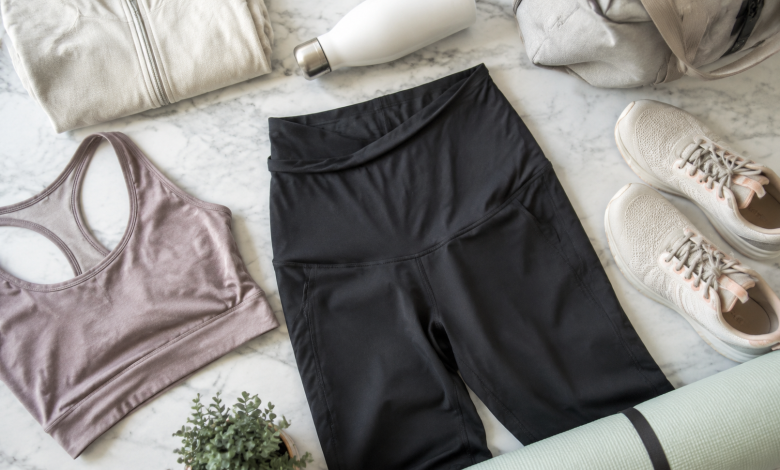
The best maternity activewear starts with the panel, that stretch of fabric across the belly that either makes or breaks the entire garment. Early iterations used a single layer of thin, scratchy elastic. Modern versions employ graduated compression, firm enough at the sides to provide gentle support without restricting blood flow, softer and more yielding across the front where the belly protrudes most. Some brands have moved to crossover panels that sit below the bump rather than over it, eliminating the overheated greenhouse effect that drives so many pregnant women to rip off their leggings mid-workout.
Beyond the Belly Band
But a good panel is only the beginning. The waistband matters just as much. Too narrow and it folds over, creating a tourniquet effect right where the body is most vulnerable. Too wide and it creeps up under the ribs, making deep breathing difficult during the very exercises that demand it most. The sweet spot is a waistband that distributes pressure across a broad surface area without feeling like a corset. Some designs use a fold-over construction that lets you adjust coverage as your bump grows. Others employ a continuous knit that stretches without losing its recovery, so the garment maintains its shape through months of use rather than bagging out after three wears.
Fabric weight tells its own story. Pregnancy runs hot. Basal metabolic rate increases. Blood volume expands by nearly fifty percent. A fabric that felt breathable at fourteen weeks can feel suffocating at thirty-two. The smartest maternity activewear uses zoned construction: denser, more supportive material where structure is needed, lighter, more breathable mesh where heat accumulates. Inner thighs, lower back, underarms. These are the regions that overheat first, and good design acknowledges that.
The Sports Bra Dilemma
If leggings represent one half of the maternity activewear equation, bras represent the other, and they might be the harder problem to solve. Breast changes during pregnancy are dramatic and ongoing. A woman might go up two cup sizes in the first trimester alone, then stabilize, then grow again in the third trimester as the body prepares for nursing. Traditional sports bras with fixed cups and rigid underwires become instruments of torture.
What works is adaptive support. Bras with wider bands that sit below the expanding ribcage rather than fighting against it. Straps that are adjustable in multiple points rather than just at the shoulder. Cups that stretch with the breast rather than compressing it into a predetermined shape. Some of the more innovative designs use a nursing-clip system that does double duty, providing secure support during pregnancy and easy access for feeding afterward. This kind of dual-purpose thinking matters because nobody wants to buy an entirely new wardrobe for each stage of motherhood when good design can bridge the gap.
The Psychological Dimension
Here’s what the product descriptions rarely mention: maternity activewear isn’t just about physical comfort. It’s about identity preservation. For women whose sense of self is intertwined with their athletic practice, pregnancy can feel like an identity crisis dressed up as a blessing. You’re told to be grateful. You are grateful. And simultaneously, you’re grieving the version of yourself that could run five miles without planning a bathroom stop, that could hold a plank without worrying about diastasis recti, that could look in the mirror and see a body you recognized.
Putting on activewear that fits, that moves with you, that makes you feel like an athlete rather than a patient, does something no amount of reassurance from a partner or a midwife can accomplish. It closes the gap between who you were and who you’re becoming. It says: you’re still here. You’re still doing this.
That psychological function explains why so many women report that finding the right maternity workout clothes was a turning point in their pregnancy experience. Not the most important turning point, certainly, but a meaningful one. A morning where the leggings stayed put during a prenatal pilates class. A run where the bra didn’t chafe. A yoga session where the fabric moved like water and they could focus on breath instead of adjusting their waistband every thirty seconds. These small victories accumulate.
What to Actually Look For
Skip anything marketed as “one size fits all.” Pregnancy is not one size. A woman at five foot two carrying high has completely different needs than a woman at five foot ten carrying low and wide. Look for brands that offer actual size ranges rather than a single stretchy tube meant to cover everyone from twelve weeks to forty.
Check the return policy. Your body at the time of purchase will not be your body in six weeks. Brands that understand their market offer generous exchange windows because they know the fit will change and that’s not a flaw in the product or the person.
Pay attention to the inseam and rise together, not in isolation. A high rise that felt perfect at twenty weeks might feel unbearable at thirty-six if it doesn’t have the stretch to accommodate a belly that’s dropped. Conversely, an under-bump style that works in the second trimester may not provide enough coverage when the belly extends beyond what the designer anticipated.
And look for flatlock seams or bonded construction. Regular overlocked seams create ridges that press into sensitized skin. During pregnancy, nerve endings are closer to the surface. What was invisible before becomes a constant irritation. The best maternity activewear eliminates internal seams entirely or uses flat bonding techniques borrowed from high-end performance gear.
The Longevity Question
A persistent myth suggests that maternity activewear is inherently disposable. You’ll only wear it for a few months, the thinking goes, so why invest? This logic falls apart on examination. Many women use their maternity activewear well into the fourth trimester, when the body is still recovering and nothing from the pre-pregnancy wardrobe fits comfortably yet. Some keep wearing their favorite maternity leggings for months postpartum because the gentle belly support feels stabilizing during core rehabilitation.
And for women who have more than one pregnancy, quality maternity activewear pays for itself twice over. The difference between a garment that maintains its stretch recovery through two pregnancies and one that bags out after a single wash cycle is the difference between a twenty-dollar impulse buy and a sixty-dollar investment in something that actually works.
The body that carries a child is doing extraordinary work. The least its clothing can do is keep up.