5 Timeless Loafers That Will Instantly Upgrade Any Casual Outfit
There’s a specific kind of confidence that comes from wearing the right shoes. Not the head-turning flash of a brand-new sneaker drop, not the power move of a sleek heel something quieter than that. Loafers have always occupied that particular lane. They’re the shoe that says you didn’t try too hard and yet somehow got it exactly right.
The loafer has been around in various forms since the 1930s, when Norwegian farmers wore a humble slip-on design for casual work. By the time the style crossed the Atlantic and landed in American prep culture, it had already started its long career as the go-to shoe for people who wanted to look put-together without appearing like they were trying. That original tension effortlessness paired with a quiet polish is exactly why certain loafer silhouettes have never stopped feeling relevant.
What separates a timeless loafer from a trendy one is largely a question of proportion and intent. Trendy shoes are designed to make a statement about a specific moment. Timeless ones make a statement about character. The five loafers below have earned their standing not through hype cycles or influencer campaigns, but through decades of consistent use by people who simply knew what worked.
The Penny Loafer
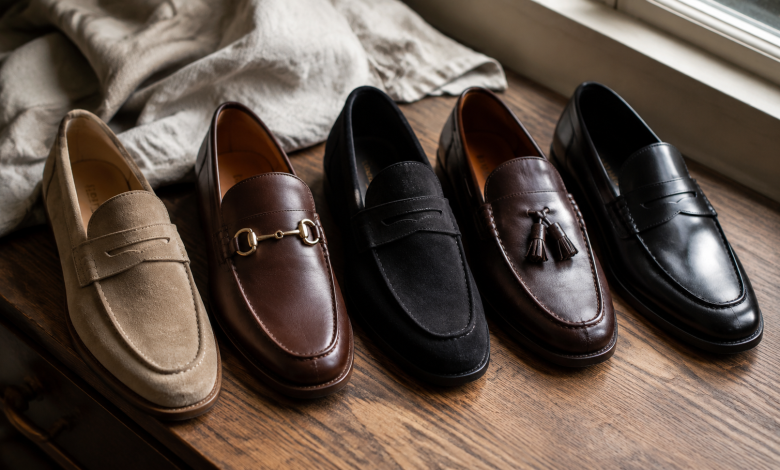
If any single loafer deserves the title of cultural cornerstone, it’s the penny loafer. The saddle strap across the vamp that small leather bridge with a slim slot cut into it gives the shoe its most recognizable feature. The name comes from an old American habit of slipping a penny into that slot for good luck or, more practically, emergency payphone money. The coin is long gone from everyday relevance, but the design persists with zero apology.
What makes the penny loafer so adaptable is its restraint. The shape doesn’t demand attention. It works in rich, dark leather for a smarter look, and just as well in tan suede when the mood is more weekend. Pair it with cropped chinos and a linen shirt in summer, or wear it sockless under slim-cut jeans in early fall. The shoe does the job quietly, and that’s precisely the point.
The Horsebit Loafer
Gucci introduced the horsebit loafer in 1953, and it remains one of the most mimicked silhouettes in footwear history. The defining detail a double ring and bar hardware piece at the strap, borrowed directly from equestrian bridle fittings elevates the shoe from understated to considered. There’s a slight formality to it, a whisper of old money, but it never tips into stuffy.
The horsebit loafer plays especially well against relaxed clothing. Throw one on with wide-leg trousers and a tucked-in tee, and you’ll notice how the shoe reshapes the whole outfit. It pulls everything upward in register without demanding a blazer or a button-down to justify it. That’s the real power of a well-chosen loafer it does the heavy lifting so the rest of your outfit doesn’t have to.
The Tassel Loafer
Tassel loafers occupy a slightly bolder space in the lineup. The dangling leather tassels at the front of the shoe read as deliberately ornamental there’s nothing functional about them, and that’s entirely the point. They’re a signal that the wearer has a sense of personality, an eye for detail that extends beyond the obvious.
The history here is interesting. Tassel loafers were designed in the 1950s by Alden Shoe Company for actor Paul Lukas, and they’ve spent most of their life associated with Brooks Brothers suits and Ivy League campuses. But the shoe has spent the last decade quietly finding its way into a different kind of wardrobe one built around well-cut basics, textured knitwear, and quality over quantity. In that context, a chocolate brown suede tassel loafer with cream-colored wide trousers and a simple crew neck sweater isn’t a costume from another era. It’s just good style.
The Belgian Loafer
Fewer people know the Belgian loafer by name, but you’d recognize the silhouette immediately. It originated in Brussels in the 1950s through the work of Henri Bendel and later popularized by shoemakers like Del Toro. The key feature is a small fabric or leather bow on the vamp, and a construction that tends to be lower, flatter, and more minimal than other loafer styles. The toe is typically more tapered. The silhouette reads as refined without the weight of traditional leather dress shoes.
Belgian loafers blur the line between casual and smart in a way that feels genuinely modern. They work in velvet for evenings when the occasion is slightly ambiguous not quite a dinner party, not quite just going out and in smooth leather or suede when the day calls for something grounded but clean. The bow that might seem decorative at first glance turns out to carry the whole personality of the shoe. Remove it mentally and you’d have something much more anonymous.
The Driving Loafer
Originally engineered for actual driving the rubber nubs on the sole were designed to grip car pedals the driving loafer has evolved far beyond its vehicular origin story. The construction is lighter and more flexible than traditional loafers, the upper often cut lower at the heel, and the overall feel is casual in a way that doesn’t sacrifice elegance.
Car Shoe, the Italian brand founded in the 1960s, essentially codified the driving loafer as a category. The design was pragmatic first, but Italian craftsmanship made it beautiful by default. Today, a good driving loafer in soft pebbled leather or suede is one of the most versatile pieces you can keep in rotation. It transitions between a beach town weekend and a relaxed city day without friction. It works with shorts in a way that most loafers simply can’t pull off with the same ease. The lower profile keeps the look from feeling overly dressed, but the quality of material still signals intention.
How to Build Around Them
The consistent thread across all five of these silhouettes is that they reward quality and simplicity in the clothes around them. A horsebit loafer doesn’t need a complicated outfit it needs a clean one. A tassel loafer thrives next to well-fitted basics. Belgian loafers ask for fabric and texture. Driving loafers want ease and lightness.
What the loafer resists is noise. Overworked outfits, too many competing details, clothes that are trying too hard to signal something all of that works against what a good loafer brings to the equation. The shoe is inherently a calming influence. It grounds an outfit, suggests a certain ease of movement, and communicates that the person wearing it has thought about how things go together without making an entire production out of the process.
That’s a harder thing to achieve than it sounds. Most people default to sneakers when they want to look casual because sneakers ask nothing of the outfit around them. Loafers ask a little more a bit of intentionality, a willingness to commit to something with heritage and shape and in return, they give the kind of finish that very few shoes can match. Not every day calls for it. But the days it does, you’ll notice the difference before you even walk out the door.