The One-In, One-Out Rule for Bedroom Decor
Why Your Bedroom Keeps Feeling Cluttered No Matter What You Do
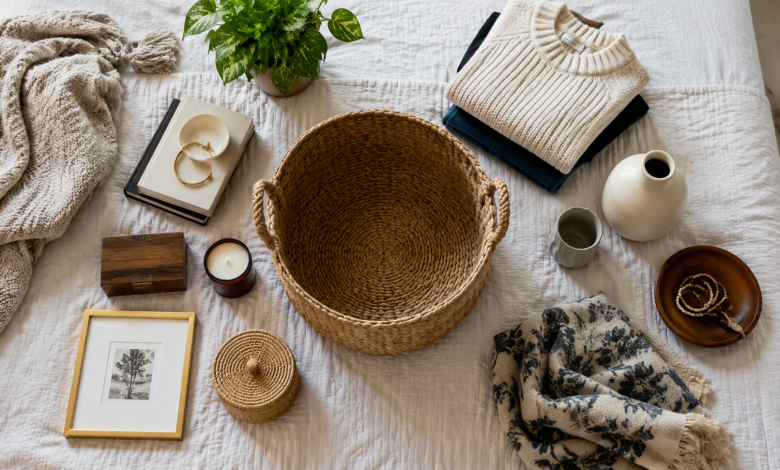
You reorganize. You donate a bag of old clothes. You buy a few matching baskets, maybe a new nightstand. For a week, maybe two, the room feels calmer. Then, quietly, it fills back up. A throw blanket from a sale. A candle you couldn’t leave in the store. A framed print a friend gave you that you felt too guilty to leave in a closet. Before long, you’re back where you started standing in the doorway of your own bedroom wondering why it still feels like too much.
The problem isn’t your taste. It’s not even your storage situation. It’s that most approaches to bedroom organization treat clutter as a one-time event rather than an ongoing condition. You declutter once and expect the result to hold. But accumulation is the default state of a lived-in home. Things come in. They don’t always go out.
That’s exactly what the one-in, one-out rule addresses not as a dramatic overhaul, but as a quiet, sustainable discipline that works precisely because it’s boring.
The Logic Behind One-In, One-Out
The concept itself is almost embarrassingly simple. Every time something new enters your bedroom, something else leaves. New pillow? An old one goes. New lamp? The one you’ve been tolerating for three years finally earns its exit. It’s a zero-sum approach to physical space, and its power lies not in any single swap but in the cumulative effect of consistently maintaining that equilibrium.
What makes it especially suited to the bedroom rather than, say, a kitchen or a living room is the particular relationship most people have with that space. The bedroom is where you begin and end every day. It holds more emotional weight per square foot than almost any other room. Clutter there doesn’t just look disorganized; it registers as noise, a low-grade visual stress that can follow you into sleep and greet you before you’re fully awake. Studies on environmental psychology have found that disordered spaces elevate cortisol levels, and while your brain might not consciously register that half-read stack of books on the floor, your nervous system often does.
One-in, one-out works as a bedroom rule because it treats the room as a closed system with finite capacity not just physical capacity, but psychological capacity. You’re not just managing square footage. You’re managing attention.
What Counts as “One”
Here’s where most people stumble when they first try this rule: the definition of “one” is more flexible and more important than it sounds.
A decorative object is easy. A new throw pillow comes in, an old one leaves. That trade is clean. But what about a set of six matching votives you found at an estate sale? Do those count as one? What about a full bedding set duvet, shams, and two euro pillows? What about art? A single large canvas affects the visual weight of a room very differently than a small print, even if numerically they’re the same.
The most practical approach is to match category to category rather than object to object. When new bedding arrives, the old set goes the full set, not just the duvet. When you bring in a decorative element like a vase or a sculpture, something in that same aesthetic category earns its departure. This keeps the logic honest. Otherwise, it’s easy to convince yourself that because you donated a single throw pillow, you’ve earned the right to bring in an entirely new gallery wall.
The harder conversation, though, is about things that arrive as gifts, or that migrate from other rooms, or that you buy during a period of strong emotion a particularly bad week, a vacation high, a sudden conviction that your bedroom needs to feel completely different right now. These acquisitions feel earned or special in ways that make them harder to count honestly. But they count. They all count.
The Part No One Talks About: Choosing What Leaves
Deciding what comes out is where the rule does its real psychological work.
Most people, when asked to remove something from their bedroom, will reach for the obvious candidate the thing they already half-know needs to go. The chair that has become a permanent laundry station. The decorative mirror they bought in a phase they’ve since outgrown. The spare blanket folded on top of the wardrobe that hasn’t been touched in two years.
Those are good starts. But the one-in, one-out rule only deepens over time if you’re willing to make harder calls. That means occasionally letting go of something you still like, not just something you’ve stopped using. A lamp that still works perfectly but no longer fits the direction the room is moving. A nightstand that was a placeholder purchase when you first moved in and never quite belonged. Items you’ve kept because they were expensive, or because getting rid of them feels like admitting a mistake.
There’s a particular kind of bedroom clutter that doesn’t look like clutter at all it looks like a room full of perfectly fine things that simply don’t cohere. No single item is wrong. Collectively, they create a space that feels restless, like a sentence with too many clauses. The one-in, one-out rule, applied consistently over time, has a natural editing effect on this kind of ambient visual noise. Each swap is a small decision about what the room is actually supposed to be.
Building the Habit Without Making It a Chore
The rule fails most often not because people disagree with it but because they forget to apply it at the moment it matters which is the moment of acquisition, not the moment of reflection.
The cleanest way to build the habit is to pair the trigger with the action as immediately as possible. When you bring something new into the bedroom, don’t put it down first. Identify what’s leaving before the new thing gets settled. Once an item finds its position on the nightstand or the shelf, it becomes part of the room’s status quo, and the friction of removing it grows.
Some people find it useful to keep a small staging area a box in the closet, a spot near the door where outgoing items live until they’re donated or passed on. This gives the “out” step a physical form and makes it harder to let the trade become theoretical. Saying “I’ll get rid of something soon” is not the same as having an item actually in the box.
It also helps to run a light audit seasonally not a full bedroom overhaul, but a quiet fifteen-minute walk-through where you look at the room with mild suspicion. What arrived in the past three months? What left? Is the ratio roughly even? If things have been coming in without much going out, the audit is the correction. You don’t have to make dramatic decisions. You just have to be honest about what the room actually needs.
What the Room Eventually Becomes
Practiced over the course of a year or two, one-in, one-out does something interesting to a bedroom. It doesn’t make it sparse or minimalist unless that’s what you’re deliberately choosing. It makes it intentional. The things that remain in the room are there because they’ve survived comparison. They weren’t just kept by default they were kept because something else left to make room for them.
That shift from passive accumulation to active curation changes how the room feels to be in. Not pristine. Not staged. Just quietly, stubbornly yours a space where nothing is there by accident, and where the visual quiet is something you’ve actually maintained rather than stumbled into.
There’s a specific kind of calm that comes from a bedroom where everything present has been chosen. It’s not the calm of emptiness. It’s the calm of a room that knows exactly what it is.