From Chaotic to Calm: My 30-Day Sleep Sanctuary Experiment
The Bedroom That Was Doing Everything Wrong
My bedroom used to be a graveyard of unfinished tasks. A laptop on the nightstand. Clothes piled on the chair I never actually sat in. A half-read book face-down next to a cold mug of tea. Notifications buzzing at 11:47 p.m. from people in different time zones who didn’t care what mine was. I told myself I slept fine. I told myself this was just how adult life looked.
Then I started waking up exhausted in a way that felt chemical not like I needed more hours, but like the hours I was getting weren’t landing. I’d lie down, scroll, half-watch something on my phone, eventually drift off around midnight, and surface at seven feeling vaguely cheated. This went on for months. Maybe longer.
The turning point wasn’t dramatic. A friend mentioned she’d read about “sleep architecture” the way your brain cycles through stages of rest and how the environment you sleep in either supports or fractures that process. I’d always thought sleep was something that happened to you. The idea that your surroundings could actively disrupt the quality of your unconscious hours felt almost offensive in how obvious it was.
So I decided to treat my bedroom like an experiment. Thirty days. Systematic changes. No supplements, no apps, no expensive mattresses. Just the room itself.
Week One: The Subtraction Phase
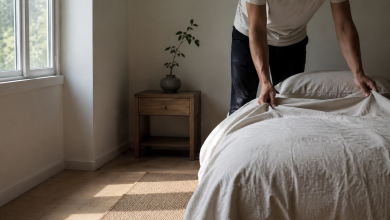
The first thing I did was remove everything that didn’t belong to sleep or intimacy. That meant the laptop left the room entirely. The TV, which I’d convinced myself I “never really watched,” went to the living room. The phone moved to a charging spot near the door close enough for an alarm, far enough to require standing up to reach it.
The room felt strange after this. Emptier than I expected, and somehow louder, which made no sense because I hadn’t touched anything acoustic. What I’d actually removed was visual noise all those objects that silently communicated “there are things you haven’t done yet.” Without them, the room had no agenda. It just existed.
The first three nights were oddly uncomfortable. I’d reach for my phone and it wouldn’t be there. I’d lie awake in a way that felt different from my usual scrolling insomnia less stimulated, more restless. I’d trained my nervous system to need input at bedtime, and now it was confused by the quiet.
By night four, something shifted. I started falling asleep faster. Not dramatically, but noticeably maybe twenty minutes versus the forty-five it used to take.
Week Two: Light and Temperature
Sleep science is pretty unambiguous on two things: your body drops its core temperature to initiate sleep, and your circadian rhythm is governed almost entirely by light. I knew both facts academically and had ignored both of them practically for years.
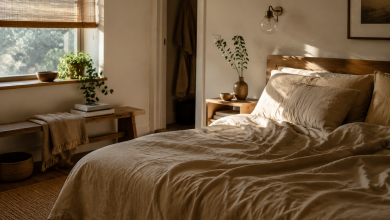
I bought blackout curtains. Not the decorative kind that still let orange streetlight seep through the edges, but actual light-blocking panels. The first morning I woke up to true darkness at 7 a.m. felt almost disorienting like waking up inside a cave. Within a few days, I noticed I was sleeping through my usual5 a.m. false-wake, the early morning rouse that used to fragment my deepest sleep phase.
The temperature piece was trickier. My apartment has inconsistent heat, and I was reluctant to run the air conditioning in October. What I found worked was layering: a lighter blanket I could kick off during the night, plus a small fan running on low. The fan did double duty it cooled the room slightly and created consistent white noise that masked the irregular city sounds I’d been half-consciously tracking all night.
These changes felt almost embarrassingly low-tech. No biometric tracker. No weighted blanket purchased after an Instagram ad. Just darkness and slightly cooler air. The difference in how I felt by morning was not subtle.
Week Three: Ritual and the Psychology of Transition
This was the week I got interested in the less material side of things. The physical environment was working, but I started noticing that my pre-bed behavior was still scattered. I’d go from answering emails to brushing my teeth to getting into bed inside a span of twelve minutes. My brain had no real warning that night was coming.
Sleep researchers sometimes call this the “wind-down window” the roughly ninety-minute period before bed where your cortisol should be naturally declining. I’d been jamming cortisol spikes (arguments by text, work emails, stressful news) right up against my sleep window and then wondering why I couldn’t fall asleep quickly.
I built a ritual that took about thirty minutes and involved nothing I’d have to brag about: dim the lights around nine, make herbal tea I didn’t particularly like but found calming for sensory reasons, read something that had no stakes old travel writing, mostly. No plot tension. No characters I worried about.
What surprised me was how quickly my body started to anticipate the ritual. Within a week, making the tea started to produce a physiological sense of slowing down. The association formed faster than I expected. By the third week, I was yawning before the mug was even full.
Week Four: What Actually Changed
By the final stretch of the experiment, I’d stopped tracking things obsessively. That was its own data point the improvements had become normal enough that I’d stopped noticing them in relief and started just living inside them.
I was falling asleep consistently within fifteen to twenty minutes. I was waking up once a night at most, usually briefly and without the anxious middle-of-the-night spiral that used to eat forty-five minutes of my rest. My mornings felt cleaner. Not euphoric I want to be specific about this, because sleep content tends toward the evangelical just less muddy. The cognitive drag I’d normalized was mostly gone.
There were things that didn’t change. I still slept poorly before high-stress events. A few nights with late social commitments reset my rhythm temporarily. The experiment wasn’t a cure for the fact that I have a human stress response.
What did change was the baseline. The floor got higher. A normal night was now genuinely restorative in a way that required no special conditions just the room I’d carefully made boring for every purpose except rest.
The Quiet Radicalism of Protecting a Room
Looking back, what strikes me most isn’t any single change but the philosophy underneath all of them: that your bedroom should have one job, and every object, light source, sound, and habit in it should either support that job or be removed.
We live in an environment that is comprehensively optimized to keep us awake, engaged, and reactive. Our phones are designed by psychologists. Our feeds are tuned to produce urgency. Choosing to let one room in your home be genuinely boring genuinely quiet, genuinely dark, genuinely free from the ambient pressure of tasks and screens is a small act of structural resistance.
It doesn’t feel radical when you’re just buying blackout curtains. But over thirty days, I watched my nervous system slowly stop expecting stimulation at bedtime and start expecting rest. That recalibration didn’t come from discipline or willpower. It came from changing what the room was for.
The chaos didn’t disappear from my life. It just stopped sleeping in my bedroom.