Is It Worth Servicing Your Watch Every Year? The Real Truth
There’s a particular kind of anxiety that comes with owning a mechanical watch. It sits on your wrist, ticking away with hundreds of tiny components spinning and meshing inside a case no larger than a silver dollar, and somewhere in the back of your mind you wonder: am I ruining this thing by not taking it in for service?
The watch industry has done a remarkable job of making owners feel like negligent parents if they skip a year. You’ll hear it from authorized dealers, from brand ambassadors at cocktail parties, from the glossy booklet tucked inside your box. “Service every three to five years.” Some brands push even harder, suggesting annual checkups like your timepiece is a patient with a chronic illness. But here’s what rarely gets discussed openly: the actual engineering reality of modern mechanical movements, the financial math behind frequent servicing, and whether the whole recommendation structure is built more on tradition and revenue than on genuine necessity.
Let’s get into it.
What “Servicing” Actually Means
When most people hear “watch service,” they imagine someone popping open the caseback, squinting through a loupe, and maybe adding a drop of oil. The reality is far more involved, and far more expensive, than that mental picture suggests.
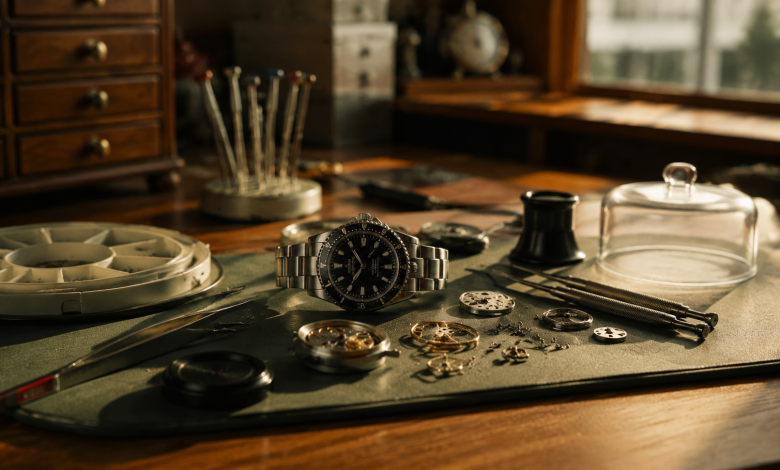
A full service means complete disassembly. Every wheel, spring, jewel, and screw comes apart. The case gets separated from the movement. Gaskets get replaced. The dial and hands come off. Each component is inspected under magnification for wear, corrosion, or damage. The parts go through an ultrasonic cleaning bath. Fresh lubricants get applied at specific points with specific synthetic oils chosen for each function. Then everything goes back together, gets regulated on a timing machine across multiple positions, and finally the case gets resealed and pressure tested.
This process takes a trained watchmaker anywhere from four to twelve hours depending on the complexity of the movement. For a simple three-hand watch, you might be looking at eight hundred to fifteen hundred dollars at an authorized service center. For a chronograph or a perpetual calendar, double or triple that figure.
Now ask yourself: does a well-running watch genuinely need this level of intervention every single year?
The Lubricant Question
The primary technical argument for regular servicing centers on lubrication. Mechanical movements rely on oils and greases at dozens of contact points. Over time, these lubricants degrade. They migrate away from where they belong. They dry out or thicken. And once metal runs against metal without adequate lubrication, you get accelerated wear on pivots and jewel surfaces.
This was a legitimate and urgent concern forty years ago. The synthetic lubricants available in the 1970s and 1980s had a useful lifespan of roughly three to five years before degradation became meaningful. That’s where the original “service every five years” recommendation was born.
But lubricant technology has changed dramatically. Modern synthetic watch oils from manufacturers like Moebius last significantly longer. Independent tests and watchmaker reports consistently show that contemporary lubricants can maintain their properties for eight to ten years under normal wearing conditions. Some watchmakers with decades of experience have opened movements after twelve or fifteen years of continuous use and found the oils still performing within acceptable parameters.
So when a brand tells you to service every three years, they’re often citing guidelines written in an era of inferior lubricants and never updated to reflect current chemistry.
The Wear Paradox
Here’s something counterintuitive that most watch owners never consider: servicing itself introduces risk.
Every time a watchmaker disassembles your movement, there’s an opportunity for something to go wrong. A hairspring gets accidentally magnetized from a tool. A screw gets slightly overtorqued. A speck of dust lands on a surface during reassembly. A gasket doesn’t seat perfectly. The crystal gets a micro-scratch during handling.
These aren’t hypothetical disasters. They’re the everyday reality that even skilled watchmakers acknowledge privately. A service performed by an excellent technician will go flawlessly. But “excellent” is doing a lot of heavy lifting in that sentence. The watch repair industry, like any trade, has a wide spectrum of competence. Sending your watch in for unnecessary service increases your cumulative exposure to human error.
There’s also the issue of case polishing, which many service centers include as standard procedure unless you explicitly decline. Every polish removes material from your case. It softens edges. It erases the original finishing. After three or four full polishes, a watch can look subtly but permanently different from how it left the factory. For vintage pieces, this represents actual value destruction.
When Annual Service Actually Makes Sense
None of this means servicing is pointless. Far from it. There are situations where more frequent attention is genuinely warranted.
If you wear a dive watch and actually take it underwater regularly, annual pressure testing is sensible. Not a full movement service, but a seal check. Water damage is catastrophic and irreversible for a mechanical movement. The cost of a pressure test is minimal compared to the cost of a flooded caliber.
If you notice your watch gaining or losing significant time, something is wrong and waiting will only make it worse. A movement running outside its specifications might have a damaged component creating metal debris inside the case, and every additional day of operation grinds that debris deeper into surfaces you’ll eventually need to pay someone to refinish or replace.
If you own a vintage piece with older lubricants of unknown age, getting a baseline service makes sense simply to establish a known starting point.
And if your watch has been dropped, exposed to strong magnetic fields, or subjected to anything outside normal wear, don’t wait for a scheduled interval. Get it looked at.
The Financial Reality
Let’s run some simple numbers. Say you own a mid-range luxury watch worth five thousand dollars, and your brand recommends service every three years at a cost of a thousand dollars per service. Over a thirty-year ownership period, you’ll spend ten thousand dollars on maintenance alone. That’s twice the original purchase price.
Now consider that many independent watchmakers and even some brand technicians will tell you off the record that a well-cared-for modern movement, worn regularly and kept away from extreme conditions, can run beautifully for seven to ten years between services. At one service per decade, your thirty-year cost drops to three thousand dollars.
The difference isn’t trivial. Especially for collectors who own multiple pieces, where the aggregate servicing costs across a collection can approach the price of acquiring another watch entirely.
What the Brands Won’t Say Out Loud
Service revenue is a meaningful part of the luxury watch business model. This isn’t conspiracy thinking. It’s just business reality. After-sales service generates reliable, high-margin income for brands and their authorized service networks. There is a financial incentive to recommend service intervals that lean toward the conservative end.
That doesn’t make the brands dishonest. From their perspective, recommending earlier service protects them from warranty claims and ensures movements stay within specifications. It’s the safest possible advice from a liability standpoint. But safest for the brand and optimal for the owner aren’t always the same thing.
Independent watchmakers, who earn their living from service work but don’t have a brand’s reputation riding on their recommendations, tend to give more relaxed timelines. Many will suggest letting a healthy watch run until it shows symptoms: loss of accuracy beyond a few seconds per day, reduced power reserve, or audible changes in the running sound.
A Practical Approach
The most rational strategy lands somewhere between paranoid annual visits and willful neglect.
Keep your watch wound and running. Lubricants actually degrade faster in a stationary movement because they settle and pool rather than distributing evenly across contact surfaces. If you rotate between multiple watches, give each one a periodic wind even when it’s not on your wrist.
Monitor accuracy. Use a phone app or simply note the time against a reference clock every few weeks. As long as your watch stays within its rated specifications, the movement is happy.
Get a pressure test every couple of years if you expose your watch to water. This costs fifty to a hundred dollars and takes fifteen minutes.
When the watch starts telling you something is off through timekeeping changes or erratic behavior, take it in for a full service. For most modern movements worn in typical conditions, that conversation with your watchmaker will happen somewhere around the eight-to-ten-year mark.
You don’t need to be precious about it. You also don’t need to throw money at a perfectly healthy machine just because a calendar page turned. Your watch was built by people who understood longevity. Trust the engineering. Listen to what the movement tells you through its performance. And find a watchmaker you trust to give you honest guidance rather than a schedule designed around someone else’s revenue goals.