How to Build a 3-Watch Collection for Under USD 5,000
There’s a particular kind of satisfaction that comes from owning exactly three watches. Not a drawer full of impulse purchases. Not a single beater you wear to death. Three. Enough to cover your life’s contexts without the creeping guilt of redundancy. And if you can pull it off for under five grand total, you’ve done something most collectors never manage: you’ve exercised taste and restraint in equal measure.
The concept isn’t new. Watch enthusiasts have debated the ideal three-watch collection for decades on forums, in barbershops, over beers. But the conversation usually drifts toward fantasy lineups a Rolex here, an Omega there, maybe a Grand Seiko for texture. That’s fine as a thought experiment. What interests me more is the version that actually respects a budget, that forces you to make real choices, and that still lands you with a trio you’d genuinely reach for every morning.
Let me walk you through how to think about this, not just what to buy.
The Framework: Roles, Not Redundancy
Before you spend a dollar, you need to assign roles. A three-watch collection only works if each piece earns its slot. Overlap is the enemy. You don’t need two watches that do the same job slightly differently that’s how five-thousand becomes ten, and ten becomes a problem you hide from your partner.
Think in terms of contexts. Most people live across three general modes: professional or dressy situations, everyday casual wear, and active or outdoor scenarios. Your collection should cover that spectrum without gaps and without doubling up.
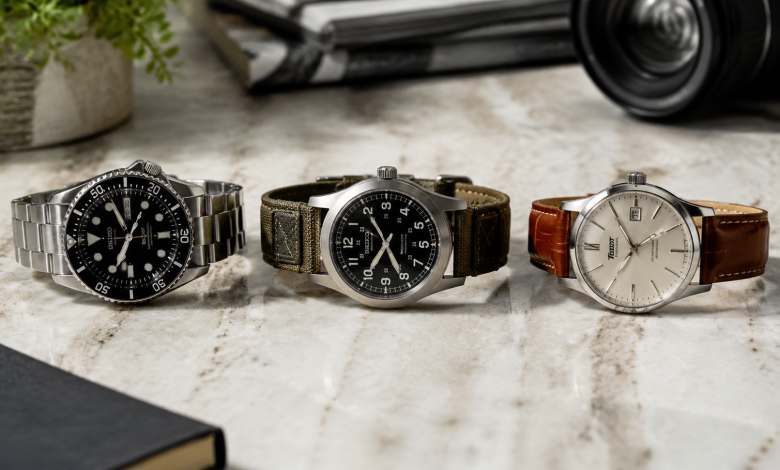
That gives you a clean architecture. A dress or dress-adjacent watch. A daily tool watch with enough versatility to handle ninety percent of your week. And something purpose-built for the rougher edges of your life weekends, travel, water, dirt, whatever your version of activity looks like.
Simple enough on paper. The art is in the execution.
Slot One: The Everyday Anchor
This is where you spend the most, proportionally. Your daily watch is the one that defines your collection’s personality. It’s the piece people actually see. It needs to pair with a t-shirt and not look ridiculous under a sport coat. It needs to survive desk diving and grocery runs and the occasional dinner that’s nicer than you planned for.
The sweet spot here, for my money, sits between eight hundred and two thousand dollars. And the category that delivers the most at this price is the modern field watch or the restrained sport watch think38to 40mm, clean dial, solid movement, enough water resistance that you don’t panic at a sink.
The Tudor Ranger comes to mind immediately. At just under two thousand retail, you get an in-house movement,100meters of water resistance, a satin-finished case that dresses up or down, and the kind of proportions that flatter almost any wrist. It borrows the Explorer DNA without the Rolex tax.
If Tudor still feels steep for the daily slot, the Longines Spirit collection offers chronometer-certified movements in a well-finished 40mm case for around fifteen hundred. Or drop lower the Hamilton Khaki Field Mechanical at under five hundred is a legitimate icon, hand-wound, 38mm, with decades of proven design language. It punches absurdly above its price.
Your call depends on how you want to allocate the remaining budget. But whatever you choose here, prioritize wearability over flash. This watch lives on your wrist. Comfort matters more than complications.
Slot Two: The Dressy Option
Here’s where people overthink things. A dress watch in2026 doesn’t need to be paper-thin or gold-toned or shaped like something your grandfather kept in a pocket. It just needs to signal a degree of intentionality. It says you thought about what you’re wearing. It pairs with a collared shirt without looking like a tool watch that wandered into the wrong room.
My favorite move in this slot is spending less than you think you should. Between three hundred and eight hundred dollars, you can find a dress watch that holds its own against piecescosting five times more because at this end of the market, you’re buying design and movement reliability, not brand equity.
The Junghans Max Bill Automatic is a masterclass in restraint. That Bauhaus dial, the domed crystal, the 38mm case that disappears under a cuff. Around nine hundred at retail but often found for less. It’s been in continuous production for over sixty years because it simply works.
Orient’s Bambino line, particularly the Version 2, offers a domed mineral crystal, an exhibition caseback, and genuinely beautiful dial finishing for around two hundred dollars. I’ve worn one to weddings. Nobody questioned it. The in-house movement is robust and serviceable, which matters for long-term ownership.
Tissot’s PRX Powermatic 80, especially in the plain dial without date variant, splits the difference between dressy and contemporary. It’s thinner than you’d expect for an integrated-bracelet design, and the 80-hour power reserve means you can leave it in a drawer for a long weekend without resetting.
The principle here: slim, clean, quiet confidence. You’re not trying to make a statement. You’re completing an outfit.
Slot Three: The Capable One
Your third watch should do something the other two can’t. It needs to handle the environments you’d hesitate to bring your other pieces into. For most people, that means water resistance, shock resistance, or both. A diver. A field watch with serious credentials. Maybe a GMT if you travel enough.
This is where value gets genuinely absurd in2026. The sub-thousand-dollar dive watch category is stacked with legitimate tools that would have been flagship pieces fifteen years ago.
The Seiko Prospex line specifically the SPB models offers 200 meters of water resistance, 6R35 movements with70-hour reserves, and enough case finishing to look intentional on a NATO or rubber strap. The SPB143, with its 62MAS-inspired case shape, has become a modern classic for a reason. Expect to spend around nine hundred to a thousand.
If you want something that can genuinely take punishment without flinching, the Casio G-Shock square the GW-M5610 costs around a hundred and fifty dollars, syncs to atomic time, runs on solar power, and will outlast everything else in your collection combined. It’s not glamorous. That’s the point. It frees your other watches from duty they weren’t designed for.
Or split the difference with something like the Citizen Promaster Diver BN0151. Solar-powered, 200 meters, ISO-certified, under two hundred dollars. It’s a genuine tool in a way that many watchescosting ten times more only pretend to be.
Putting It Together: A Sample Build
Here’s one configuration that sings, coming in right around forty-seven hundred:
Tudor Ranger as the daily anchor, roughly nineteen hundred. Junghans Max Bill for the dressy moments, around eight hundred to nine hundred. Seiko SPB143 as the capable diver, close to a thousand. Total outlay lands under five thousand with room to spare for astrap or two.
Want to come in lower? Swap the Tudor for a Hamilton Khaki Field Mechanical and the Junghans for an Orient Bambino. Suddenly your total is closer to sixteen hundred, and you’ve built a collection that still covers every context with genuine quality. The remaining budget becomes a cushion for servicing down the road, for a premium strap rotation, or simply for the peace of mind that comes from spending well below your ceiling.
The Deeper Game
What makes a three-watch collection worth building isn’t really the watches themselves. It’s the constraint. Five thousand dollars is enough to buy something genuinely excellent, but not enough to be careless. Every choice costs you another option. That pressure produces clarity.
I’ve seen collectors with fifty watches who can’t tell you why they own half of them. The three-watch collector always can. There’s a story behind each slot, a reason it earned the spot over the dozen alternatives. That intentionality that sense of a collection being curated rather than accumulated is what separates the person who owns watches from the person who collects them.
And here’s the thing nobody tells you: once you’ve built a three-watch collection you genuinely love, the urge to buy more doesn’t intensify. It quiets. You stop browsing listings at midnight because theitch has been scratched properly. You’ve built something complete.
That’s worth more than any single watch could cost.