Cafes, Books, and Cobblestones: Cities Made for Single Flâneurs
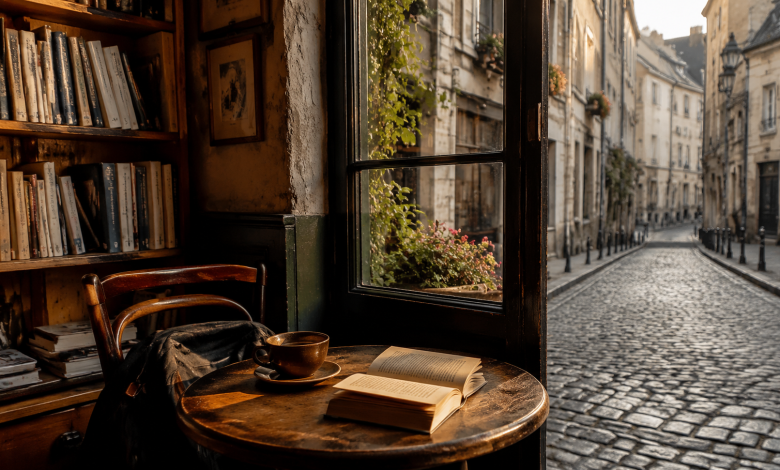
The Art of Going Nowhere in Particular
There is a specific kind of freedom that only arrives when you are walking alone through an unfamiliar city with no one waiting for you at a particular hour. No compromise on the route. No explaining why you want to double back to that narrow street you passed twenty minutes ago. No performing enjoyment for someone else’s timeline. You stop when something catches your eye. You keep walking when you’re ready. The city becomes entirely yours in a way it simply cannot be when you’re accountable to another person’s experience of it.
This is the flâneur’s inheritance a French concept born in19th-century Paris, theorized by Baudelaire and later Walter Benjamin as a mode of urban observation that is equal parts philosophy and sensory practice. The flâneur wanders. He watches. He absorbs the city not as a destination but as a text. And while the original archetype skewed male and bourgeois, the underlying impulse has always been democratic: the desire to exist inside a city at your own pace, reading its rhythms the way you read a book.
Solo travel, particularly of the slow urban variety, is perhaps the purest modern expression of this. And certain cities, it turns out, are built for exactly this kind of person.
What Makes a City Flâneur-Friendly
Not every city rewards the aimless wanderer. Some are efficient, grid-locked, car-dependent machines that move people from point A to point B with maximum speed and minimum texture. They are functional. They are not interesting to walk through at10 a.m. on a Tuesday with a coffee in hand and nowhere to be.
The cities that work for solo travelers tend to share a few qualities that have nothing to do with tourist rankings or Instagram familiarity. They have neighborhoods with genuine street-level life cafes that face the sidewalk, booksellers who stack their shelves on the pavement outside, markets where the commerce spills past its designated perimeter. They have visual density, the kind that rewards looking: ornamental ironwork, worn stone stairs, a doorway framed by overgrown wisteria, a handwritten menu in window condensation.
They also have the right pace. Cities that move too fast financially, socially, aesthetically don’t let you linger without feeling like an obstacle. But cities with a certain ease in their public culture, where sitting alone at a cafe for two hours is unremarkable, where nobody checks on you or hurries you out, create conditions for a particular kind of solo presence that is deeply restorative.
Cobblestones matter more than they should, honestly. There’s something about an uneven stone surface that slows you down involuntarily and makes the act of walking feel deliberate. It’s a small piece of friction that the body registers as texture, as time.
Lisbon and the Pleasure of Getting Slightly Lost
Lisbon does something to solo travelers that is hard to describe without sounding like a cliché, so let’s be precise about it instead. The city is built on seven hills, which means every route involves either climbing or descending, and both directions offer views that reframe where you’ve just been. There is no truly flat walk in Lisbon, which means there is no truly forgettable one.
The older neighborhoods Alfama, Mouraria, parts of Mouraria’s edges that don’t have names on most maps have a residential quality that resists full touristification. Laundry still hangs between buildings. Cats occupy the warmest stretch of every staircase. Tiled facades in blues and yellows and greens line streets barely wide enough for two people to pass comfortably. And everywhere, embedded in the city’s acoustic atmosphere, is fado sometimes live, often drifting from a radio left on somewhere above you.
For the solo traveler, Lisbon offers something particularly valuable: the sense that you are not intruding on a performance of city life, but moving through actual life. The cafes are inexpensive and unpretentious. A pastel de nata and a coffee at a stand-up counter costs next to nothing and requires no social negotiation. You eat, you watch the street, you leave when you want to. The city absorbs lone figures with a casualness that feels like acceptance.
Books as Urban Infrastructure
Any serious flâneur knows that bookshops are not optional. They are part of the route, the same way a particular fountain or a certain slant of light through an arcade is part of the route. The bookshop is where you go to extend the morning without committing to anything, where you can stand in an aisle and feel that time has suspended its usual conditions.
Porto has one of the world’s most photographed bookshops, Livraria Lello, and the photography does not do it justice in either direction it’s both more theatrical and more genuinely intimate than any image conveys. But the more important thing about Porto for the solo book-minded traveler is that the culture of secondhand books spills into the city itself. There are boxes of old Portuguese paperbacks outside ordinary storefronts. Small independent shops in the Bonfim neighborhood stay open late and feel like they belong to the neighborhood rather than to tourism.
Prague is another city where the relationship between books and walking feels almost structural. The density of small presses, literary cafes, and antiquarian shops in Vinohrady and Žižkov is such that an afternoon of wandering can feel like moving through a slow, three-dimensional reading experience. The architecture compounds this: ornate facades built during the Habsburg period create a theatrical backdrop that makes even routine errands feel historically weighted.
The Ethics of Solitude in Public Space
There is an interesting tension that solo urban travelers eventually encounter, and it is worth naming directly rather than romanticizing past it. The flâneur’s gaze observational, absorptive, slightly removed can tip into a problematic passivity, a tourist’s way of consuming a neighborhood’s authenticity without contributing to or even fully acknowledging its social reality.
This is not an argument against solo travel. It is an argument for a kind of ethical attentiveness that solo travel actually enables more naturally than group travel does. When you are alone in a city, you are more permeable to it. You make eye contact with the woman running the corner tobacco shop. You pick up the local newspaper even if you can only read half of it. You notice when a neighborhood shifts in income or character, and you think about why. You are not insulated by the social bubble of your traveling companion.
The best solo travel is not extraction. It is participation, even quiet participation. You buy your bread from the bakery that the neighborhood uses, not the one with the English-language sign outside. You sit in the park where the local retirees sit. You are present in the city as a city, not as a backdrop.
Cities for People Who Travel with a Book in Every Pocket
Bologna in late September. Kraków’s old town on a gray November morning. Ghent at almost any time, its small medieval canals not quite as famous as Bruges’ but more livable, more legible as an actual place people inhabit. These are cities that seem designed for a particular type of slow, intelligent, solitary presence.
What they share is not picturesque perfection but a kind of cultural density that rewards attention. There are museums, yes, but also the unofficial archives: the ceramics in the window of a shop you’d never find on a map, the inscription above a doorway that turns out to be a quotation from Dante, the neighborhood festival that doesn’t show up in any travel guide because it has never occurred to anyone that it needs explaining.
The single flâneur, more than any other kind of traveler, is positioned to find these things. There is no itinerary to protect, no consensus to reach. There is only the city, the morning light, the weight of a book in a coat pocket, and the next corner, which might lead anywhere.
That is the whole point. That has always been the whole point.