Don’t Let a Narrow Lot Limit Your Garden Dreams
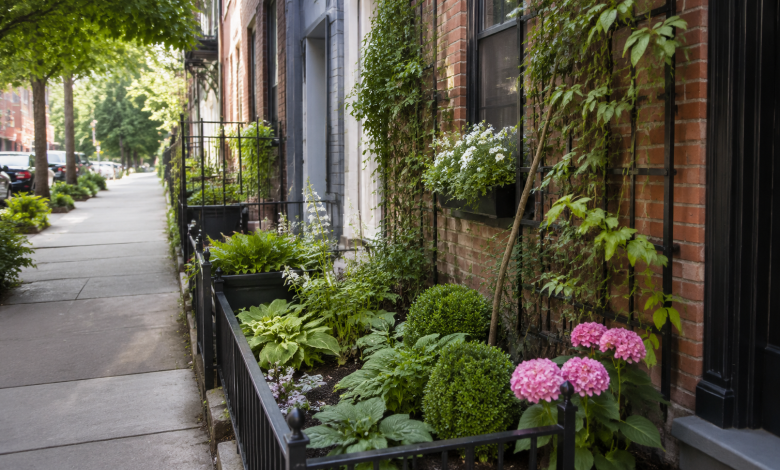
There’s a particular kind of frustration that comes with falling in love with a house that has almost no yard. You picture mornings with coffee in a garden, maybe a row of tomatoes along the fence, some climbing roses, a place where the dog can stretch out in the sun. Then you measure the actual strip of land between your foundation and the property line, and reality does its usual thing.
But here’s what most people miss: narrow lots have produced some of the most inventive, most beautiful urban gardens in the world. The constraint isn’t the enemy. The assumption that a garden needs width is.
Why Width Is a Habit, Not a Requirement
Most of us grew up with a specific mental image of what a garden looks like a roughly square or rectangular patch of ground, plants arranged in neat beds, maybe a lawn as the central stage. That image comes from somewhere: suburban planning, the aesthetics of country estates scaled down, decades of gardening magazines that tend to photograph horizontal spaces.
A narrow lot breaks that template. And the first thing a narrow lot forces you to do, if you’re willing, is think vertically.
Vertical space is almost always underused. A fence that runs the full length of your property is a growing surface. A wall facing south is a solar collector. An overhead pergola creates not just shade but a third dimension for climbing plants. The moment you stop thinking about your garden as something that sits on the ground and start thinking of it as something that occupies a volume of air, a10-foot-wide strip of land starts looking a lot more promising.
The Long Garden as a Journey
One useful reframe is to stop treating a narrow, elongated garden as a limitation and start treating it as a corridor which, in design terms, can be one of the most compelling spatial experiences there is.
Long gardens reward what designers call “sequential revelation.” Instead of seeing everything at once, a visitor moves through a series of distinct moments. A dense planting of ornamental grasses near the entrance creates an enclosed feeling. Then it opens. Then a bench tucked against the fence invites a pause. Then a small raised bed with herbs, then a tree underplanted with shade perennials, then maybe a painted wall at the far end that draws the eye and makes the whole thing feel longer than it is.
This is how garden designers in London, Amsterdam, and Brooklyn have been working for years. Townhouse gardens that are12 feet wide and 60 feet deep are practically their own genre. What they have in common is that every square foot earns its place, and the design creates a feeling of depth through layering rather than width.
Going Up: The Case for Vertical Growing
If there’s a single tool that transforms a narrow lot, it’s the trellis. Not the flimsy plastic kind you push into the ground and forget about, but a real structural element cedar, steel, or even tension wire that becomes part of the garden’s architecture.
Climbing roses can reach 15 feet. Clematis will cover a 6-foot fence in a single season. Espaliered fruit trees, trained flat against a wall in a fan or horizontal cordon pattern, produce real crops while taking up almost no lateral space. Cucumbers, pole beans, and indeterminate tomatoes all grow upward by nature; a well-placed trellis just gives them something to hold onto.
The other vertical move that gets overlooked is stacking. Hanging baskets at head height, window boxes at mid-level, ground-level plantings at the base three tiers of growing where most people use one. In a 3-foot-wide bed against a fence, you can realistically grow herbs in a wall-mounted planter, compact shrubs at eye level on the fence itself, and a mix of perennials and ground cover at the soil surface. That’s density without chaos, as long as you’re thoughtful about sun and water requirements at each level.
Choosing Plants That Work With the Space
Plant selection matters more in a narrow garden than almost anywhere else. A plant that spreads 6 feet wide in an open border is a problem when your entire bed is 4 feet wide. The good news is that the horticultural world has spent decades developing columnar, upright, and compact cultivars of almost everything.
Columnar apple trees like’Ballerina’ or ‘Urban Apple’ grow tall and narrow, producing full-sized fruit on a footprint the size of a large pot. Fastigiate hornbeams and upright junipers give you the visual weight of a tree without the canopy spread. Even ornamental grasses come in narrow, upright forms Karl Foerster feather reed grass, for instance, grows 5 feet tall but barely a foot wide.
For color, go with plants that bloom over a long period rather than ones that put on a short spectacular show. In a small space, a plant that looks good for two weeks and then turns into a brown stick is a significant cost. Salvias, geraniums, catmint, and most roses will give you months of color. Sedums and ornamental grasses carry the late-season interest when everything else has faded.
Think also about scent. In a narrow enclosed space, fragrance concentrates in a way it never does in an open garden. A single jasmine on a fence, a pot of lavender near the back door, a patch of sweet alyssum along the path these small choices become significant sensory experiences in a tight corridor.
The Infrastructure That Makes It Work
Narrow gardens often fail not because of the planting plan but because of practical oversights. Irrigation is one. When you’re working in a tight space, a hand-watering routine can get tedious fast, and an inconsistently watered garden shows. A simple drip system with a timer is worth every penny in a small garden it keeps moisture consistent, reduces disease pressure, and frees you from obligation.
Path placement is another. In a narrow lot, the path isn’t just a way to get from one end to the other. It defines the width relationship between planted space and movement space. Too wide, and you sacrifice growing room. Too narrow, and the garden feels cramped and the plants get damaged. A24-inch path is generally the minimum for comfort; stepping stones set into ground cover are a way to get the permeability you need without committing too much hard surface.
Storage and infrastructure compost, tools, hoses need a home that doesn’t eat into the visual experience. A slim vertical compost bin, a wall-mounted tool rack, a coiled hose in a corner: these exist, and they make the difference between a garden that looks tended and one that looks like a series of compromises.
Light, Borrowed Views, and the Illusion of Space
One thing narrow lots in urban areas often have is walls your own fence, your neighbor’s wall, maybe a garage at the far end. These surfaces, instead of being treated as barriers, can do real work.
A light-colored or white painted wall at the far end of a narrow garden does something almost optical: it reflects light back into the space and acts as a visual terminus that makes the eye read the garden as having more depth. Mirrors, used carefully, can extend this effect though placement matters, since a poorly placed mirror in a garden reads as strange rather than clever.
Borrowed views are another tool borrowed from Japanese garden design. If there’s a tree in your neighbor’s yard, or a rooftop visible above the fence, consider how your planting can frame rather than block that view. A narrow gap between shrubs that aligns with something interesting beyond your boundary makes the garden feel connected to a larger landscape.
What Narrow Gardens Teach You
Gardeners who’ve worked in small spaces for a few seasons often say the same thing: they became better gardeners. The constraints force intentionality. Every plant has to justify its presence. Every design decision has visible consequences because there’s nowhere for a mistake to hide.
There’s something almost meditative about a garden that demands your full attention. You notice more. You catch problems early. You develop a real relationship with specific plants rather than a vague, generalized interest in “the garden” as a category.
Width was never what made a garden worth having. Care, creativity, and the willingness to see possibility where other people see limitation those are what make it worth having. And those have nothing to do with how many feet of space you’re working with.