
What Postpartum Hair Loss Taught Me About True Strand Longevity
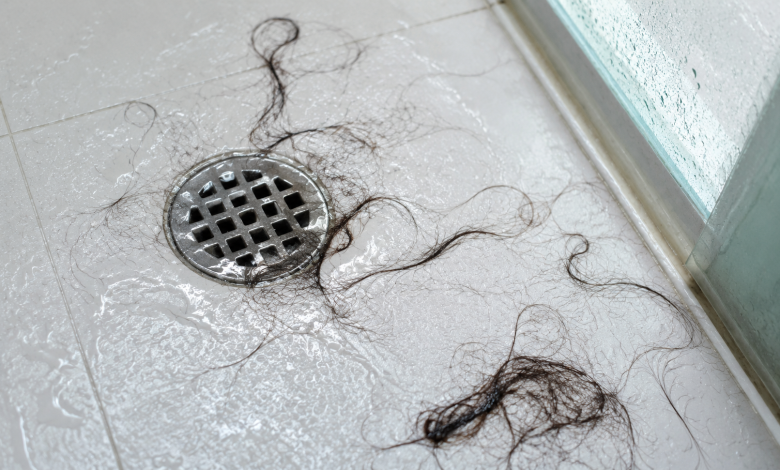
The Shower That Changed Everything
It started with a drainclog.
Three months after giving birth, I stepped into what should have been a restorative morning shower and watched clumps of my own hair spiral toward the drain in a slow, sickening swirl. I stood there longer than I should have, one hand pressed against the tile for balance, counting the strands tangled around my fingers. I wasn’t sick. I wasn’t aging dramatically. I had simply had a baby one of the most natural things a human body can do and now my hair was leaving me in handfuls, as if it had somewhere more important to be.
What followed was a months-long education I never asked for, but one that fundamentally rearranged everything I thought I understood about hair health.
Why Postpartum Shedding Hits Different
During pregnancy, elevated estrogen essentially freezes hair in what’s called the anagen phase the active growth stage. Your strands don’t fall out on their regular cycle. They just keep growing, dense and cooperative, while hormones quietly hold them hostage in the best possible way. Most pregnant women notice their hair looking fuller, shinier, almost absurdly healthy. That’s not a myth. It’s biology doing something genuinely beautiful, even if the reason involves a complete hormonal takeover of your body.
Then the baby arrives. Estrogen drops sharply. And all those strands that were on pause suddenly receive their eviction notices at the same time. The clinical term is telogen effluvium a stress-triggered shift that pushes large numbers of follicles simultaneously into the resting and shedding phase. In practice, it means you lose between six and twelve months’ worth of hair in what feels like a few brutal weeks.
That knowledge helped me intellectually. It didn’t help me emotionally when my ponytail went from wrist-thick to pencil-thin between Thanksgiving and February.
What I Got Wrong About Hair Strength
Before this experience, my relationship with my hair could be generously described as surface-level. I bought whatever shampoo smelled good, used heat tools without much consideration, and defined “healthy hair” as hair that looked shiny in photos. Thickness, length, manageability those were the metrics I cared about. The actual biological infrastructure underneath? Completely invisible to me.
Postpartum shedding forced me to look deeper, literally and figuratively. I started reading about the hair growth cycle in a way I’d never bothered to before. I learned that a strand of hair is essentially dead tissue from the moment it exits the scalp the living, metabolically active part of any follicle is the root structure beneath the skin. That root is exquisitely sensitive to nutritional status, hormonal fluctuation, circulation, and stress. The beautiful length you see is a record of what happened months ago, underground, before you had any idea whether things were going well or not.
This realization came with a specific kind of vertigo. You can’t observe the health of your hair in real time. You’re always reading a history, not a current report.
The Nutrients Nobody Mentioned in My Prenatal Appointments
I was meticulous about prenatal vitamins during pregnancy. Folic acid, iron, DHA I took them without fail. What nobody told me was that the demands of the postpartum period, particularly for women who are breastfeeding, can deplete certain micronutrients at rates that make the prenatal phase look moderate. Ferritin levels the stored form of iron can crash in the months after delivery and are strongly correlated with hair shedding. Zinc drops. Biotin, while often overhyped in supplement marketing, still plays a genuine role in keratin synthesis. Vitamin D, which behaves more like a hormone than a vitamin and has receptors in hair follicles, frequently falls to levels that would concern any clinician paying attention.
I got bloodwork done at four months postpartum, mostly because my midwife happened to be thorough. My ferritin was at 11ng/mL. The lab’s reference range bottom was 12. On paper, I was technically within normal. In practice, that number explained a lot.
Rebuilding those stores took time roughly four months of consistent supplementation and dietary changes before I noticed any real difference in the shed rate. There’s no dramatic turnaround moment. The drain just gradually stops being a crime scene.
Scalp Health Is Infrastructure, Not Spa Treatment
One of the more embarrassing realizations I had during this period was how completely I had neglected my scalp for the preceding thirty-some years. I washed my hair. I conditioned from mid-shaft to ends, as instructed. I treated my scalp essentially as a surface to be managed rather than a living tissue to be supported.
A healthy scalp maintains a specific pH balance, a particular microbiome, and an adequate sebum production that lubricates the hair shaft as it grows. When you strip it with harsh sulfates or suffocate it with heavy silicones, you’re not just affecting texture you’re altering the environment in which new growth has to occur. During the postpartum period, when follicles are already under hormonal duress, an inflamed or imbalanced scalp is the last thing they need.
I started paying attention to scalp circulation: gentle massage during washing, being more deliberate about rinsing thoroughly, reducing the frequency of tight hairstyles that create chronic tension at the hairline. These aren’t glamorous interventions. They don’t photograph well for social media. But they address the actual architecture of the problem rather than its aesthetic symptom.
The Long Timeline Nobody Warned Me About
Postpartum hair loss typically peaks around the three to four month mark after delivery, then gradually resolves. “Gradually” is doing a lot of work in that sentence. For most women, full recovery takes anywhere from six to eighteen months. Eighteen months. That’s a year and a half of watching the bathroom floor after you blow dry, of adjusting how you part your hair to conceal thinning, of quietly calculating whether the growth coming in at your temples is real or wishful thinking.
The length of that runway taught me something that I think applies far beyond the postpartum experience: hair health is deeply, stubbornly long-cycle. The decisions you make today about what you eat, how much you sleep, whether you’re managing chronic stress, whether you’re deficient in something your body needs won’t show up on your head for three to six months. And the recovery from damage, whether hormonal or mechanical or nutritional, plays out over a similar lag time.
We live in a culture that prizes rapid feedback. We want to try something new and see results next week. Hair doesn’t work that way. It’s one of the few visible markers of your internal health that operates on a genuinely long horizon, which means you have to trust a process you can’t immediately verify. That requires a different relationship with patience than most of us have been asked to develop.
What Longevity Actually Means for Hair
By the time my hair had largely recovered somewhere around fourteen months postpartum, if I’m being honest about the full timeline I had developed a completely different vocabulary for what I wanted from it. I wasn’t thinking about length as the primary goal. I was thinking about density, about the integrity of individual strands, about whether my scalp felt calm and well-supplied rather than reactive and stripped.
True strand longevity isn’t about keeping hair forever. Every follicle has a finite number of growth cycles across a lifetime, and the goal isn’t to cheat biology it’s to support the cycles you do have so they run at their full potential. That means staying ahead of deficiencies before they crater your ferritin levels. It means protecting the scalp environment as seriously as you protect the strands that grow from it. It means understanding that heat damage and mechanical breakage are borrowing against future density, not just cosmetic inconveniences.
The postpartum period put all of that in front of me in the starkest possible terms because there was simply no way to be casual about it. When you lose a third of your hair volume in three months, you stop skimming the surface of the subject.
I didn’t want to learn hair health this way. I would have preferred a gentler classroom. But there’s something clarifying about having a system fail loudly enough that you’re forced to understand how it actually works and what it needs to keep working, long after the crisis has passed.