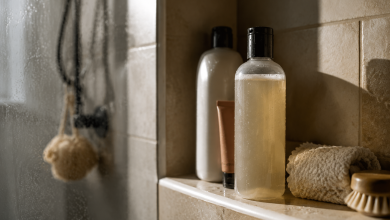
Skinimalism: How Scaling Back Your Products Saved My Budget and My Complexion.
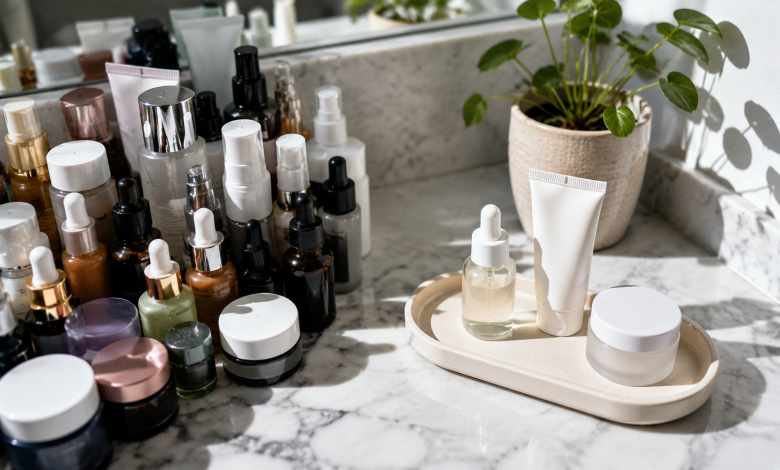
There was a period in my life when my bathroom shelf looked like the back room of a Sephora. Serums lined up in neat rows. Toners in amber glass bottles. A rotating cast of moisturizers for morning, evening, post-gym, and apparently some theoretical third skin event I never quite identified. I told myself this was self-care. Looking back, it was closer to anxiety dressed up in pretty packaging.
The breaking point came on a Tuesday morning when I counted seventeen products in my routine. Seventeen. And my skin, despite all that devoted attention, was a mess reactive, congested, perpetually dull. I had redness I’d never had before. Breakouts along my jawline that appeared and vanished with no predictable pattern. A dermatologist I finally visited asked me to list everything I was using. When I finished, she looked at me with an expression that mixed professionalism and mild horror. “Your skin is overwhelmed,” she said. “You need to strip everything back.”
That was my introduction to skinimalism, though I wouldn’t learn the word for another few months.
What Skinimalism Actually Means (And What It Doesn’t)
The term gets misused constantly. People hear “skinimalism” and assume it means doing nothing bar soap and a prayer. That’s not it. Skinimalism is about intentionality. It’s the practice of paring your routine down to the products that genuinely serve your skin’s specific needs, cutting everything else, and resisting the industry pressure to constantly add more.
It is, in many ways, a direct response to the maximalist skincare era that peaked somewhere around 2018to 2021 when ten-step Korean beauty routines became aspirational and influencers filmed themselves applying layer after layer of product to already-glowing skin. The logic seemed airtight: more ingredients meant more benefits. More bottles meant more coverage. If one antioxidant serum was good, surely two were better.
Except skin doesn’t work that way. It’s not a math problem where inputs always compound toward a positive outcome. It’s an organ with its own ecosystem, its own barrier function, its own tolerance thresholds. Push past those thresholds and the skin doesn’t reward you it retaliates.
The Chemistry of Overload
Here’s something the marketing rarely tells you: many popular skincare actives actively interfere with each other when layered. Vitamin C one of the most beloved brightening ingredients oxidizes and loses efficacy in the presence of certain pH levels, which is exactly the environment created by many exfoliating acids. Retinoids and benzoyl peroxide can degrade each other on contact. Niacinamide, at high concentrations, combined with high-dose vitamin C can cause flushing in some people, though the science here is more nuanced than the internet debates suggest.
None of this means these ingredients are bad. They’re not. But using all of them at once, every day, on the assumption that more coverage equals better protection that’s where the trouble starts.
My own skin’s rebellion made sense once I understood this. I had been layering a vitamin C serum over a glycolic acid toner, following it with a niacinamide moisturizer, and finishing with a retinol oil at night, every night, without exception. My skin barrier was essentially under constant siege from actives with competing pH requirements and mechanisms. The redness wasn’t a mystery. It was my skin telling me, in the only language it had, to stop.
The Stripped-Back Experiment
My dermatologist’s instruction was blunt: pick a gentle cleanser, a simple moisturizer, and sunscreen. Use nothing else for thirty days.
Those first two weeks were psychologically difficult in a way I didn’t expect. I’d built a ritual around my elaborate routine. Standing in front of the mirror with just three products felt like I was doing something wrong, neglecting myself somehow. The beauty industry had done a thorough job of convincing me that complexity equaled care.
But by week three, something was shifting. The redness along my cheeks had quieted noticeably. My skin felt less tight after cleansing. The congestion on my forehead, which I’d been aggressively treating with acids for two years, had started to clear not because I was attacking it, but because I’d stopped inflaming everything around it.
By the end of thirty days, I had genuinely better skin than I’d had in years. Not dramatically transformed, not retouched-photo perfect. Just… calm. Functional. Like a machine that had been allowed to run without interference.
The Budget Revelation
When the skin results were undeniable, I finally let myself look at the financial side of what I’d been doing.
In the two years prior, I had spent and I did sit down and actually calculate this somewhere in the range of $180to $220 per month on skincare. Multiply that out and it’s roughly $2,400 to $2,600 a year. On products. A significant portion of which, I now understood, were actively working against each other.
My current routine costs me about $45 a month. A gentle foaming cleanser I replenish every six weeks. A ceramide-rich moisturizer that lasts nearly two months. A broad-spectrum SPF 50 that I genuinely go through quickly because I apply it properly. Occasionally, a single targeted treatment a mild retinol I use three times a week now that my barrier has healed enough to handle it.
The savings aren’t just numerical. There’s a cognitive savings too, one I hadn’t anticipated. Decision fatigue is real, and so is the particular exhaustion of maintaining a complicated ritual. Mornings are faster. Travel packing takes ten minutes instead of an hour of deliberation over what makes the cut. I spend less time reading conflicting ingredient advice online because I have fewer variables to obsess over.
What Actually Stays in the Routine
After months of testing and reintroduction carefully, one product at a time, with weeks between additions here’s what earned a permanent place.
A gentle, low-pH cleanser that doesn’t strip. This is the category where “more” often does the most damage. Harsh cleansers destroy the skin’s natural microbiome and acid mantle, setting off a cascade of compensatory oil production and sensitivity. Gentle doesn’t mean ineffective it means appropriate.
A moisturizer with ceramides, hyaluronic acid, or both. Barrier repair is foundational. Everything else is secondary. When the skin barrier is intact, it handles environmental stress, regulates hydration, and manages minor irritants without requiring intervention. When it’s compromised, no serum in the world fixes the underlying dysfunction.
Sunscreen, daily, non-negotiable. This is the one product with decades of unambiguous research behind it. UV exposure is responsible for the majority of visible skin aging. No brightening serum compensates for skipping this step.
And then, selectively, one targeted active used with real restraint. For me that’s retinol, low concentration, a few nights a week. For someone else it might be a niacinamide serum for hyperpigmentation, or a salicylic acid treatment for congestion-prone zones. The key word is one. Not a category. A single product with a single, clear purpose.
The Harder Conversation About the Industry
Skinimalism doesn’t emerge in a vacuum. It’s a reaction to something specifically, to a beauty industry with a structural incentive to convince you that your current routine is incomplete. New hero ingredients are announced seasonally. Limited editions create urgency. Influencer partnerships make elaborate routines look like the baseline.
None of this is conspiracy. It’s just business. But understanding the mechanics of it makes the pressure to constantly buy and add and upgrade much easier to resist. Skin doesn’t need innovation every quarter. It needs consistency and the space to function without constant intervention.
The version of self-care I practice now looks much quieter than what I was doing before. It doesn’t photograph as well. There’s no visual drama in three products lined up on a shelf. But my skin and my credit card statement have both recovered in ways that no serum ever managed to deliver.
Sometimes subtraction is the most radical thing you can do.