The Tiny Apartment Guide to Choosing a Nightstand
The Space You Sleep In Tells You Everything
There’s a particular kind of frustration that comes with furnishing a small apartment. You’ve measured the wall. You’ve measured the furniture. The numbers technically work. And then you bring the piece home, slide it into the corner, and suddenly your bedroom feels like a storage unit with a bed in it. This happens most often and most painfully with the nightstand.
It’s easy to underestimate the nightstand. Compared to choosing a bed frame or a sofa, it feels like a minor decision, almost administrative. But in a small bedroom, the nightstand operates at a completely different level of consequence. It sits at eye level when you’re lying down. It’s the first thing you reach for in the morning and the last surface you touch at night. In a room where every square foot carries weight, a nightstand that’s even slightly wrong in scale or function doesn’t just look off it actively shrinks the room around it.
So where do you even start?
Stop Measuring the Nightstand. Start Measuring the Gap.
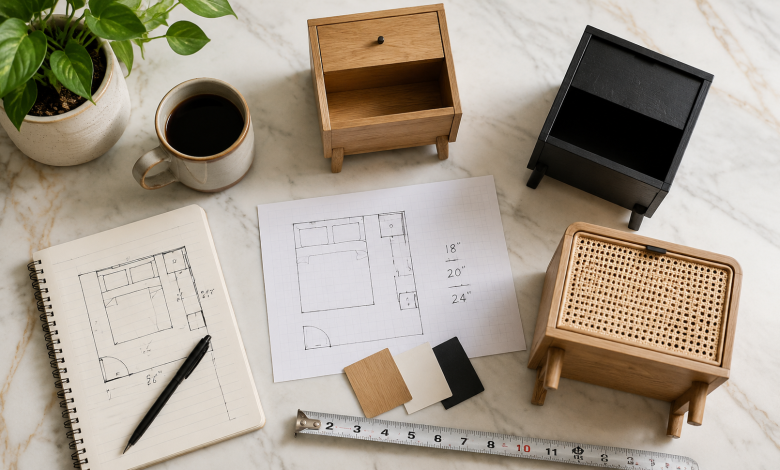
Most people begin by browsing nightstands and then checking whether they’ll fit. That’s backwards. The right starting point is the space itself specifically, the gap between your bed frame and the nearest wall or obstacle.
In a standard bedroom, you have options. In a small apartment bedroom, you have constraints. Maybe that gap is fourteen inches wide. Maybe it’s nine. Maybe there’s a radiator six inches from the edge of the mattress that nobody told you about when you signed the lease.
Measure that usable space precisely, then knock two to three inches off on each dimension. That buffer is what separates a room that feels intentionally designed from one that feels stuffed. A nightstand that technically fits but grazes the wall every time you open a drawer is not, functionally, a good fit.
Height matters just as much as footprint. The general guideline nightstand surface should sit within two inches of your mattress height exists for a reason. Reaching up or down to grab your phone in the dark is a minor irritation that accumulates into a genuine quality-of-life issue. Measure from your floor to the top of your mattress. Write that number down. It will save you a return shipment.
The Multipurpose Principle (And Its Hidden Traps)
Small-space design has one recurring gospel: everything must do more than one thing. And it’s largely true. A nightstand with a drawer beats a nightstand without one. A nightstand with a lower shelf beats a floating surface you can only stack things on. Built-in USB charging ports, cable management channels, built-in lighting these features genuinely earn their presence in a compact bedroom.
But the multipurpose principle has a shadow side that doesn’t get discussed enough: complexity creates clutter in disguise.
A nightstand with three drawers, two open shelves, a magazine rack on the side, and a charging station sounds like maximum utility. In a small room, it becomes the place where everything accumulates. That bottom shelf? It will hold things you haven’t thought about in four months. Those three drawers? You’ll forget what’s in the back of each one within a week. The visual noise of an over-featured nightstand contributes to that particular anxiety of small spaces the sense that things are pressing in on you from all sides.
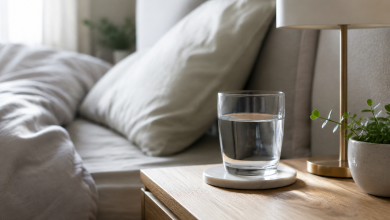
The sweet spot is usually one concealed storage element (a single drawer or a cabinet door) combined with one open surface. Concealment handles the items you need accessible but don’t want visible: a book, a charger, a notepad, whatever you reach for at night. The open surface stays minimal a glass of water, a lamp, maybe something that brings you a moment of quiet pleasure when you look at it. That’s the whole inventory. Anything beyond that is a sign that the nightstand is being asked to solve an organizational problem that really belongs somewhere else in the room.
When the Traditional Nightstand Isn’t the Answer
Here’s a conversation worth having honestly: in some small apartments, the traditional freestanding nightstand is simply not the best tool for the job.
A wall-mounted floating shelf does everything a small nightstand does, but it doesn’t occupy floor space. Floor space in a compact bedroom is load-bearing in a psychological sense the more of it you can see, the larger the room feels. A shelf that mounts at mattress height, maybe twelve inches deep and eighteen to twenty-four inches wide, provides a surface and sometimes a drawer if you choose a model with one, and it completely frees the floor beneath it. If your floors are interesting a good hardwood, patterned tile, a nice rug floating shelves let that detail breathe and contribute to the room’s sense of space.
Bedside wall sconces paired with a minimal shelf take this approach even further. You eliminate the lamp footprint entirely. The surface stays uncluttered. The room gains a kind of composed, intentional quality that’s very difficult to achieve with a bulky traditional nightstand in a tight space.
Cane or open-frame nightstands are another option worth considering when the space feels visually dense. Solid wood or solid-panel furniture has visual weight that glass,cane, rattan, and metal frames simply don’t. A nightstand you can see through even partially reads as lighter to the eye, which changes how the room feels even when the actual footprint is identical.
Color, Finish, and the Illusion of Boundaries
Visual scale and physical scale are not the same thing, and understanding this distinction is quietly one of the most useful skills in small-space furnishing.
A dark walnut nightstand against a white wall is a block. It announces itself. It has edges that are crisp and defined against the background. That’s not inherently bad sometimes the intention is to have a piece that grounds the space but in a very small room, a lot of visual blocks create a lot of visual stops, and too many visual stops make a room feel choppy and compressed.
A nightstand in a tone close to the wall color a pale oak against warm white, a soft gray against a similar gray wall blurs those edges slightly. The eye doesn’t stop hard at the boundary of the furniture. The room reads as less interrupted, which makes it feel more open.
This doesn’t mean everything should match everything. It means being conscious about which pieces you want to visually recede and which ones you want to stand out. In a small bedroom, it usually makes sense to let the bed be the statement, and let the nightstand support rather than compete.
The One Rule That Overrides All the Others
There’s a version of small-space advice that becomes its own kind of trap: the constant optimization. Every piece evaluated purely for function-per-square-foot efficiency. Every surface kept aggressively minimal. Every purchase justified through utility alone.
That approach produces rooms that feel like well-organized problem statements rather than places someone actually lives.
The nightstand you choose should work within the space. But it should also work for you the person who is going to reach for it in the dark, half-asleep, for years. If a particular piece is slightly more generous in size than the strict math would recommend but you love the way it looks, and the room still moves and breathes around it, that’s a better outcome than the perfectly sized piece that you feel indifferent about every morning.
Constraints are real. In a tiny apartment, the physics of space are unforgiving and the margin for error is thin. But constraint doesn’t have to mean resignation. The best small-space decisions aren’t just correct they’re choices you can live with comfortably, in every sense of that word.