How to Make a 100-Square-Foot Bedroom Feel Like a Luxury Suite
The Room Isn’t the Problem The Thinking Is
Most people walk into a small bedroom and immediately start calculating what won’t fit. The king bed is out. The reading chair is a fantasy. The walk-in closet was never on the table. And so the room gets furnished not with intention but with resignation whatever fits, fits.
That’s the wrong starting point entirely.
Luxury has very little to do with square footage. Spend a night in a well-designed boutique hotel in Tokyo or Lisbon, and you’ll understand this immediately. Those rooms are tiny. They’re also immaculate, sensory-rich, and strangely calming. The designers behind them didn’t treat smallness as a problem to solve. They treated it as a constraint that forced better decisions. That’s the mental shift that makes everything else possible.
Light Is Doing More Work Than You Think
Before you move a single piece of furniture, look at how light moves through the room. Natural light is the single most powerful tool for making a space feel expansive, and most small bedrooms are quietly strangling it.
Heavy curtain panels pulled to the sides and blocking half the window frame are one of the most common offenders. The fix is almost embarrassingly simple: mount curtain rods several inches above the window frame and extend them well beyond the edges. When the curtains are open, every inch of glass is exposed, and the eye reads the full height of the wall rather than a compressed frame. The room feels taller. It feels more like a room someone chose rather than settled for.
Mirrors amplify this effect. A full-length mirror on the wall opposite the window doesn’t just reflect light it creates the visual impression of a second space existing just beyond the wall. Designers have used this trick in Parisian apartments for centuries. It works because the brain reads reflected depth as actual depth, at least at a glance, and that brief perceptual moment is enough to make the room feel open.
Artificial lighting deserves the same attention. A single overhead fixture casting flat, even light is the fastest way to make a room feel institutional. Layer your lighting instead a warm bedside lamp, a small sconce on the wall if wiring allows, even a plug-in pendant hung from a ceiling hook. Varied light sources create shadow and dimension, which paradoxically makes a room feel more spacious because the eye has more to travel across.
The Bed Is the Architecture
In a 100-square-foot bedroom, the bed isn’t furniture. It’s the room’s central architectural fact. Every other decision orbits around it.
The instinct is often to go smaller a full instead of a queen, or a platform bed to minimize visual bulk. That instinct is partly right and partly wrong. A bed that’s too small for the room actually makes the room look smaller, because the surrounding empty floor space feels awkward and disproportionate rather than generous. A well-proportioned bed that fits the room creates a sense of intention. The room looks like it was designed around this bed, and that reads as luxury.
What you want to eliminate is unnecessary height. Beds with thick box springs stacked under mattresses lift the sleeping surface to a height that competes visually with the ceiling in a low or standard room. A platform frame with a quality mattress directly on it keeps the sight lines low and open. The ceiling feels higher. The room breathes.
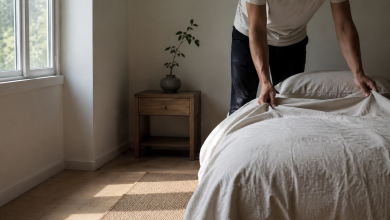
Invest in the bedding the way you would invest in the room’s main visual statement, because that’s exactly what it is. Hotel-quality white or cream linens with real weight to them a good thread count, a duvet that drapes with substance signal quality immediately. You don’t need to spend hotel procurement money. You need to spend enough to get linens that don’t pill, wrinkle into a mess, or look thin under light.
Vertical Space Is Mostly Ignored and Entirely Valuable
The floor plan of a small room is fixed. The vertical space is not.
Most bedrooms use maybe six feet of their wall height and treat the rest as empty air. That’s an enormous amount of real estate being ignored. Shelving that runs from around the five-foot mark up to the ceiling creates storage and visual interest without consuming a single square foot of floor space. The eye follows the shelving upward, which makes the ceiling feel further away.
Built-in or floating shelves beside and above a headboard can replace a nightstand entirely while adding substantial storage. Keep objects on these shelves spare and curated a few books, a plant, a single object you actually like looking at. The difference between a shelf that makes a room feel like a luxury space and one that makes it feel cluttered is almost entirely a matter of restraint.
Under-bed storage is worth addressing separately because it’s genuinely transformational when done well. Bed frames with integrated drawers allow you to move most closet overflow off-season clothes, extra linens, shoes out of the closet and under the bed, which in turn allows the closet to breathe. A closet that isn’t stuffed beyond capacity suddenly feels like a dressing area rather than a holding zone. That distinction matters more than it sounds.
Color and Texture Are Doing the Heavy Lifting
Paint color in a small bedroom is one of those subjects where conventional wisdom and good design part ways. The conventional wisdom says light colors make small rooms feel bigger. That’s true in a flat, literal sense. It’s also how you end up with a bedroom that feels like a rental that’s been freshly repainted to be inoffensive.
Deep, saturated colors navy, forest green, a warm charcoal do something interesting in small rooms. They create enclosure, yes, but enclosure that feels intentional and cocooning rather than cramped. Some of the most celebrated small hotel rooms in the world use exactly this approach: dark walls, rich textiles, warm lighting. The room doesn’t feel small. It feels considered. It feels like somewhere you were meant to be.
The key when going dark is consistency. Paint the ceiling the same color as the walls, or one shade lighter. When the walls and ceiling are different colors, the eye reads the line where they meet as a boundary, and the room feels boxed in. When that seam disappears, the space feels like a single enveloping environment, which is the sensation most closely associated with genuine comfort.
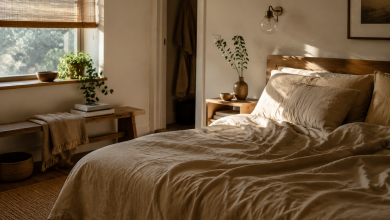
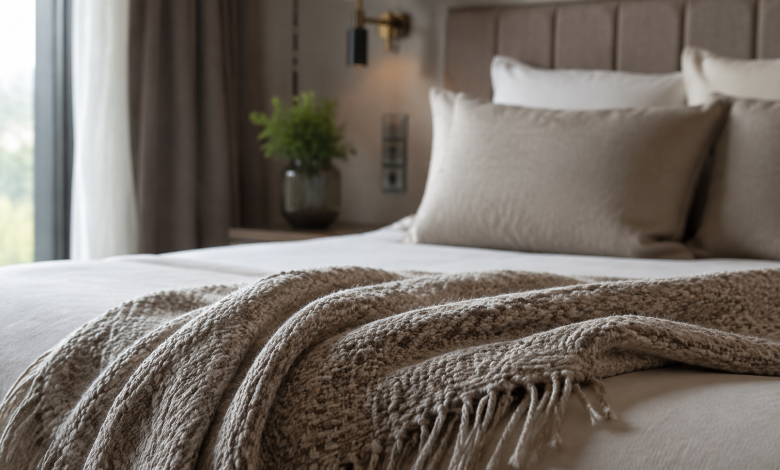
Texture matters alongside color because texture is what prevents a room from feeling flat on camera and dead in person. Layer materials that differ in their surface quality a linen duvet, a wool throw, a cotton rug with some pile to it, a ceramic lamp base. When light hits a room with textural variety, it creates depth and interest that paint alone can’t achieve.
What Luxury Is Actually Made Of
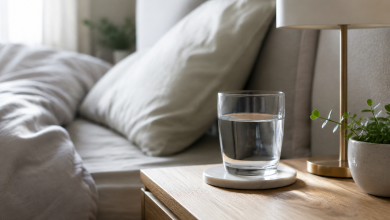
There’s a reason boutique hotels invest in fragrance, in the quality of the water glass on the nightstand, in a single well-placed chair in the corner even when the room barely has room for it. Luxury in a bedroom is largely sensory rather than spatial. It’s the feeling of a space that was thought about, where someone made deliberate choices rather than default ones.
A 100-square-foot bedroom can have a decent lamp or a lamp that looks genuinely beautiful. It can have a rug that covers too little floor or one that anchors the bed properly. It can have a door that opens into clutter or one that opens into a space where everything visible was placed there on purpose.
None of these choices require a renovation. They require attention to proportion, to light, to what the eye rests on when it enters the room. That attention, applied consistently, is what separates a small bedroom from a small bedroom that feels like something much more.