How to Curate a Bedroom That Lowers Your Cortisol Levels
Your Bedroom Is Already Talking to Your Nervous System
Before you even open your eyes in the morning, your brain has already been processing the room around you. The temperature of the air, the quality of the light filtering through your curtains, the faint hum of a neighbor’s AC unit all of it registers. Your nervous system doesn’t wait for conscious thought to begin its assessment. It’s been running diagnostics all night.
Cortisol, the hormone most people associate with stress, actually has a natural rhythm. It should peak in the early morning to pull you out of sleep, then taper through the day, bottoming out at night so your body can repair itself. The problem is that modern bedrooms with their glowing devices, synthetic fabrics, visual clutter, and artificial light keep nudging that curve in the wrong direction. The room designed for rest becomes a low-grade stressor.
This isn’t about aesthetics. It’s about biology. And once you understand that your environment is in constant conversation with your endocrine system, redesigning your bedroom stops feeling like an optional luxury and starts feeling like maintenance.
Light Is the Most Underestimated Variable
Most people address light in their bedrooms as an afterthought a blackout curtain here, a dimmer switch there. But light is arguably the single most powerful environmental cue for cortisol regulation, because it’s directly tied to your circadian rhythm through the suprachiasmatic nucleus, a tiny cluster of cells in your hypothalamus that essentially serves as your body’s master clock.
Blue-spectrum light, which is abundant in LED bulbs, phone screens, and overhead lighting, suppresses melatonin and signals to your brain that it’s midday. Even thirty minutes of exposure in the hour before sleep can delay your melatonin onset by ninety minutes. That’s not a minor inconvenience. That’s your entire wind-down sequence getting pushed back while cortisol stays elevated longer than it should.
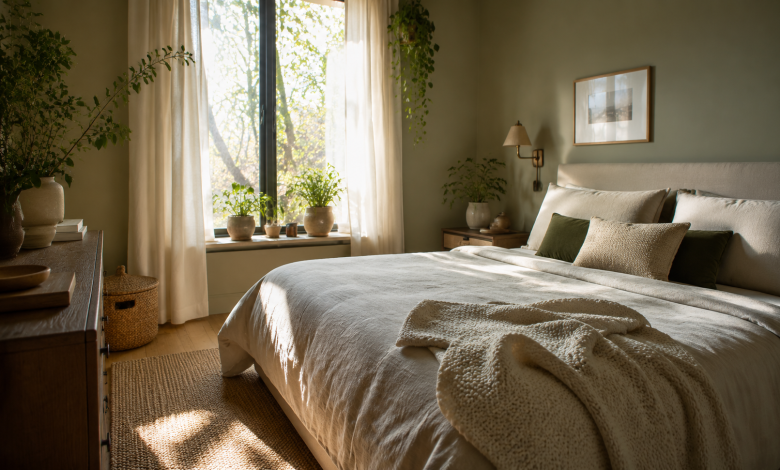
The fix isn’t simply “use your phone less.” It’s about creating a light environment that shifts with the time of day. Warm-toned bulbs in the 2200–2700 Kelvin range in bedside lamps. Dimming everything to below 50 lux an hour before bed. If you do look at a screen, amber-tinted glasses are not a gimmick the research supporting them is solid. The goal is to stop accidentally convincing your hypothalamus that the sun is still up.
Blackout curtains deserve their own mention. Streetlights, porch lights, the ambient orange glow of a city at3 a.m. these interrupt sleep architecture in ways that are cumulative. A night of fragmented sleep elevates cortisol the following morning measurably. Total darkness isn’t just comfortable; it’s mechanistically protective.
Temperature Dictates More Than Comfort
There’s a reason you sleep worse during a heatwave that has nothing to do with the inconvenience of sweating. Core body temperature needs to drop by one to two degrees Fahrenheit for deep sleep stages to initiate properly. If your room is too warm, your body keeps trying to offload heat, cycling through lighter sleep stages instead of sinking into the slow-wave sleep where cortisol repair actually happens.
The sweet spot for most people sits between 65 and 68 degrees Fahrenheit. That number might feel cooler than what seems comfortable when you first get into bed, but that initialchill is actually what triggers the thermoregulatory cascade that pulls you under. Heavy blankets that trap body heat without raising ambient room temperature weighted blankets being a notable example work partly because they satisfy the sensation of warmth while still allowing the room itself to stay cool.
If you can’t control your room temperature precisely, a cooling mattress topper is worth considering. Wool bedding, counterintuitively, regulates temperature better than many synthetic alternatives because it responds dynamically to body heat rather than trapping it uniformly. The material choices in your bed aren’t just about softness they’re thermal management decisions.
Visual Clutter Is a Stressor You’ve Learned to Ignore
This is the part that gets dismissed most often, usually by people who describe themselves as “not bothered” by mess. But your visual cortex processes everything in your field of view, even when you’re not consciously attending to it. Incomplete tasks a pile of laundry, unopened mail on the dresser, a half-assembled piece of furniture are registered by the brain as open loops. Open loops sustain low-level cortisol activation. You don’t feel stressed, exactly. But the signal is there.
The research on this comes partly from studies on chronic household clutter and its relationship to cortisol levels in women, published in Personality and Social Psychology Bulletin. Women who described their homes as cluttered or unfinished showed flatter cortisol curves throughout the day meaning their stress hormone failed to drop properly, which is its own kind of dysregulation. The bedroom, as the last environment you see before sleep and the first you see on waking, carries disproportionate weight in this pattern.
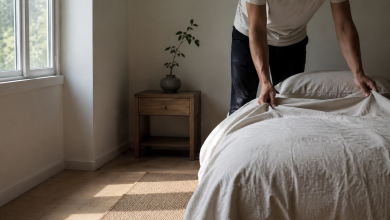
The remedy isn’t minimalism for its own sake. You don’t need a room that looks like a hotel. What you need is a visual environment where nothing demands your attention. Closed storage beats open shelving. A made bed, even a loosely made one, matters more than most people expect. Surfaces that are clear enough to feel resolved rather than pending. The visual quietness of a well-curated bedroom communicates safety to a nervous system that’s always scanning.
Sound, Scent, and the Stuff You Think Doesn’t Matter
Low-frequency noise traffic rumble, HVAC systems, a refrigerator two rooms over is processed during sleep and can trigger microarousals that fragment your sleep stages without fully waking you. You wake up feeling inexplicably tired. White or pink noise machines aren’t just for light sleepers; they work by masking these irregular acoustic intrusions with a consistent, non-threatening sound envelope. The brain habituates to steady sound; it can’t habituate to unpredictable noise.
Scent is genuinely underutilized in bedroom design. Lavender’s reputation as a sleep aid has decent science behind it specific compounds like linalool interact with GABA receptors in ways that produce mild anxiolytic effects. A few drops of lavender essential oil on a bedside diffuser, run for an hour before you sleep, isn’t aromatherapy theater. It’s a low-cost intervention with a plausible mechanism.
The phone on your nightstand deserves one final mention, not because screens are the only villain, but because a phone within arm’s reach changes your behavior even when you’re not using it. The possibility of checking it a notification, a reflex, an anxious late-night search keeps the prefrontal cortex more activated than it should be at midnight. Charging it in another room removes the option entirely, which is the cleanest behavioral design available.
The Room You Return to Should Feel Like a Decision
Curating a low-cortisol bedroom isn’t a weekend project you finish and forget. It’s an ongoing attentiveness to the fact that your environment is always acting on your body, whether you’ve consciously designed it or not. The light is communicating something. The temperature is negotiating with your sleep stages. The pile of unread books on the floor is registering as an open loop, quietly.
What changes when you take this seriously is not just sleep quality though that comes. It’s the baseline from which you start each day. Cortisol that rises and falls as it should, rather than staying slightly elevated around the clock, means less reactive thinking, more emotional bandwidth, a nervous system that isn’t perpetually braced. That’s not a small thing. And it begins, quite literally, with the room you sleep in.