The Science of Better Sleep: Finding Your Perfect Bedroom Temperature
Your Body Already Knows What It Wants
There’s a reason you instinctively kick one leg out from under the covers at 2 a.m. Your body isn’t being dramatic it’s doing something remarkably precise. As you transition from wakefulness into sleep, your core body temperature begins to drop, shedding roughly 1 to 2 degrees Fahrenheit over the course of the night. That leg hanging in the cool air? It’s helping your body radiate heat, nudging your internal thermostat in exactly the direction it needs to go.
This isn’t a quirk. It’s biology at work, and understanding it is the foundation of why bedroom temperature matters far more than most people realize.
Sleep researchers have known for decades that the brain’s circadian rhythm and body temperature are deeply intertwined. The hypothalamus the small region of your brain that governs both your body clock and temperature regulation begins preparing for sleep hours before your head hits the pillow. As evening arrives, your blood vessels near the skin dilate, dispersing heat outward. Your fingers and toes become slightly warmer to the touch, which is actually a signal that heat is being pulled away from your core. By the time you fall asleep, your core temperature is in descent.
When the environment cooperates when the air around you is cool enough to absorb that escaping heat the process is smooth, efficient, almost effortless. When it doesn’t, you spend the night fighting your own physiology.
The Number That Researchers Keep Landing On
Ask a sleep scientist for an ideal bedroom temperature and you’ll almost always get the same answer: somewhere between 65 and 68 degrees Fahrenheit (18 to 20 degrees Celsius). That range isn’t arbitrary. It’s the zone where the body can complete its nightly temperature drop without working too hard or being interrupted by environmental extremes in either direction.
The research supporting this has come from multiple angles. A widely cited study from the National Institutes of Health found that thermal environment is one of the most significant external factors affecting sleep quality arguably more disruptive than moderate levels of noise. Studies using polysomnography, which tracks brain waves, eye movements, and muscle activity throughout the night, have consistently shown that subjects sleeping in warmer rooms spend less time in slow-wave sleep the deep, restorative stage where cellular repair happens and memory consolidates.
Slow-wave sleep is not something you can easily recover. If the heat robs you of it at1 a.m., you can’t just make it up later in the night. The architecture of sleep doesn’t work that way.
What’s less discussed is what happens on the cold end of the spectrum. A room that’s too cold creates its own interference. The body begins shivering or increases metabolic activity to generate warmth, which triggers mild arousal not the dramatic waking-up kind, but the subtle kind that fragments your sleep cycles without you ever fully realizing it. You wake in the morning feeling strangely unrested, unable to point to why.
When Your Bedroom Works Against You
Most people don’t think of temperature as a sleep problem. They blame their mattress, their phone, their stress. But consider how many nights you’ve tossed around in July without air conditioning, or woken up repeatedly in a hotel room that felt inexplicably stuffy despite an open window. The culprit was right there, ambient and invisible.
Urban living makes this particularly complicated. City apartments trap heat. Top-floor units absorb it from the roof. Open-plan bedrooms never fully cool down after a warm afternoon. And for the majority of people without central air or precise climate control, the ideal temperature range can feel like a luxury rather than a baseline.
There’s also the factor of sleeping partners. Two people sharing a bed are each generating body heat, and their thermal preferences may not align. One person radiates heat; the other runs cold. This is less a romantic problem than a physiological one women, for example, have a slightly higher core body temperature than men on average, and hormonal fluctuations across the menstrual cycle or during perimenopause can dramatically shift what “comfortable” feels like on any given night. A woman experiencing night sweats during menopause isn’t overreacting to inconvenience; her hypothalamus is genuinely misfiring, and no amount of lighter blankets fully compensates.
What Actually Happens When You’re Too Hot
Warm nights don’t just reduce sleep duration. They alter the structure of sleep in ways that carry into the next day and beyond. REM sleep the stage associated with dreaming, emotional processing, and creative thinking is particularly vulnerable to heat. The brain actually turns off its own temperature regulation during REM, making it almost entirely dependent on the ambient environment to maintain thermal stability. A warm room during REM is essentially forcing the brain into a kind of low-grade stress state that shortens or fragments the stage.
Over time, chronically poor REM sleep has been associated with increased anxiety, difficulty processing emotional memories, and even impaired immune function. This is not alarmism it’s the downstream effect of what seems like a minor environmental variable compounding night after night.
There’s also evidence that glucose metabolism is affected. Research published in the journal Diabetes found that subjects sleeping in a75-degree room showed reduced insulin sensitivity compared to those sleeping in a 66-degree environment. The warm-room group showed changes in brown adipose tissue activity the metabolically active fat that helps regulate body temperature and blood sugar. A warm bedroom, in other words, doesn’t just make you groggy. It may be quietly nudging your metabolic health in the wrong direction.
Working With the Environment You Have
The ideal is a bedroom that stays consistently between 65 and 68°F through the night. The practical reality is that most people are working with imperfect conditions and imperfect budgets.
Cooling strategies don’t have to be expensive. Blackout curtains significantly reduce daytime heat absorption, keeping rooms cooler by evening. A fan pointed toward an open window (facing outward) pulls warm air out rather than just circulating it. Breathable bedding in natural fibers cotton or linen rather than synthetic materials allows moisture to evaporate rather than trap it against the skin. These aren’t hacks in any dismissive sense; they’re legitimate interventions backed by the same physics that governs industrial cooling.
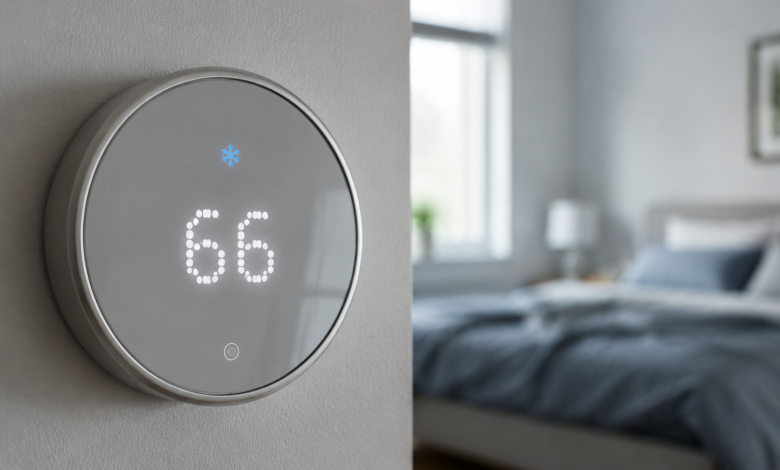
For those who can invest more: smart thermostats with sleep schedules let you drop the temperature automatically at bedtime and bring it back up toward morning, which mirrors the body’s natural cycle without you having to think about it. Cooling mattress pads that circulate chilled water have shown measurable improvements in sleep quality in small trials niche technology, but not fringe science.
If you share a bed with someone whose thermal preferences don’t match yours, dual-zone solutions exist separate blankets, adjustable mattress surfaces, or even simply acknowledging that the bedroom temperature should default to the cooler preference, since it’s easier for a person who runs cold to add a layer than for a person who runs hot to shed one.
The Quiet Variable You Keep Ignoring
Temperature sits in a strange category in conversations about sleep hygiene. It lacks the cultural visibility of screen time or caffeine, even though the research places it firmly alongside those factors in terms of impact. We’ve built entire industries around sleep weighted blankets, melatonin gummies, white noise machines and yet the one free variable that science returns to again and again is the temperature of the room you’re sleeping in.
Your body is not passive during sleep. It’s engaged in a carefully orchestrated biological process that depends, in part, on the thermal environment you provide it. Get that right, and everything else the depth of your sleep, the coherence of your dreams, the clarity you carry into the next morning tends to follow.