How to Choose the Perfect Jeans for Your Specific Body Shape
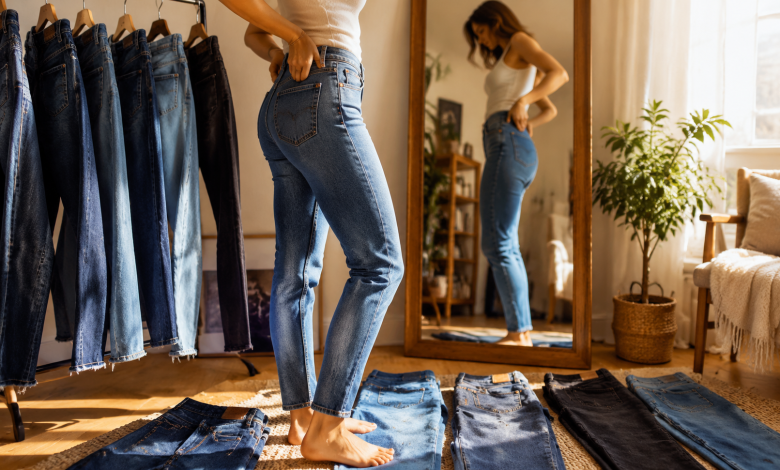
I spent $200 on a pair of raw selvedge denim last spring because a guy at the store told me they’d “mold to my body like a second skin.” Six weeks later, I looked like I was wearing a denim diaper. Expensive lesson. But it taught me something I wish I’d learned at nineteen: the perfect jeans have almost nothing to do with brand, wash, or trend cycle. They have everything to do with geometry.
Your geometry, specifically.
Why Most Jeans Advice Gets It Wrong
Here’s what bugs me about the standard “jeans for your body type” articles floating around. They sort people into neat little fruit categories apple, pear, hourglass and then assign one magic cut to each. As if your entire lower half can be summarized by a single noun from the produce aisle.
Bodies are stranger than that. More specific. You might carry weight in your thighs but have a flat backside. You might have long legs but a short rise that makes every mid-rise pair feel like it’s trying to cut you in half. The fruit system isn’t useless, but it’s a starting point, not an answer.
So I’m going to get more granular here.
The Real Starting Point: Measure Before You Shop
Before you even think about cuts or washes, grab a fabric measuring tape or a piece of string and a ruler, nobody’s judging and write down three numbers:
Your natural waist (smallest part of your torso, usually above the belly button).
Your hips at the widest point (stand with feet together, measure around the fullest part of your butt).
Your inseam (crotch to where you want the hem to hit).
That ratio between waist and hips? That’s the number that actually determines which jeans will look like they were made for you versus which ones will gap, pinch, or sag. I ignored this for years and kept buying jeans based on how they looked on the hanger. Rookie move.
Jeans for Your Body Shape: A Real Breakdown
If your hips are significantly wider than your waist
You already know the gap problem. The waistband fits your hips but leaves a canyon at the back when you sit down. A curvy fit or contoured waistband is your best friend here brands like Levi’s Curvy and Good American actually engineer the waist-to-hip ratio differently. A high rise also helps because there’s more fabric to accommodate that transition from narrow waist to wider hip.
But here’s the thing nobody tells you: a slight bootcut or straight leg will visually balance wider hips better than a skinny jean. I know skinnies feel more “modern,” but if balance is the goal, a little flare at the hem does more work than you’d expect.
If you carry weight through the midsection
Mid-rise is your danger zone. I’m serious. Mid-rise hits right at the softest part of the belly on most people, which creates that muffin-top effect that has nothing to do with your actual fitness level and everything to do with bad engineering.
Go high-rise. The waistband sits above the squishiest area and creates a smooth line. Look for structured denim with at least 2% elastane enough stretch to be comfortable, but enough rigidity to hold you in rather than cling to you. Dark washes with no whiskering through the front also help here, because distressing draws the eye exactly where you don’t want it.
If you have a longer torso and shorter legs
High-rise again but for a different reason. A longer rise eats into your visual leg length. You want jeans that sit at your natural waist and create the illusion that your legs start higher than they actually do. Pair with a cropped or tucked-in top and you’ve just “added” two inches to your legs without heels.
Avoidcuffing. Every fold at the ankle shortens you. A clean, unhemmed break or a slight crop that shows ankle bone works better.
If you’re tall and lean with narrow hips
You can get away with low-rise in a way most people can’t something to be grateful for, honestly. Wide-leg and boyfriend cuts add visual volume and keep you from looking like a pair of chopsticks wrapped in denim. But here’s my slightly controversial take: if you want to wear skinnies, skip the ones with too much stretch. A stiffer, more structured fabric on a narrow frame looks intentional and architectural. Too much lycra on a lean body just looks like leggings.
If you’re muscular through the thighs and glutes
Athletic fit exists for a reason, and it’s not a marketing gimmick the thigh-to-waist ratio on a standard straight cut is usually wrong for you. Brands like Barbell Apparel and the Levi’s Athletic Taper actually draft patterns with more room through the quad without making the waist enormous.
Stretch is non-negotiable here. You need at least 2-3% elastane or you’ll blow out the inner thigh within six months. Ask me how I know.
The One Thing That Matters More Than Cut
Fabric weight.
I genuinely believe fabric weight matters more than almost any other factor, and nobody talks about it. A 14-oz rigid denim holds its shape and smooths you out. A 9-oz stretch denim clings to every curve and bump which is great if you want that, but terrible if you’re trying to create clean lines.
Heavier denim = more structure = more forgiving silhouette. Lighter denim = more comfort = more revealing. Neither is wrong. But you should choose on purpose, not by accident.
Stop Trusting the Mirror in the Store
Those mirrors are often angled slightly back, which elongates your legs and slims your midsection. I’m not saying it’s a conspiracy, but okay, maybe I’m sort of saying that. My friend Elena, who managed a denim bar in Brooklyn for three years, told me they specifically chose mirrors that “flattered.” Her word.
Try this instead: take a photo in the fitting room. Straight on, phone at hip height. That’s what you actually look like. Unflattering lighting and all. If you still like the jeans in a phone photo taken under fluorescent lights, they’re the ones.
A Note on the “Perfect Jeans” Myth
Can I be honest? There’s no single perfect pair for your body shape. There’s a perfect pair for your body shape plus the specific outfit, plus the specific occasion, plus how bloated you are on a Tuesday versus a Saturday. I own six pairs of jeans and they all serve different functions. The idea that you’ll find The One and never need another pair is romantic but impractical.
What you can do is understand your proportions well enough to eliminate80% of wrong choices before you even enter a fitting room.
That alone saves you hours, hundreds of dollars, and the quiet despair of a denim diaper.
Where to Start Right Now
Measure yourself today. Write those three numbers on a sticky note. Next time you’re shopping online or in person compare those numbers against the brand’s size chart before you grab your “usual” size. Your usual size means nothing across brands. A28in one brand is a 30 in another and a 26 in a third.
And if a pair doesn’t feel right within thirty seconds of putting them on? They won’t break in to feel right. They’ll just break in to feel slightly less wrong. Life’s too short for slightly-less-wrong jeans. Walk away.