The Art of the Layered Garden: Maximize Every Inch of Soil
There’s a particular kind of satisfaction that comes from standing at the edge of a garden that looks, somehow, like it has always been there. Not planted so much as grown into itself canopy pressing upward, middle shrubs softening the edges, ground covers threading between everything like a living carpet. This is the layered garden. And for anyone who has felt the quiet frustration of a small yard or a narrow border that never quite delivers, it might be the most liberating design philosophy in horticulture.
The concept isn’t new. It’s borrowed, really, from the forest itself.
What the Forest Already Knows
Walk into any mature woodland and you’re walking through a system of layers so efficient it makes conventional gardening look almost wasteful. There’s the high canopy the tall trees claiming the light. Beneath them, the understory: smaller trees and large shrubs adapted to working with filtered sun. Lower still, the shrub layer, then the herbaceous layer of perennials and ferns. Below that, ground cover hugging the soil. And threading invisibly through everything, a root layer and a fungal network tying it all together.
What makes this structure remarkable isn’t beauty though beauty is certainly a result. It’s the sheer biological efficiency. Every photon of light gets intercepted at some level. Every inch of soil has something living in it. There is almost no waste.
When garden designers talk about layering, they’re essentially trying to replicate this efficiency in a domestic setting. The results can be dramatic. A 400-square-foot backyard, planted in thoughtful layers, can contain what would otherwise require twice the square footage in a conventional, single-plane arrangement.
Starting With the Canopy or Knowing When to Skip It
Not every garden needs a tree. That’s worth saying plainly, because a lot of layering guides assume a canopy as the starting point, and in a small urban yard, a full-sized tree isn’t a design choice it’s a commitment you’ll spend decades managing.
But the principle of a high anchor still applies. In small spaces, a single multi-stemmed serviceberry (Amelanchier) or a narrow columnar hornbeam can serve as the canopy equivalent. It creates vertical reference andcasts the dappled shade that makes mid-layer planting possible. In a courtyard setting, even a large structural wall trellis with a climbing rose or wisteria can function as the uppermost layer, providing that crucial sense of enclosure and scale.
The anchor layer does more than fill vertical space. It defines the microclimate for everything beneath it. This is the part that beginning gardeners tend to underestimate. Shade from a tree changes soil moisture, moderates temperature swings, and shifts which plants will thrive in the layer below. You’re not just choosing a tree you’re authoring the conditions for every other planting decision you make.
The Middle Distance: Where Most Gardens Go Wrong
If there’s a single layer that separates a good garden from an extraordinary one, it’s the mid-layer: the shrubs and larger perennials that occupy roughly the three-to-six-foot range. This is where most residential plantings go thin. A homeowner plants a foundation shrub here, an ornamental grass there, some roses along the fence. The plants don’t talk to each other. There’s no continuity, no sense that they belong to the same conversation.
Building a coherent mid-layer requires thinking about succession what looks good when. A well-sequenced shrub planting might begin in late February with witch hazel (Hamamelis), transition through forsythia, into lilac, into the long summer performance of spirea or hydrangea, and close with the fall berries of viburnum or beautyberry. That’s a single border carrying interest from late winter through November, with barely any overlap and almost no dead time.
The structural shrubs define the bones. Around and between them, mid-height perennials fill the gaps seasonally catmint spilling forward in June, agastache holding the back border through August, asters and sedums closing out October. The shrubs hold the layer through winter. The perennials provide the seasonal narrative.
Going Low: Ground Layer as Living Mulch
One of the most underused strategies in home gardening is treating the ground layer as an active design element rather than an afterthought. The instinct, especially among newer gardeners, is to mulch bare soil between plants. Mulch has its place, but it is inert. It compacts, it depletes, it invites weeds. Ground cover planting is a different proposition entirely.
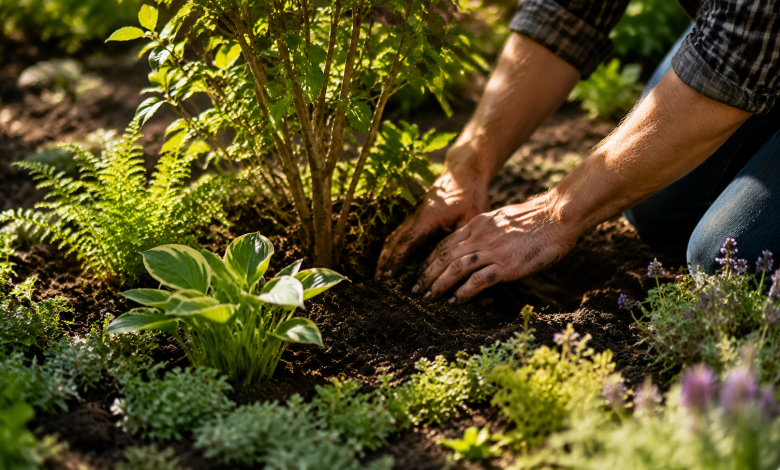
Plants like creeping thyme, sweet woodruff, wild ginger, or epimedium do something mulch never can: they compete. A dense mat of epimedium under a large shrub will out-compete most annual weeds, retain soil moisture, add organic matter as it drops leaves, and look handsome doing it. It’s labor that pays forward for years.
There’s also the functional matter of soil health. Bare soil loses structure. Roots from a continuous ground layer keep the soil open and oxygenated, feeding the microbial communities that the whole garden depends on. The layered garden doesn’t just look fuller it is functionally healthier at the soil level because every square foot has something growing in it.
Thinking in Vertical Time, Not Just Space
The spatial logic of layering is intuitive once you see it. Harder to internalize and ultimately more rewarding is the temporal dimension. A layered garden, properly designed, is never the same twice. It doesn’t peak in June and slump the rest of the year. It cycles.
This requires a kind of sequential thinking that doesn’t come naturally when you’re standing in a garden center surrounded by things in full bloom. It means buying the bare-lookingamsonia in May because you know it’ll be a yellow firework in October. It means planting spring bulbs under a deciduous shrub layer, knowing they’ll complete their cycle and disappear before the shrubs leaf out and block their light. It means understanding that the brown stalks of last year’s grasses are, in February, the most beautiful thing in the bed and that cutting them down early is a mistake.
A layered garden asks you to hold the whole year in your mind at once. That’s a discipline, but it’s also a practice that changes how you experience time outdoors. You stop moving through the garden and start reading it.
Small Spaces, Larger Possibilities
The cruel irony of conventional garden advice is that it tends to scale down poorly. Many classic border designs assume space a fifteen-foot-deep herbaceous border, an orchard, a kitchen garden in four raised beds. Strip those designs down to a city backyard and what’s left is either too sparse or too crowded.
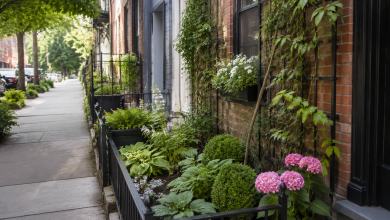
Layered planting scales down beautifully. A strip of ground eight feet wide and twenty feet long can hold a small multi-stemmed tree, two or three mid-layer shrubs, a sequence of perennials, and a ground cover below and feel not cramped but lush. The vertical dimension does the work that horizontal space used to do.
Container gardening can extend the logic even further. A large pot planted with a dwarf conifer, underplanted with trailing sedum and a single bulb layer of grape hyacinths, is a micro-layered garden. The principles don’t require acreage. They require only a shift in how you look at the vertical column of space above each square foot of soil.
The Return on Patient Investment
A layered garden takes a few years to settle into itself. The first season, it may look slightly underdone the shrubs haven’t spread, the ground layer is patchy, the tree looks too young to be a tree. Gardeners who expect instant results sometimes bail in year two, just before the planting starts to become something.
Year three or four is usually when it happens. The shrubs reach into each other. The ground cover closes the gaps. The tree casts real shade. The garden acquires a density and a logic that makes the initial plan feel prophetic rather than provisional.
That transformation is what this style of planting is ultimately about. Not the cleverness of the technique. Not even the efficiency of space use, though that matters. It’s the point at which a garden stops being a collection of plants and becomes a place somewhere the eye settles, where the light falls in ways that feel considered, where the soil is doing something alive beneath every step you take.