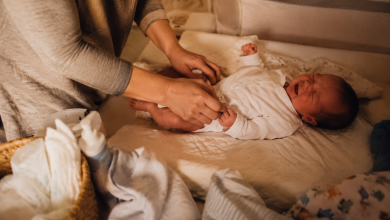
Flying with a Newborn: Everything You Need to Know for a Smooth Flight
The first time you fly with a newborn, nothing quite prepares you for it. You’ve packed and repacked the diaper bag three times. You’ve read the airline’s policy on car seats. You’ve mentally rehearsed the boarding process while feeding your baby at 2 a.m. And yet, standing at the gate with an infant strapped to your chest and a stroller to check, you realize that all the preparation in the world still leaves room for the unexpected. That’s not a failure of planning it’s just what traveling with a newborn is.
The good news is that flying with a very young baby is often easier than flying with a toddler. Newborns sleep. A lot. They don’t run down the jetway or demand to watch the same cartoon seventeen times. What they need is feeding, warmth, comfort, and a parent who isn’t completely unraveled by anxiety. The logistics are manageable. The mindset is everything.
When Can You Actually Fly with a Newborn?
Most pediatricians recommend waiting until a baby is at least two weeks old before flying, and many prefer four to six weeks. This isn’t arbitrary caution newborns have immature immune systems, and airports are genuinely high-traffic environments filled with recirculated air and surfaces touched by thousands of people daily. The pressurized cabin itself isn’t dangerous, but the exposure risk is real.
Airlines have their own minimums. Most domestic carriers in the U.S. allow infants as young as two days old, though some require a doctor’s note for babies under a certain age. International carriers can be more restrictive. It’s worth calling the airline directly rather than relying solely on what’s written online, because gate agents sometimes enforce policies differently than what the website describes.
If your baby was premature or has any respiratory or cardiac concerns, this decision needs to come from your pediatrician, not from an airline policy page.
Booking Smart: The Details That Actually Matter
Lap infant or paid seat that’s the first decision. In the U.S., children under two can fly without a purchased seat, riding as a “lap infant” for free on domestic flights (international flights often charge10% of the adult fare). It sounds like an obvious choice, but the FAA and the American Academy of Pediatrics both recommend securing infants in an approved car seat for the safest travel. Turbulence is unpredictable, and holding a baby through a sudden drop is harder than it sounds.
If you do opt for a lap infant, choose an aisle seat. You’ll need the maneuverability for feeding, for walking the baby when they fuss, for making a fast exit to the bathroom. Window seats feelcozy in theory but become traps when you’re trying to navigate a narrow aisle with a squirming infant.
Book early morning or red-eye flights when possible. Planes are less full, the airport is calmer, and your baby’s sleep schedule may actually work in your favor. Some parents swear by timing the flight around feeding so the baby is nursing or taking a bottle during takeoff the swallowing motion helps equalize ear pressure, which is one of the main sources of infant discomfort during ascent and descent.
What to Pack (And What You Think You Need But Don’t)
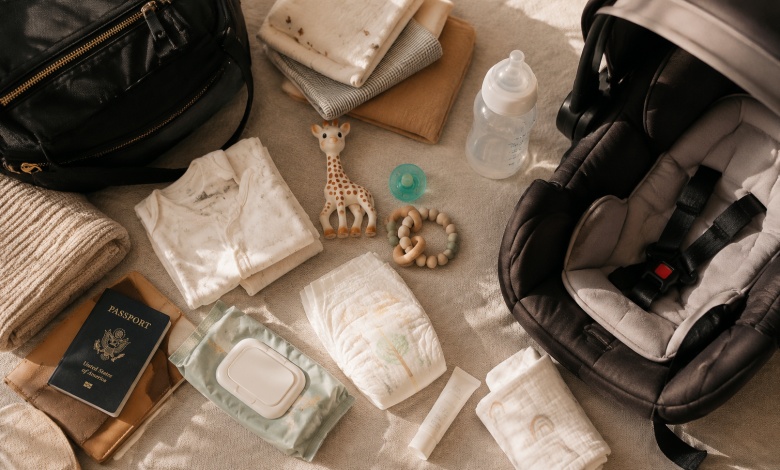
The diaper bag is where most first-time traveling parents overpack. A long-haul flight with a newborn does not require seven outfit changes. Two extras is the real number one for a blowout, one because the first change happened at gate B12and the flight got delayed two hours.
What you do need, without exception: enough diapers for the flight plus a buffer of four or five (airport diaper changes happen), a changing pad because the fold-down tray in the lavatory is smaller than you remember, and a blanket for warmth since cabins run cold and babies lose heat faster than adults.
If you’re formula feeding, TSA allows formula, breast milk, and juice for infants in quantities exceeding the standard 3.4-ounce liquid rule. You don’t need to apologize for the extra bottles. Pre-measured formula in those little single-serve containers is genuinely one of the most useful inventions for traveling parents.
A baby carrier or wrap earns its weight in gold at the airport. It keeps your hands free for documents, bags, and the moment you have to take your shoes off at security while also managing a stroller, a car seat, and a carry-on. Most security lanes are accommodating about allowing you to keep the baby in the carrier through the scanner ask the TSA officer when you approach.
On the Plane: Managing the Reality
Newborns cry on planes. So do adults, emotionally, though they do it more quietly in the window seat. The difference is that parents of newborns feel a crushing social pressure to silence something that is, fundamentally, a baby doing what babies do.
Let that pressure go, or at least soften it. The vast majority of fellow passengers are reasonable people who understand that infants exist. A quick, genuine smile and a “we’ll do our best” acknowledgment to the people seated nearby goes further than you’d think toward creating goodwill.
For the crying itself: identify the cause before cycling through every soothing technique. Hunger is the most common trigger, followed by ear pressure, temperature discomfort, and overstimulation. A plane is a loud, bright, strange environment for a creature who, days ago, was experiencing none of it. Skin-to-skin contact, a pacifier, and motion swaying gently in your seat or walking the aisle address most of the acute distress.
If your baby does fall asleep, resist the urge to transfer them to a flat surface. In a car seat, in a carrier, on your chest these are the positions where newborns sleep safely during flight. The overhead luggage bin is not an option, despite the occasional joke.
The Security Line and Boarding Process
Gate-check your stroller. You’ll get it back at the jet bridge, and it will save your life at every airport transition. Travel car seats can also be gate-checked, though if you’ve purchased a seat for your baby, you’ll want to carry it on and install it yourself.
TSA PreCheck is worth every dollar if you travel even occasionally, but it’s worth even more now. Standard security lines with an infant require collapsing the stroller, pulling the car seat off it, removing the baby from the carrier it’s a production. PreCheck moves faster and involves less disassembly.
Board early. Take the airline up on the pre-boarding offer. Use those extra ten minutes to get settled, install the car seat if you have one, store your bag, and breathe before the rest of the plane fills in around you.
What Nobody Tells You About Arrival
You land. The baby is either peacefully asleep or furious. Either way, you made it. That part is worth acknowledging, not as a dramatic accomplishment, but as a simple confirmation that the thing you were dreading was survivable maybe even fine.
Baggage claim with an infant has its own physics. You’ve got to reassemble the stroller, retrieve the gate-checked car seat, find your checked bags, and do all of it while the baby decides this is an excellent moment to need feeding. If you’re traveling with a partner, divide the labor explicitly before you land. If you’re solo, let the bags go around the carousel twice. They will still be there.
The muscle memory builds surprisingly fast. The second trip is noticeably easier than the first. By the third or fourth flight, you’ll find yourself giving quiet knowing nods to other parents standing at the gate, carrying that same overwhelmed and determined expression you wore the first time.
Flying with a newborn isn’t the most comfortable travel experience of your life. But it is, without question, one of the most clarifying a reminder that competence and love are both things you build in motion.