Ten Minutes to a Tidy Nightstand: A Nightly Routine
The Nightstand Knows Everything
There’s something quietly revealing about a nightstand. It’s the last thing you reach for before sleep and the first thing you see when you wake up. Over time, it accumulates the residue of your daily life a half-read book, a phone charger coiled like a snake, three lip balms you forgot you owned, a receipt from two weeks ago, a glass of water that may or may not be from yesterday. The nightstand doesn’t judge. It just holds everything you couldn’t put away.
That accumulation isn’t laziness. It’s physics. The nightstand exists in a liminal zone close enough to the bed that you’ll toss things onto it without thinking, but far enough from the rest of the room that tidying it feels like a separate project you’ll get to later. Later, of course, never comes. And so the pile grows.
What most people don’t realize is that clearing this small surface before bed isn’t really about cleanliness. It’s about what that clearing does to your brain.
Why Ten Minutes Is the Right Number
There’s a reason this routine isn’t called a thirty-minute deep clean or an hour-long bedroom reset. Ten minutes is long enough to be meaningful and short enough to feel non-negotiable. It fits inside the gap between brushing your teeth and lying down. It doesn’t require motivation just habit.
Sleep researchers have long noted that the environment you fall asleep in sends signals to your nervous system. Visual clutter, even peripheral clutter you’re not consciously registering, keeps your threat-detection system mildly activated. Your brain sees disorder and interprets it as unfinished business. A cluttered nightstand is, in the language of your nervous system, a problem unsolved. And your brain does not love going to sleep with unsolved problems nearby.
Ten minutes is also the threshold at which a habit stops feeling like a task and starts feeling like a ritual. The word ritual matters here. Tasks are things you complete. Rituals are things you inhabit. When you approach the nightstand with ten minutes and a clear intention, you’re not just tidying you’re signaling to yourself that the day is done.
What Actually Lives on a Nightstand (And What Shouldn’t)
Let’s be honest about the categories. Most nightstand clutter falls into four types: things that belong there, things that wandered there from elsewhere, things you meant to deal with and didn’t, and things you genuinely don’t recognize.
Things that belong on a nightstand are simpler than you’d think. A lamp. Whatever you’re currently reading. Your phone or alarm clock. A glass of water. Maybe a small notepad if you’re the kind of person who thinks of things at2 a.m. That’s essentially it. Everything else is a visitor that overstayed its welcome.
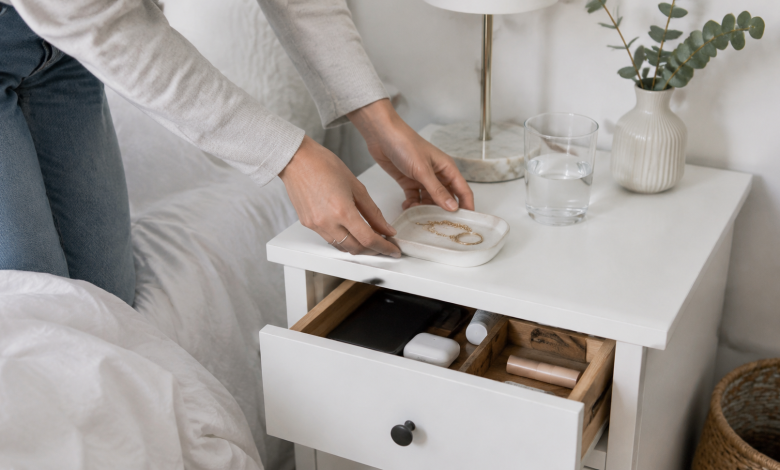
The wanderers are the most common offenders hair ties, coins, earrings, a pen that ended up there after you signed something in bed. These items have homes elsewhere in the room or the house. They just took a detour. During your ten-minute routine, these go back where they belong, not shoved into a drawer to create a different kind of chaos.
The undealt-with pile the receipt, the unopened mail, the note you scrawled to yourself is where people hesitate. There’s often a vague guilt around these items. They represent things undone. The move here isn’t to deal with them at10 p.m. It’s to relocate them to wherever you handle such things: a desk, an inbox tray, a folder. Out of the bedroom. The bedroom is not the place for administrative anxiety.
The Ten-Minute Structure, Without the Rigidity
Think of it less as a checklist and more as a sequence that becomes automatic. You start with removal anything that clearly doesn’t belong on the nightstand leaves first. This takes about two minutes and is the most satisfying part because the surface transformation is immediate and visible.
Then comes the wipe-down. A dry cloth or a slightly damp one across the surface takes thirty seconds and does something disproportionately powerful to how the whole space looks. Dust and ring stains from glasses make a clean nightstand look messy even when nothing is on it. This small step changes the visual quality of the space entirely.
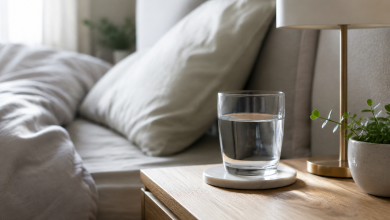
What goes back is intentional. The lamp stays. The book goes back, but only if you’re actively reading it if you finished it three weeks ago, it belongs on a bookshelf. The water glass gets refreshed with clean water for the night. The phone goes on its charger in a designated spot so you’re not reaching around in the dark.
The last two minutes are the slow part. This is where you check in with how the space feels rather than how it looks. Is the lamp positioned so it’s easy to reach? Is the book spine-up or face-down so you don’t lose your page? Is there anything you want within reach for the night lip balm, earbuds, your journal? Small adjustments. The kind you make not because a cleaning guide told you to, but because you’re setting yourself up for the next twelve hours.
The Morning You’re Preparing For
Here’s the part of this routine that gets underappreciated: you’re not just tidying for tonight. You’re tidying for tomorrow morning.
There’s a version of yourself who wakes up at 6:30 a.m. slightly groggy, reaches for the phone, knocks over a pile of things, can’t find the charger, and starts the day already behind. There’s another version who opens their eyes to a clear surface, reaches for their phone in the exact spot where they left it, and has a quiet moment before the day begins. The ten minutes you spend tonight is, in a real sense, a gift you’re giving to your morning self.
This is the logic that makes the routine stick in a way that pure tidiness motivation doesn’t. Tidiness for its own sake is hard to sustain. Tidiness as an act of care toward your future self is something different. It has a narrative. It connects tonight’s action to tomorrow’s experience in a direct and personal way.
Making It a Real Habit
The graveyard of good intentions is full of routines that lasted two weeks. The difference between a routine that sticks and one that doesn’t usually comes down to the trigger the specific cue that initiates the behavior automatically.
Stack the nightstand tidy onto something you already do without thinking. After you brush your teeth. After you plug in your phone. After you turn off the main bedroom light. The trigger doesn’t matter as much as its consistency. Choose one moment that already happens every night without fail and let the ten-minute tidy follow it.
It also helps to keep your clearing supplies in the room. If the cloth you need for wiping is in a cabinet down the hall, you won’t use it. One small cloth in the top drawer of the nightstand itself removes the friction entirely. Small friction is the enemy of any habit. Eliminate it wherever you find it.
Some people resist routine on principle they find it constraining, too regimented, at odds with their self-image as someone spontaneous. But a nightstand routine isn’t the kind of structure that limits you. It’s the kind that quietly makes everything else easier. It’s ten minutes, at the end of the day, when the day is already over and you have nothing left to do but rest. That’s not discipline. That’s just a small decision that pays for itself every morning you wake up to a clear surface and a calm beginning.