Looking for Peace? Try These Remote Villages Frozen in Time
There’s a particular kind of exhaustion that sleep can’t fix. You wake up already bracing for the day notifications, deadlines, the low hum of ambient noise that modern life has normalized into background wallpaper. At some point, the question stops being “how do I rest better?” and becomes something harder to answer: where do I actually go to feel human again?
The answer, for a growing number of people, isn’t a beach resort or a wellness spa. It’s a village. A small, tucked-away place where the rhythm of life moves according to seasons and sunlight rather than algorithms and news cycles. These aren’t tourist destinations engineered to look quaint. They’re real places with real histories communities that, through geography, tradition, or sheer stubbornness, have managed to exist mostly outside the machinery of contemporary life.
What they offer isn’t entertainment. It’s something quieter, and in some ways more radical: a world that doesn’t demand your constant attention.
Why “Frozen in Time” Isn’t Just a Travel Cliché
The phrase gets used so often it almost means nothing anymore. But spend a few days in a village that genuinely moves at a different pace, and you start to understand what it’s pointing at.
In Hallstatt, Austria an Alpine village of roughly 800 people perched between a mountain and a lake the infrastructure of daily life looks almost exactly as it did centuries ago. Salt mining brought prosperity here before recorded history, and the village’s narrow lanes and wooden lakefront houses haven’t expanded to accommodate mass development because there’s simply nowhere to expand to. The mountain sits on one side. The Hallstätter See on the other. Constraint, in this case, became preservation.
What strikes visitors isn’t the architecture so much as the absence of urgency. People walk to the bakery. Boats cross the lake on a slow schedule. There’s a local cemetery so old and so spatially limited that graves are eventually cleared and the bones moved to a charnel house a practice that sounds grim until you realize it reflects something genuine about how this community relates to time and continuity. The past isn’t erased here. It’s just quietly accommodated.
That feeling of being somewhere that has made its peace with limits is precisely what so many overextended people are searching for.
The Villages That Stayed Behind on Purpose
Not every preserved village is preserved by accident. Some communities have made deliberate choices to resist the forces that homogenize everywhere else.
Shirakawa-go, in the Japanese Alps, is famous for its gassho-zukuri farmhouses steep thatched roofs built to shed heavy snow, some of them over 250 years old. The village was designated a UNESCO World Heritage Site in 1995, but the residents were already invested in preservation long before that designation arrived. Farming, silk production, and communal labor practices called yui where neighbors work each other’s land reciprocally had sustained this place for generations. What visitors see isn’t a museum. Families still live in those farmhouses. Some run small guesthouses out of them.
Staying overnight in one changes the experience entirely. The wooden beams overhead, the faint smell of old thatch, the sound of nothing but wind and the occasional crow it’s disorienting in the best way. You realize how much of your usual environment is synthetic, designed to stimulate rather than to calm.
Then there’s Monsanto in Portugal, a mountain village where medieval granite boulders are literally incorporated into the buildings houses are built between and underneath massive rocks, with the stone serving as walls or evenceilings. The village sits atop a hill in the Beira Baixa region and was once declared the “most Portuguese village in Portugal.” That title was partly a tourism stunt in the 1930s, but the place earned it honestly. Monsanto has a gravitational peculiarity: it looks like it grew there, like it emerged from the landscape rather than being imposed on it. Walking through it, you feel like you’ve stumbled into something that predates the concept of urban planning entirely.
These places share a quality that’s hard to name precisely. It’s not nostalgia, exactly, because nostalgia implies longing for something you’ve lost. It’s more like perspective the sense that the present moment isn’t the only possible way to organize a life.
The Paradox of Going Somewhere to Disconnect
Here’s the honest tension: the very act of traveling to these places is embedded in the modern systems they seem to exist apart from. You find them on Instagram. You book accommodations through an app. You fly or drive to reach them, burning fuel, generating carbon, arriving with a smartphone that you probably don’t fully put away.
And as these villages attract more attention, they face the same pressures that have altered so many others. Hallstatt now draws millions of visitors annually, leading Austrian authorities to periodically consider limiting tourist numbers. Shirakawa-go gets so crowded during winter illumination events that the atmosphere of quiet it’s supposed to offer nearly disappears beneath tour buses and camera lenses. The South Korean conglomerate Samsung reportedly built a full-scale replica of Hallstatt in Guangdong province testament to how badly people want what these places represent, and how thoroughly that desire can consume the thing itself.
This isn’t a reason to avoid them. It’s a reason to visit differently. Go in the shoulder season, when the crowds thin and the village returns to something closer to its actual self. Stay longer than a day trip allows. Eat where the locals eat, if those places still exist. Walk without a destination. The peace these villages offer isn’t a backdrop for photographs it’s something that emerges slowly, in the gaps between doing things.
Lesser-Known Places Worth the Search
The most famous preserved villages are worth seeing, but they’re no longer secrets. A different kind of traveler is increasingly looking further off the trail.
Civita di Bagnoregio in central Italy sits on a crumbling volcanic plateau that can only be reached by a narrow pedestrian bridge. The surrounding tufa rock has eroded so severely over centuries that the village is literally disappearing sinking, piece by piece, into the valley below. It’s been called “the dying city.” At lastcount, fewer than ten people live there year-round. The fragility of the place gives it an almost unbearable poignancy. You walk through streets built for a community that no longer exists at full capacity, past churches and wells and stone archways that absorbed hundreds of years of ordinary life. There’s a lesson in it, though not a tidy one.
Further east, the cave village of Kandovan in northwestern Iran is genuinely unlike anything in the Western travel imagination. Residents live in dwellings carved into volcanic rock formations that look like something from a fantasy novel conical, pockmarked, ancient. Some of these homes have been continuously inhabited for over 700 years. The village is still active; people farm, sell honey and handicrafts, receive visitors. The rock keeps the interior temperature stable year-round, a natural insulation that makes the caves surprisingly comfortable. Standing in one, you understand that the impulse to find a quiet, protected place to live is not a modern luxury. It’s one of the oldest human drives there is.
What You’re Really Looking For
Peace is an overloaded word. It gets attached to spa weekends and meditation apps and every product that wants to position itself as an antidote to the modern condition. But when people say they’re looking for peace in a place like this, what they usually mean is something more specific.
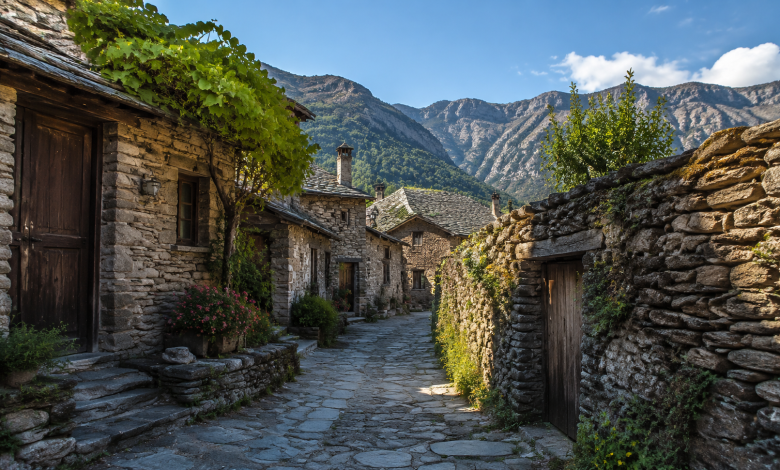
They mean the sensation of time slowing down. They mean the absence of optimization places that exist for their own sake rather than for maximum efficiency or engagement. They mean the reminder that most of human history was lived without the particular anxieties of right now, and that somewhere in the distance between your usual life and one of these stone-paved hillside villages, something releases.
That release doesn’t last forever. You come back. The notifications return. But the recalibration matters. It shifts your baseline, even slightly, even temporarily. And sometimes temporary is enough to remind you what you were looking for in the first place.