Lighting Magic: How to Brighten Up a Dark, Cozy Courtyard
There’s a particular kind of sadness that settles into a dark courtyard at dusk not the dramatic, cinematic kind, but the quiet, low-grade disappointment of a space that never quite fulfills its potential. You step outside, the air is warm, the dimensions are intimate, and yet something about the dimness makes you want to retreat indoors. The problem isn’t the courtyard itself. It’s the light.
Or rather, the absence of it.
Courtyards have been coveted spaces for centuries from the sun-drenched riads of Marrakech to the lantern-hung hutong alleys of old Beijing. What made those spaces feel alive wasn’t square footage. It was the interplay between shadow and glow, the way light moved across stone walls and pooled in corners. That magic is entirely replicable in a modern backyard courtyard, and it doesn’t require a landscape architect or a massive budget. It requires understanding what light actually does to a space, and then working with it deliberately.
Start with the Walls, Not the Floor
Most people instinctively look down when they think about outdoor lighting solar path lights, deck fixtures, ground-level stakes. That instinct is almost always wrong for a courtyard.
In an enclosed or semi-enclosed outdoor space, the walls are your greatest asset. They act as reflective surfaces, amplifiers, canvases. A single well-aimed uplight mounted at the base of a textured stone or brick wall can throw warm light upward and outward, effectively doubling its reach through reflection. The wall doesn’t just receive the light it redistributes it.
The principle here is borrowed from interior design: uplighting creates the illusion of height and openness, which is exactly what acozy (read: compact) courtyard needs. You’re not just adding brightness. You’re visually expanding the space. Place two or three low-voltage uplights at the base of your perimeter walls, aimed at roughly a 30-degree angle, and watch the entire courtyard lift.
This is especially effective if your walls have texture old brick, stacked stone, exposed aggregate. Smooth painted walls will diffuse light more evenly, which reads as softer and cleaner. Rough surfaces create micro-shadows and highlight, giving the wall a warmth and depth it completely lacks in daylight.
The Layering Logic
Professional lighting designers talk about layering the way chefs talk about seasoning not one big addition, but multiple subtle contributions that build into something complex and satisfying.
For a courtyard, that means working across three distinct zones: ambient, accent, and task.
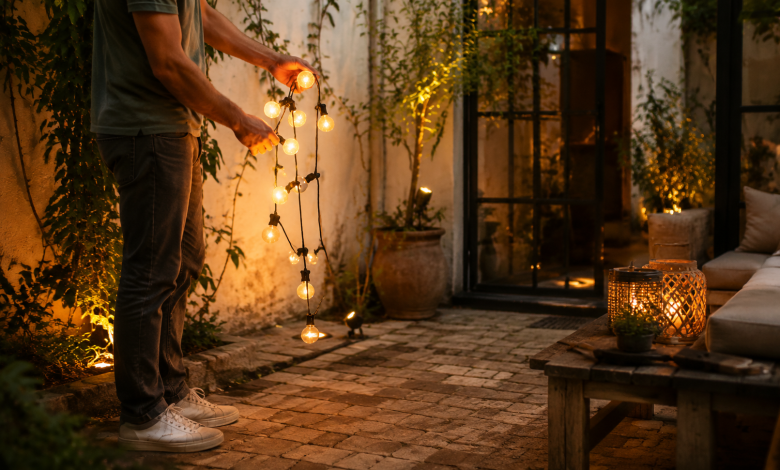
Ambient is your base layer the overall glow that prevents the space from feeling like a cave. String lights are the classic choice here, and they remain popular for good reason. Run them overhead in a loose grid or catenary pattern between anchor points on your walls, and you immediately establish a ceiling of warm light. The key is bulb color temperature: stay between2200K and 2700K. Anything cooler starts to feel clinical and sterile, which is the last thing you want in an intimate courtyard.
Accent lighting is where personality enters. This is the spotlight on a climbing vine, the small fixture that grazes across an outdoor artwork or a particularly beautiful planter. Accent lights draw the eye and create focal points without them, ambient light tends to flatten everything into a single undifferentiated glow. Think of accent lighting as punctuation. It gives the space rhythm.
Task lighting is the practical layer: the sconce beside the door, the fixture above an outdoor dining table, the light that actually lets you see what you’re eating or read a book comfortably. It’s the least romantic element, but skipping it entirely creates a courtyard that looks beautiful in photos and frustrates people in reality.
The Overlooked Power of Candlelight and Fire
Here’s something that no amount of clever electrical work can fully replicate: the movement of a real flame.
Candles, lanterns, and small fire features don’t just add light they add life. A flame flickers. It breathes. It responds to the same breeze that moves through your hair and rustles the leaves of whatever plant you’ve tucked into the corner. That responsiveness is something deeply human, something we’re wired to find comforting and mesmerizing going back to the earliest campfires.
Even in a courtyard that’s already well-lit with string lights and uplights, a cluster of candle lanterns on the table or a small tabletop fire bowl introduces an element of warmth that electric light can’t touch. It changes the atmosphere rather than just the brightness level.
Outdoor lanterns the kind designed to hold pillar candles or LED flame-effect bulbs work particularly well in courtyards because their enclosed design allows you to hang or place them in spots where open flames might be impractical. Grouping three lanterns of varying heights on a corner surface creates a focal point that is both decorative and functional. It also anchors that corner of the courtyard during the day, when you need visual interest even without illumination.
Plants as Light Collaborators
This one surprises people: the right plants can meaningfully improve how light behaves in your courtyard.
Pale-leafed plants silver-leafed artemisia, white-variegated hostas, light green ferns act as natural light gatherers. They catch and reflect whatever ambient light exists, staying visible and soft even as evening deepens. Place them near your light sources and they almost seem to glow from within.
Translucent leaves work even better when backlit. Position a small uplight behind a large-leafed plant like a banana or a tropical philodendron, and the leaves become luminous panels jade green, veined, and otherworldly. It’s one of the most striking effects you can achieve in a courtyard, and it costs almost nothing beyond the fixture itself.
Mirrored and reflective surfaces follow the same logic. A small water feature even a simple glazed bowl of still water will capture overhead light and scatter it in quiet, moving patterns across adjacent surfaces. Moroccan-style mosaic tiles and polished metallic planters do something similar. You’re essentially building a network of secondary light sources out of objects that also serve a completely different purpose.
The Dimmer Is Not Optional
If there is one piece of practical advice that rises above all the aesthetics, it’s this: put everything on a dimmer.
Outdoor lighting that cannot be adjusted is outdoor lighting that will frequently feel wrong. On a cool September evening with friends around the table, you want it brighter. On a slow Tuesday night reading alone, you want it barely there just enough to see the page and feel the space around you. Rigid fixed-output lights make it impossible to adapt the courtyard’s mood to the moment.
Smart outdoor lighting systems Philips Hue Outdoor, LIFX, and similar products now make it genuinely easy to control color temperature and brightness through a phone or voice assistant. Some allow you to save “scenes” so you can shift from dinner-party bright to late-night ambient with a single tap. That kind of control isn’t a luxury feature anymore. It’s the difference between a courtyard that serves one version of itself and one that can be whatever the evening calls for.
Darkness as a Design Element
There’s a counterintuitive truth that the best lighting designers hold onto: not everything should be lit.
The corners of a courtyard that remain in shadow don’t represent failure. They create contrast and contrast is what makes the lit areas feel warm rather than merely bright. A courtyard flooded uniformly with light becomes flat and exhausting, like being in a parking structure. The shadows are what give the lit zones their depth and drama.
This is the underlying philosophy of Japanese garden lighting, where single fixtures are placed with extreme intentionality, and vast areas are left deliberately dark. The eye is guided rather than bombarded. The darkness is trusted.
In practice, this means resisting the urge to add one more light when you think the courtyard looks too dim. Step back. Sit in it for a while. Let your eyes adjust. Often what felt like insufficient light is actually a perfectly calibrated balance of glow and shadow the kind of balance that photographs beautifully and feels even better in person.
A dark courtyard, thoughtfully lit, stops being a problem to solve. It becomes exactly the kind of place you don’t want to leave.