3 Materials That Instantly Elevate a Simple Room
There’s a particular kind of frustration that comes from standing in a room you’ve lived in for years and feeling like something is still missing. The furniture is fine. The layout makes sense. The colors don’t clash. And yet the space feels flat like a sentence that’s technically correct but somehow doesn’t land. Most people respond by buying more things. Another throw pillow. A new rug. Maybe a plant. But the problem was never quantity. It was material.
What a room is made of matters more than almost any other design decision, and yet it’s the one most often treated as an afterthought. We obsess over paint swatches and furniture arrangements while completely ignoring the tactile and visual weight of the surfaces we’re surrounding ourselves with. The truth is that certain materials carry an inherent richness a quality that reads as considered, intentional, and alive that no amount of accessorizing can replicate. And there are three in particular that do this work faster than anything else.
Linen: The Fabric That Makes a Room Feel Lived In (In the Best Way)
Linen has been around for thousands of years, which is part of why it works so well. It doesn’t try to impress you. It just settles in, softens over time, and makes everything around it feel a little more human.
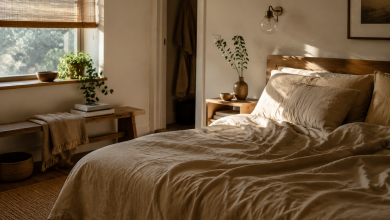
The specific quality linen brings to a room is something designers often call “relaxed elegance” a phrase that sounds like marketing speak until you actually experience it. A linen curtain hanging in late afternoon light does something to a room that a polyester curtain simply cannot. It diffuses the light instead of blocking it, creates gentle texture where there was none, and signals to anyone entering that the space was put together with a certain amount of care and restraint.
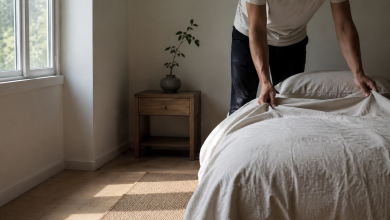
Restraint is the key word here. Linen is not a maximalist material. It doesn’t shout. Its neutrality the way it exists in that soft zone between cream, gray, and warm white makes it compatible with almost any existing palette. A sofa reupholstered in natural linen can reset the entire visual temperature of a living room. Linen throw covers on mismatched cushions unify them without making the room feel stiff or staged. Even a simple linen tablecloth can shift a dining area from purely functional to something that feels worth lingering in.
There’s also a sensory dimension that photographs don’t capture. Linen has a slight roughness that softens with washing, and that physical quality the sense that a material is aging well rather than degrading is something people register on an unconscious level. A room that contains linen tends to feel like it belongs to someone rather than being assembled from a catalog.
Unlacquered Brass: The Metal That Actually Gets Better With Age
Brass went through a difficult period. For most of the 1990s and2000s, it was synonymous with dated bathroom fixtures and hotel lobbies that hadn’t been updated since1987. The industry pivoted hard to chrome and brushed nickel, and brass mostly disappeared from serious design conversations.
Then something shifted. Designers started reaching for unlacquered brass specifically not the shiny,coated version that ages poorly and looks cheap when it chips, but the raw, living finish that patinas naturally over time. The difference is not cosmetic. It’s philosophical.
Lacquered brass pretends to be permanent. It resists change, and when change comes anyway as it always does the result looks like failure. Unlacquered brass accepts change as part of its nature. It develops darker tones in the areas touched most often, lighter areas where it catches the light. No two pieces age identically, which means that over time, your hardware, your light fixtures, your cabinet pulls develop a character that is entirely specific to your home and how you live in it.
In practical terms, introducing unlacquered brass into a simple room creates immediate contrast and warmth without requiring a full renovation. A pair of brass wall sconces in a bedroom that previously had only a ceiling fixture does two things simultaneously: it brings the light source down to human scale, and it introduces a warm metallic note that wood tones and soft textiles respond to immediately. Brass plays particularly well against matte plaster walls, raw wood surfaces, and dark grout lines combinations that feel current without feeling trend-dependent.
The patina question is the one people hesitate over most. The idea of a material that will change on its own feels like a loss of control. But that’s exactly the point. Rooms that feel alive tend to contain materials that are actually, subtly, alive. Brass that has been touched and used and exposed to air for five years tells a story about habitation that no showroom finish ever could.
Raw Wood: When the Grain Becomes the Design
“Natural wood” is a phrase so overused in interior design that it’s nearly meaningless. Everything from cheap MDF with a printed veneer to genuinely beautiful solid timber gets sold under that banner. So it’s worth being specific: what transforms a room is not wood in the generic sense, but raw, minimally processed wood where the grain, knots, and natural variation are the point rather than imperfections to be hidden.
This distinction matters enormously in practice. A smooth, heavily lacquered wood surface reads as furniture. A live-edge oak slab reads as sculpture. The difference is not just visual it’s about whether the material is being itself or pretending to be something else.
Raw wood in a simple room introduces a kind of organic complexity that manufactured surfaces cannot fake. A plank wall with visible grain and natural color variation becomes an entire background that shifts with the light throughout the day. A dining table in unfinished walnut, sealed only lightly with an oil finish, brings warmth and unpredictability into a space that might otherwise feel controlled to the point of coldness. Even a smaller application a raw wood shelf, an unfinished beam, a slab used as a windowsill can serve as an anchor point that the rest of the room organizes around.
What raw wood provides, at a deeper level, is evidence of time. There’s a reason people pay significantly more for reclaimed timber than for new lumber of comparable quality. The former carries a visible history old nail holes, weathered surfaces, grain worn smooth by use. In a new build or a recently renovated apartment, that sense of accumulated time is precisely what’s missing, and it’s very hard to manufacture. Raw wood is one of the few shortcuts that doesn’t feel like one.
There’s also a thermal quality worth noting. Spaces lined with stone or concrete or glass tend to feel acoustically harsh and physically cold in a way that affects how long people want to stay in them. Raw wood absorbs sound gently, reads as warm to the eye even when the room temperature is neutral, and creates a sensory environment that most people find genuinely easier to relax in. This isn’t sentimentality it’s a material property that designers and architects account for deliberately.
Why Material Choice Is Actually a Values Question
Taken individually, each of these three materials elevates a room for specific reasons. Together, they point toward a broader principle that rarely gets discussed in practical design writing: material choice is a form of decision-making about what you want your space to value.
Rooms furnished primarily in synthetic, maintenance-free, visually consistent materials send a particular message they prioritize convenience and appearance over experience and longevity. There’s nothing inherently wrong with that. But rooms that include linen, unlacquered brass, and raw wood make a different kind of commitment. They accept that things will change, that surfaces will develop character, that the space will look different in ten years than it does today and that this is a feature rather than a flaw.
That orientation is, in the end, what separates rooms that feel designed from rooms that feel inhabited. Anyone can buy furniture that looks good in a photograph. The harder and more interesting project is building a space that deepens over time, where every surface and material becomes more specific to you the longer you live with it. Linen, brass, and raw wood don’t just make a room look better. They make it easier for a room to become yours.