
Why I Regret Buying a Massive Headboard
The Room Looked Perfect in My Head
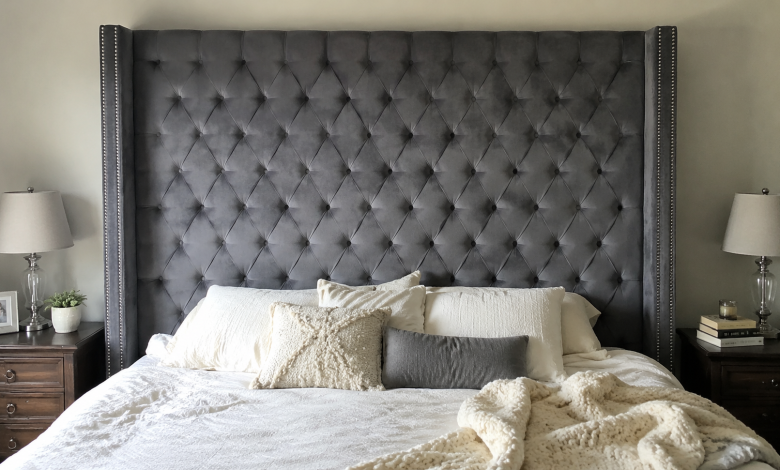
I had spent three weeks on Pinterest before I finally pulled the trigger. A king-sized upholstered headboard, nearly six feet tall, tufted in a deep slate-gray velvet. In every mood board I’d assembled, it anchored the bedroom like a piece of architecture. It made the whole room feel intentional. Considered. Like the kind of space you see in a boutique hotel and never quite forget.
The headboard arrived on a Thursday. Two delivery guys and a tight stairwell later, it was installed against the wall of my bedroom. I stood back and looked at it. And for about forty-eight hours, I was genuinely thrilled.
Then real life started happening around it.
The Practical Problems Nobody Warns You About
The first issue surfaced within a week. My bedroom ceiling is standard height eight feet, nothing dramatic and a headboard that rises to nearly six feet eats into the visual space of the room in a way that photographs never fully capture. On screen, a tall headboard reads as bold. In person, in a room that isn’t a staged showroom with12-foot ceilings and professionally calibrated lighting, it reads as heavy. Oppressive, even. The room didn’t feel luxurious anymore. It felt small.
Then came the cleaning problem. The velvet, which I had loved for its color depth and its softness, turned out to be a lint and dust magnet of almost supernatural commitment. Within two weeks, the lower tufted panels were collecting pet hair from a cat I don’t even own. Lint rollers became a weekly ritual. I bought a handheld vacuum attachment specifically for the headboard. I started to resent it.
Tufted surfaces, I learned too late, are also acoustically interesting in a way nobody warns you about. The fabric and the deep buttons create pockets that trap sound slightly differently than a flat wall. My partner noticed it first a faint difference in the way ambient noise moved through the room. It’s subtle, but once you notice it, you can’t stop noticing it.
When Your Furniture Starts Dictating Your Life
Here’s the thing about a very large, very expensive piece of furniture: you start making decisions around it. My bedroom layout had previously been flexible. If I wanted to move the dresser, I moved the dresser. When the headboard arrived and established itself as the room’s immovable anchor, every other piece of furniture had to negotiate with it. The nightstands had to be a certain height to not look absurd beside it. The ceiling light fixture, which I’d always thought was fine, suddenly read as too small. The rug needed to be larger. The bedding needed to be more elevated.
It created an interior design debt I hadn’t anticipated. One statement piece has a way of making every surrounding element look provisional.
I found myself six months later pricing new bedside tables, researching pendant lights, and considering whether I needed to repaint the wall behind the headboard in a different tone to give it the contrast it seemed to demand. What started as a single purchase had become a renovation logic. The headboard was running the room.
Size and Scale Are Not the Same Thing
This is the distinction I genuinely wish someone had sat me down and explained. A piece of furniture can be large without having good scale. Scale is about proportion how a piece relates to the ceiling height, the square footage, the other objects in the space. My headboard was large. It was not well-scaled to my room. Those are different problems with different solutions, and I confused one for the other when I was buying it.
I was seduced by the logic that bigger equals more dramatic, more luxurious, more of a statement. That logic works in spaces designed to hold it. A primary bedroom in a 3,000-square-foot home with nine-foot ceilings and a wall of windows can carry a massive headboard with ease. My bedroom cannot. My bedroom is a normal bedroom, and what a normal bedroom needs is furniture that fits it not furniture that challenges it.
The interior design content I was consuming at the time didn’t help. Instagram and Pinterest are fundamentally aspirational media. They show you rooms that exist in exceptional circumstances and let you believe those circumstances are replicable. They’re not. Not without the square footage. Not without the ceiling height. Not without the budget to make every surrounding element match.
What I Should Have Done Instead
A lower-profile upholstered headboard something in the48to 54-inch range would have given me the softness and the visual warmth I was looking for without dominating the room. A wooden orcane headboard would have been easier to maintain and would have introduced texture without the weight. Even a simple panel headboard in a solid finish would have read as intentional without demanding that everything around it perform at the same level.
The other thing I should have done: brought a tape measure and some painter’s tape into the room before buying. A ten-minute exercise of taping out the dimensions of the headboard on the wall would have shown me, clearly and in real space, how much of the wall it would consume. It’s an obvious thing to do. I did not do it.
There’s also a resale reality that becomes apparent quickly with a piece this size. A six-foot tufted velvet headboard is not easy to move, literally or commercially. It came in a box the size of a studio apartment. Shipping it anywhere is expensive. Selling it locally means finding someone with both the taste for it and the space to hold it. It’s been sitting in my guest room for the better part of a year because I cannot bring myself to take the loss on it and I cannot figure out where else to put it.
The Deeper Lesson About How We Buy for Rooms
There’s a version of this story that’s just about a headboard. But I think it’s actually about the gap between how we imagine our spaces and how we live in them. The imagination is drawn to drama, to transformation, to the before-and-after. The lived experience is more interested in whether the duvet cover is easy to wash and whether the room still feels calm at6 AM on a Tuesday.
Those are not the same set of values. And the furniture industry, the influencer economy, the aspirational scroll none of it is particularly interested in Tuesday mornings. It’s interested in the reveal. The moment of installation. The photograph.
I bought for the photograph. I live in the room every day. That tension between the curated moment and the continuous reality is where most bad furniture decisions live. The headboard just made mine very visible, very tall, and very difficult to move.