
The First Fever: When to Call the Doctor and When to Breathe
The Night Everything Feels Urgent
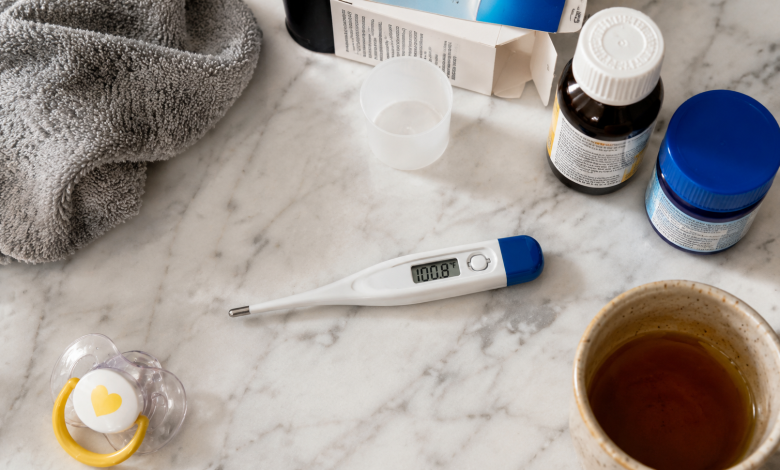
It’s two in the morning. Your baby’s forehead is warm warmer than it should be. You reach for the thermometer with hands that are steadier than your thoughts, and when the number blinks back at you, something primal kicks in. Not quite panic. Something closer to that specific dread that only new parents know: the fear of missing something, of waiting too long, of doing the wrong thing.
That moment thermometer in hand, child flushed and restless, the whole house quiet except for the sound of your own heartbeat is one of the most universal experiences in early parenthood. And yet, for all its familiarity, it doesn’t get easier to navigate. Because the question isn’t just “how high is the fever?” The question is always: what does this mean, and what do I do next?
What a Fever Actually Is
Here’s the thing most of us were never properly taught: fever is not the enemy. It’s a signal. A deliberate biological response. When the immune system detects an invader a virus, a bacterium, something the body has flagged as foreign it raises the internal temperature as a defense mechanism. A warmer body is a harder environment for many pathogens to thrive in. The fever, in other words, is the immune system doing exactly what it was designed to do.
This doesn’t mean fever is harmless or that it should always be ignored. But it reframes the conversation in a way that matters. You’re not watching your child’s body fail. You’re watching it fight.
Most childhood fevers are caused by ordinary viral infections the kind that circulate endlessly through daycares, playgrounds, and school hallways. They spike, they resolve, and they leave behind a slightly more experienced immune system. Pediatricians will tell you this, and they mean it. The number on the thermometer, taken alone, is a far less useful piece of information than it’s often treated as.
The Numbers We Obsess Over
That said, numbers do matter depending on context.
For a newborn under two months old, any fever at or above 100.4°F (38°C) is an automatic call-the-doctor situation. Not a “monitor and see.” Not a “give it an hour.” This is one of the clearest rules in pediatric medicine, and it exists for good reason: newborns have immature immune systems and very limited reserves. What presents as a minor fever in an older child can be a sign of serious infection in an infant this young. The threshold is low because the stakes are different.
Once a child passes the two-month mark, the calculus shifts. A fever of 101°F in a six-month-old who is nursing well, making eye contact, and falling back asleep is a very different situation than the same temperature in a child who won’t stop crying, won’t eat, and seems to be looking through you rather than at you. That distinction behavior over number is one that experienced pediatricians return to again and again.
By toddler age and beyond, fevers up to 103°F are common with viral illnesses and don’t, by themselves, indicate an emergency. What you’re watching for is how your child is acting between the spikes, not how high the spike goes.
Reading the Child, Not the Thermometer
Parents who’ve been through a few rounds of this eventually develop what amounts to a gut-level clinical instinct. They stop fixating on the number and start watching the child. Is she drinking? Is she producing tears when she cries? Is she engaging with the world in any recognizable way even sluggishly? Or does she seem somewhere else, unreachable, glassy-eyed in a way that doesn’t match the temperature?
The concept doctors use is “toxic appearance” a child who looks seriously unwell regardless of the fever’s height. It’s a somewhat vague term, but parents often recognize it intuitively. There’s a quality to a truly sick child that is different from a miserable but stable one. The color, the responsiveness, the muscle tone. It’s the kind of thing that makes a parent say “something isn’t right” before they can articulate why.
Trust that. It’s not nothing.
On the other side of the spectrum, there’s the child with a 104°F fever who, the moment the ibuprofen kicks in, wants to know if they can watch a movie and whether there’s any juice. That child is almost certainly fine. The fever is high, but the child is present and fighting effectively.
When to Call A Practical Framework
Rather than offering a rigid list, it helps to think in terms of categories of concern.
Age is the most important variable, especially under three months. Duration matters too a fever that persists beyond four or five days warrants medical attention even if the child seems otherwise okay, because prolonged fever can indicate an infection that isn’t resolving on its own. A fever that goes away and then returns after a day of normal temperature is worth calling about.
Location of symptoms adds another layer. Fever combined with a stiff neck, sensitivity to light, a purple or red rash that doesn’t fade when you press it, or difficulty breathing any of these elevate the conversation immediately. These are not “wait and see” scenarios. These are go-now scenarios.
Fever in an immunocompromised child, or a child with certain chronic conditions, follows different rules entirely and should always be discussed in advance with their specific care team.
And then there’s the catch-all that pediatricians universally support: if something feels wrong to you as a parent, call. You don’t need to have a clinical reason. You don’t need to justify the call. A good pediatric nurse or advice line is not going to judge you for checking in. That’s what the service is there for.
The Emotional Weight of “Wait and See”
What nobody talks about enough is how hard it is to wait when your child is sick. There is something almost counterintuitive about being told to monitor a feverish child and not act, when every parental instinct is screaming that action equals safety.
Part of what makes this so difficult is that the guidance even when correct doesn’t resolve the anxiety. It just puts the anxiety on hold. You’re checking on them every hour. You’re recalculating. You’re staring at a sleeping child and trying to decide whether their breathing looks right. The waiting is its own kind of labor.
What helps is having a framework before the fever arrives. Talking to your pediatrician at a well-child visit about fever thresholds, about what to look for, about when their after-hours line is the right call versus the emergency room that conversation, had in the calm light of a Tuesday morning, pays dividends at two a.m. when clarity is harder to come by.
What Fever Medicine Actually Does
Acetaminophen and ibuprofen don’t treat the underlying infection. They lower the temperature and improve comfort. That’s meaningful a miserable child who can rest and stay hydrated is in a better position than one who can’t but it’s worth understanding that bringing the fever down is not the same as fixing the problem.
Ibuprofen is generally not recommended for infants under six months. Dosing for both medications is weight-based, not age-based, which catches a surprising number of parents off guard. The bottle’s age ranges are approximations. Your child’s weight is the actual variable that should guide the dose.
Alternating between the two medications is a common practice and is generally considered safe when done correctly, but it’s worth confirming the protocol with your pediatrician rather than improvising at midnight.
The Longer View
A child who gets sick, fights a fever, and recovers is a child whose immune system is learning. That’s the longer arc. It doesn’t feel that way when you’re in it when the laundry is piling up and you haven’t slept properly in three nights and you’re rationing the last of the children’s Tylenol. But the immune system is, genuinely, a system that develops through use.
The first fever is hard partly because it’s the first. The parent has no reference point, no internal library of “we’ve been here before and it was fine.” That library gets built over time, through experience, through all the fevers that came and went and left your child unchanged except for being a little older and a little more resilient.
You’ll find your footing. You already have more instinct for this than you know.