Why a Small Fire Pit is the Ultimate Game-Changer for Tiny Lawns
The Myth That Small Yards Can’t Have Big Atmosphere
There’s a particular kind of defeat that comes with a tiny backyard. You scroll through Pinterest, you see those sprawling outdoor living spaces with sectional sofas and pergolas and stone fireplaces the size of a studio apartment, and you quietly close the tab. Not for you. Your yard is the size of a generous parking spot, hemmed in by a wooden fence on one side and your neighbor’s air conditioning unit on the other.
But here’s the thing nobody tells you: outdoor atmosphere isn’t about square footage. It’s about focal points. And a small fire pit one of those compact, well-designed units that fits comfortably in a corner or anchors a tight seating circle does something architecturally interesting to a tiny lawn. It gives the space a reason to exist after sunset.
This isn’t about making your yard look bigger. It’s about making it feel complete.
What Fire Actually Does to a Space
Light designers talk about something called “layering.” The idea is that a space feels more dimensional, more human, when light comes from multiple sources at different heights. A small fire pit sitting at ground level or table height introduces warm, flickering light at exactly the layer that makes people lean in rather than look away.
Think about the last time you sat around a campfire. The conversation slowed down. People stopped checking their phones. Eye contact became easier. That phenomenon isn’t nostalgia it’s neurological. Firelight operates on a frequency that signals safety and rest to the oldest parts of our brains. You can recreate that effect in a twelve-by-fifteen-foot backyard just as effectively as you can in a forest clearing.
The scale of the fire doesn’t change the psychology. A small fire pit pulls off the same trick.
The Space Problem Is Actually a Design Opportunity
Landscape designers who specialize in urban and small-space yards will tell you something counterintuitive: constraints force creativity in ways that open space never demands. A huge lawn gives you options, sure. But it also gives you the paralysis of options. A small yard forces you to think in terms of zones, layers, and intentional placement.
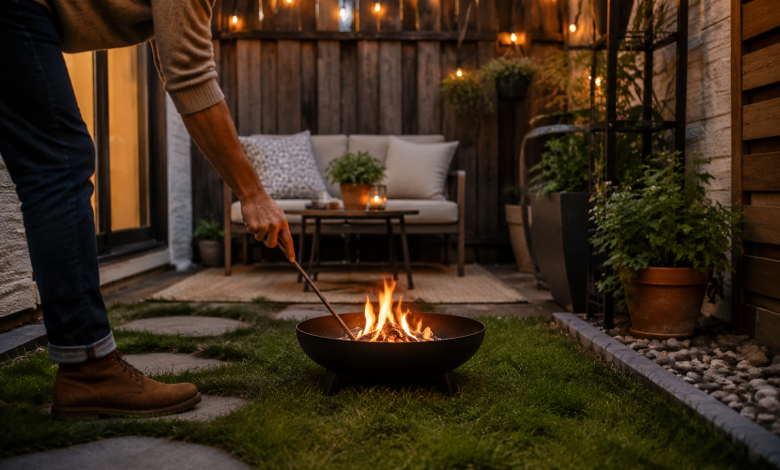
A compact fire pit say, something in the 24to 30-inch diameter range creates an instant gathering zone without consuming the yard. Pair it with two or three low-profile chairs, maybe a small side table, and suddenly that previously empty patch of grass has a logic to it. There’s somewhere to go, something to orient toward. Guests don’t wander awkwardly around an undefined space. They sit. They settle. That’s the kind of transformation that a $300 fire pit can deliver that a $3,000 landscaping project sometimes can’t.
It also solves a specific problem that tiny lawns always have: the feeling of being in a waiting room. Without a visual anchor, small outdoor spaces feel transitional, like somewhere you pass through rather than linger. The fire pit fixes this instantly. It’s a destination.
Why Smaller Is Genuinely Better Here
There’s a temptation, when you finally decide to buy a fire pit, to go big. To compensate for the yard’s size by choosing something dramatic. Resist it.
A large fire pit in a small yard creates a kind of visual claustrophobia. The proportions fight each other. More practically, the heat radius of a full-sized pit makes seating uncomfortable when you’re already working with limited space guests end up pushed back against the fence, which defeats the whole purpose.
A properly sized fire pit lets you arrange seating at a genuinely comfortable distance. Four chairs placed around a small pit can sit within easy conversation range of each other. Nobody’s shouting across flames. Nobody’s sweating through their jacket. The intimacy of the setting works with the scale of the fire, not against it.
There’s also a safety argument. In tight spaces, a smaller fire is more manageable. Sparks travel a shorter horizontal distance. You’re not creating a situation where a stray ember can land on your wooden deck or your neighbor’s dry grass. Many compact fire pits also come with mesh covers that make spark containment straightforward. That peace of mind matters when you’re three feet from your back door.
Seasonal Logic and Year-Round Value
Here’s where the small fire pit earns its keep in a way that most lawn furniture simply doesn’t. A patio set disappears in October. A grill becomes seasonal the moment the temperature drops below a certain threshold for most people. But a fire pit extends the outdoor season in both directions earlier in spring, deeper into fall because the warmth it provides is direct, radiant, and genuinely useful.
In climates where summer evenings carry achill, the fire pit becomes the reason you’re still outside at nine o’clock instead of retreating indoors after dinner. In shoulder seasons, it’s the thing that makes a Sunday afternoon in late October feel like a celebration rather than a last stand against winter.
For a small yard, this matters doubly. You’ve invested thought and money into making that space functional. Getting eight months of use out of it instead of four months is a significant return. The fire pit isn’t just an aesthetic choice it’s what activates the space.
Choosing the Right Type for a Compact Lawn
Not all small fire pits behave the same way, and the choice you make has real consequences for how the space functions.
Wood-burning pits are romantic and irreplaceable in terms of smell and sound. The crackle, the smell of oak or hickory, the way the embers shift these are experiences that a propane flame can’t replicate. But they require more management, produce more smoke, and aren’t always permitted in urban or suburban settings with local burn ordinances. If you’re in a dense neighborhood, check your municipal rules before you buy.
Propane or natural gas fire pits offer a different kind of convenience. They ignite instantly, produce little to no smoke, and the flame height is adjustable. For a small space where you’re often eating or socializing directly adjacent to the fire, the smoke factor isn’t trivial. There’s a reason many urban homeowners default to gas. The ambiance is slightly more controlled, slightly less wild but still deeply satisfying.
Tabletop fire pits occupy an interesting middle ground. For truly tiny spaces, or for renters who can’t make permanent changes, a tabletop unit placed on an outdoor dining table brings the same psychological warmth at a fraction of the footprint. They’re not a replacement for the full experience, but they’re not nothing, either.
The material of the pit itself affects how it ages in your yard. Steel develops a patina that some people love and others don’t. Cast iron holds heat beautifully but requires maintenance to prevent rust. Concrete and stone finishes tend to weather gracefully and integrate naturally with plantings or pavers.
The Social Physics of a Fire
There’s a pattern that plays out reliably once a fire pit enters a small backyard: people use the yard more. Not in a casual, passing-through way. In a deliberate, stay-a-while way.
Hosts who previously felt self-conscious about their limited outdoor space start entertaining outside because the fire pit gives the setting a reason for being. Neighbors get invited over. Friends linger after dinner. The yard becomes, finally, a room with all the social function that implies.
A small lawn doesn’t need to be an apology for not having a bigger one. With the right anchor, it becomes something more specific, more intentional than a sprawling yard that tries to be everything. A fire pit in a compact space creates a kind of gathering pressure everyone moves toward it, everyone faces each other, everyone slows down.
That’s not a small thing. That might be the whole point of having an outdoor space at all.