
The Myth of the “Matching” Bedroom Set
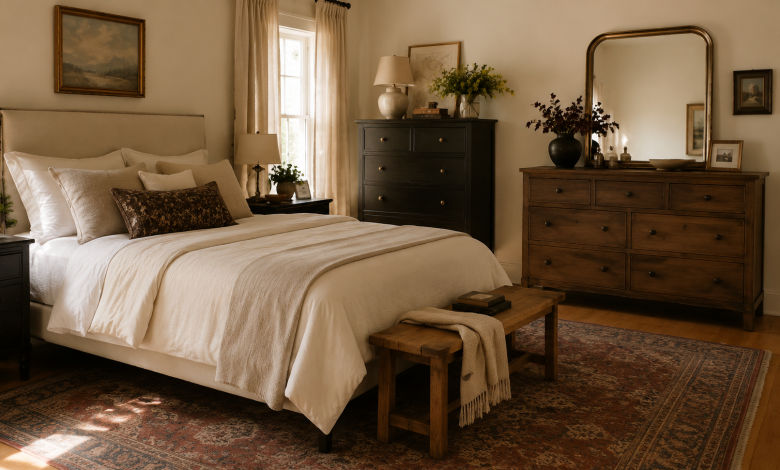
There’s a bedroom in a catalog somewhere you’ve seen it a thousand times. The nightstands are twins. The dresser echoes the headboard. The bed frame, the mirror, the chest of drawers: all the same wood tone, same hardware finish, same quiet insistence that everything belongs together. It looks complete. Deliberate. Safe.
And for decades, that image quietly convinced an entire generation that this was the goal.
The matching bedroom set became one of the most persistent myths in home furnishing not because it was beautiful, but because it was easy to sell. It answered a question most people didn’t know how to answer themselves: How do I make a room feel finished? The furniture industry handed them a shortcut, wrapped in a bow, usually at a mid-range price point that made the whole bundle feel like a reasonable investment in adult life.
But here’s what that shortcut actually costs you.
The Furniture Industry Didn’t Invent Taste It Invented a Product Category
Matching bedroom suites as we know them are largely a post-World War II phenomenon. When manufacturing scaled up, when suburban housing boomed, and when the American middle class started furnishing starter homes en masse, retailers needed a way to move inventory efficiently. Selling a six-piece set was easier than selling six individual pieces. It simplified the showroom floor, simplified the sales conversation, and simplified the customer’s decision fatigue.
None of that has anything to do with good design.
Before mass production, rooms were assembled over time. A chest of drawers might be inherited. A bed frame might be locally crafted. Nightstands were sometimes repurposed side tables. The room told a story because it was built from a life, not bought in a single afternoon. Variation wasn’t a failure of taste it was evidence of time, of accumulation, of actual living.
What the matching set did was erase that story and replace it with something that looked curated but was, in practice, the opposite of curation.
When Everything Matches, Nothing Stands Out
There’s a visual principle that designers refer to as contrast the idea that the eye needs somewhere to rest, somewhere to travel, and occasionally somewhere to be surprised. A room built from a single collection offers none of that. The eye scans the space, finds nothing to catch on, and the whole thing registers as forgettable.
Think about the bedrooms that stay with you. The ones in films, in hotels you remember, in homes of people whose aesthetic you quietly envied. Almost none of them are built from matching sets. They tend to have a vintage piece beside something contemporary. A raw linen headboard against painted plaster walls. A sculptural lamp that has no business being next to a humble thrifted dresser and yet, somehow, that’s exactly what makes it work.
That tension is doing something. It creates visual rhythm. It suggests intention without broadcasting it.
A room where the nightstand is clearly the sibling of the dresser, which is clearly the sibling of the bed frame, announces that its occupant made one decision and walked away. It doesn’t feel lived-in. It feels staged.
The Coordination Trap
Here’s where the myth gets genuinely insidious: matching sets don’t just limit your aesthetic options they lock you in.
Buy a six-piece bedroom suite and then try to refresh the room two years later. You can’t add a vintage armoire without it feeling like an intruder. You can’t replace the nightstands with something more interesting without the remaining pieces looking orphaned. The set, by design, resists evolution. It was built to be complete, which means it was also built to be static.
Rooms that are assembled with intention mixing sources, eras, finishes actually age better because each piece has its own identity. You can rotate things out, bring in something new, let the room shift as your taste shifts. Nothing holds everything else hostage.
There’s also a more practical trap embedded here. Matching sets tend to prioritize visual cohesion over function. You get the nightstand that came with the suite, even if it’s too small, has no drawer, or sits at the wrong height for your bed. You keep the dresser that’s part of the collection even if it doesn’t fit the corner you actually have. The set defines the room rather than the room defining what you need.
What “Cohesion” Actually Means
This is the part that genuinely trips people up, because the fear underneath the matching-set myth is real: I don’t want my bedroom to look chaotic. I don’t want it to feel like five different ideas that never talked to each other.
That’s a legitimate concern. It’s just that matching furniture is a blunt instrument solution to a nuanced problem.
Real cohesion comes from a handful of things that have nothing to do with whether the pieces were manufactured together. Color temperature is one warm wood tones, even across different species and finishes, tend to feel harmonious in a way that a mismatched warm-and-cool pairing won’t. Scale matters enormously: a room where every piece is proportionally right for the space creates calm even if nothing technically coordinates. Material repetition does a lot of quiet work if you’ve got brass hardware on two or three pieces, a brass lamp pull brings it together in a way that reads as thoughtful, not accidental.
And then there’s negative space. The thing that makes a curated room feel curated isn’t that every piece belongs to the same family it’s that the editor knew what to leave out.
Restraint is a design tool. It’s also the thing you forfeit when you fill a room by checking boxes off a matching-set list.
The Permission Slip You Didn’t Know You Needed
There’s something quietly liberating about letting go of the matching set as a benchmark. It means the dresser you found at an estate sale the one with the interesting proportions and the slightly uneven patina is not a compromise. It’s a choice. It means you don’t have to wait until you can afford to replace everything before the room can feel intentional.
Some of the most considered bedrooms are built on almost nothing. A bed with real presence. One piece of furniture with genuine character. Light that’s been thought about. Textiles that feel like they were chosen rather than defaulted to.
None of that requires a suite. It requires a different kind of attention one that asks not “does this match?” but “does this belong?”
Those are very different questions. The first is about conformity to a set. The second is about whether something earns its place in a space that’s genuinely yours.
The catalog bedroom with its matching everything will keep showing up in advertisements. It photographs well. It’s easy to want from a distance. But rooms aren’t meant to be looked at from a distance. They’re meant to be lived in, morning after morning, in the particular and unrepeatable details of an actual life and no furniture company can pre-package that for you.