The Freedom of the Unadorned Corner
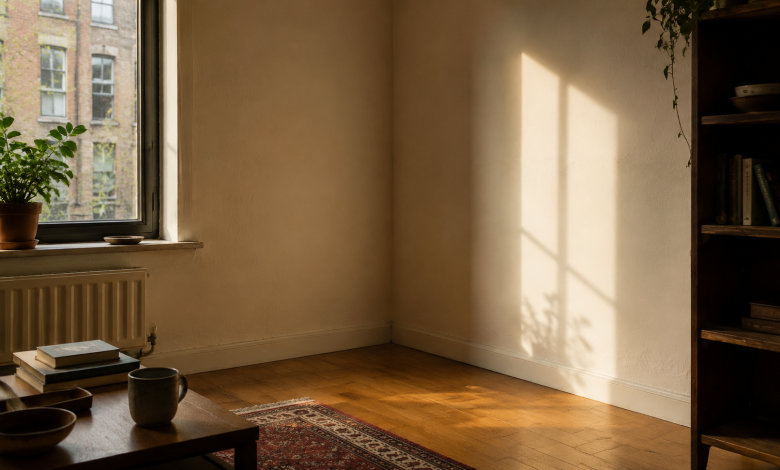
The Corner Nobody Wants
There’s a corner in my apartment that has been empty for three years. Not neglected empty. No shelf wedged in at an angle, no floor lamp arching over a reading chair that never quite fits, no artificial plant bought in a moment of guilty optimism. Just plaster, light, and the soft geometry of two walls meeting.
Guests notice it. Their eyes drift there involuntarily, the same way a tongue finds a missing tooth. Sometimes they ask about it, with the tentative politeness of someone pointing out a stain. “Are you still figuring out what to put there?” And I tell them no. This is what I chose.
The discomfort that follows is more interesting than the corner itself.
We live in a culture that has made filling space into a moral act. A bare wall suggests incompleteness. An empty shelf reads as neglect or, worse, as a personality not yet fully assembled. We are told, through every catalog and every curated Instagram grid, that beauty is additive that comfort is something you layer on, purchase by purchase, until a room finally looks “done.” The empty corner resists all of that. It refuses the logic of accumulation. And that refusal, it turns out, is its own kind of statement.
What Emptiness Actually Does
There is a concept in Japanese aesthetics called ma often translated as “negative space” or “pause,” but neither translation fully captures it. Ma is the interval. It is the silence between notes that gives music its shape, the gap between objects that allows each one to be seen. It is not absence as deprivation. It is absence as breath.
Western design has long been suspicious of this idea. We build rooms to be filled and filled again, treating emptiness as a problem waiting to be solved. But anyone who has walked into a sparsely furnished room one where the proportions are allowed to breathe knows the feeling of suddenly being able to think. The air quality doesn’t change. The acoustics might. But mostly it’s psychological: when there is less to process visually, the mind unclenches.
That corner in my apartment acts as a kind of reset valve. I walk past it at odd hours and feel, briefly, nothing in particular. That nothing turns out to be something I need more than I expected.
The Furniture We Buy to Feel Safe
Most of us don’t fill corners because we love what goes in them. We fill them because of a low-grade anxiety that an empty corner represents wasted potential spatial, economic, even existential. A bookshelf signals that someone reads. A gallery wall announces taste. An accent chair implies that guests are welcome and that the host has thought about their comfort. All of this is real, and none of it is wrong. But somewhere in that calculus, the room stops being about living and starts being about display.
The furniture industry understands this. So does the home décor market, which has ballooned into a multi-billion dollar industry premised almost entirely on the fear of looking like you haven’t tried. Seasonal refresh campaigns, the annual push toward a new “style moment” these things don’t exist because our rooms genuinely need updating. They exist because emptiness has been successfully marketed as a deficiency.
When you leave a corner bare, you opt out of that market, at least in one small rectangle of your life. You stop the cycle in one place. And the interesting thing is how much you notice it not the corner, but the stillness that absence creates around it.
The Harder Work of Restraint
There’s a version of minimalism that’s really just aesthetic maximalism in different clothes. The perfectly curated shelf with three objects placed just so. The living room photographed for an architecture magazine, so pristine it looks like no one has ever eaten cereal in it. This kind of restraint is its own performance, no less effortful than the overstuffed Victorian parlor, just more expensive per square foot.
The empty corner I’m describing isn’t that. It isn’t staged emptiness. It didn’t require sourcing the right nothing. It required only the repeated decision not to do something not to buy the plant, not to move the lamp, not to fill the space because filling felt like progress.
That kind of restraint is harder than it sounds, because it asks you to sit with incompleteness. The corner doesn’t resolve into anything. It stays a corner. And our instinct trained by years of being told that every problem has a product is to keep reaching for solutions to things that aren’t actually problems.
Doing nothing takes a certain nerve.
Space as a Form of Honesty
There’s something truthful about unfilled space that decorated space can never quite achieve. A room full of carefully chosen objects tells a story, and stories are always partly fiction a curated version of the self, presented for an audience that may include only the person doing the curating. The empty corner doesn’t tell any story. It just is.
This might be why certain creative people are drawn to sparse environments for the actual work of thinking. Not the performance of thinking the office set up to look like serious ideas happen here but the real friction of trying to figure something out. Georgia O’Keeffe’s house in Abiquiú was famously bare. A door in one wall, a window in another, the desert outside. Philip Glass writes in rooms that look like very little happens there. Something about the absence of visual narrative seems to make room for another kind.
I’m not claiming my empty corner gives me O’Keeffe’s clarity. What it gives me is a single place in my home where I haven’t made a decision. And that passivity, that deliberate withholding of choice, turns out to feel like a small freedom.
What We’re Actually Protecting
When I try to explain the appeal of that corner to people who find it puzzling, I usually end up talking about attention. Not décor, not minimalism as philosophy, not any design principle just attention, and where it goes.
Every object in a room makes a small claim on awareness. A plant asks to be watered and noticed. A stack of books implies a project started or abandoned. A rug gathers visual weight and grounds the gaze. None of this is burdensome in isolation, but collectively it adds up to a constant low-level negotiation between you and your environment. The room is always talking. Sometimes quietly, sometimes not.
The empty corner doesn’t talk. It waits. And in a life that is, for most people, relentlessly full of input, obligation, content, noise a corner that simply waits can feel like one of the quietest luxuries available.
It costs nothing. It asks nothing back. It doesn’t need to be refreshed in the fall.
There’s a kind of freedom in that so ordinary it’s easy to miss. Until you stand next to it, and feel the wall on two sides, and realize you’ve been holding your breath for a while, and that this is the first time in hours you’ve been allowed to let it go.