Stop Storing Things Under Your Bed (Do This Instead)
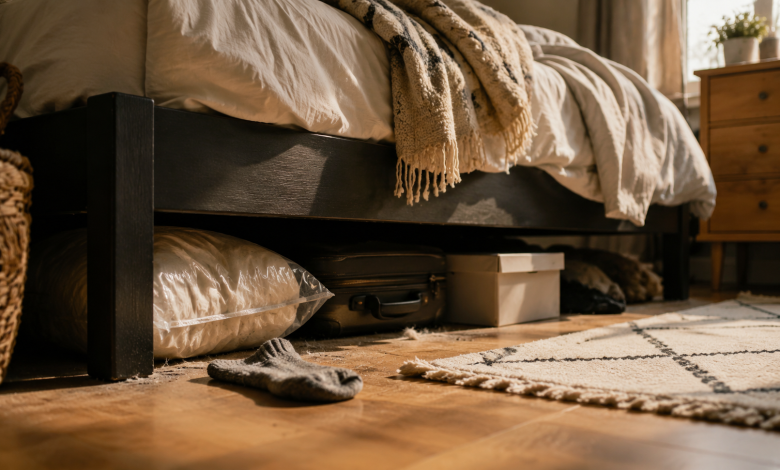
There’s a specific kind of dread that comes from looking under a bed. Not the childhood fear of monsters something more adult, more mundane, and honestly worse. It’s the dread of seeing your own chaos staring back at you: a flattened shoebox you forgot about, a winter duvet still in its plastic wrap, a suitcase you never fully unpacked from that trip two years ago. Maybe a rogue sock. Definitely some dust.
Most people look at this situation and think the problem is a lack of storage containers. Buy better bins. Label them. Problem solved. But the under-bed storage habit isn’t really a storage problem. It’s a thinking problem and until you understand why it backfires so consistently, you’ll keep feeding the cycle.
Why Under-Bed Storage Feels Smart (But Isn’t)
The logic is seductive. You have a flat, unused plane of real estate directly beneath where you sleep every night. It’s hidden from guests. It costs nothing extra. And in a small apartment where square footage is a genuine luxury, every inch feels worth exploiting.
The problem is that “out of sight, out of mind” is not a storage philosophy it’s the absence of one. When something goes under the bed, it enters a kind of domestic limbo. You can’t easily see what’s there. You can’t rotate items efficiently. You can’t grab something quickly without doing a minor excavation. And because access is awkward, you stop accessing it altogether. Items get pushed further back. New items pile in front. The whole system calcifies.
There’s also a psychological cost that rarely gets talked about. Bedroom environments influence sleep quality and mental rest more than most people acknowledge. Clutter generates low-level visual and cognitive noise. You might not consciously register the disaster underneath you each night, but spatial awareness is ambient your brain is processing the environment even when you’re not actively looking at it. Some sleep researchers have pointed to bedroom clutter as a factor in elevated cortisol levels and disrupted sleep onset. The bed is supposed to be a place of recovery. Turning the space beneath it into a storage unit works against that.
What You’re Actually Storing (And Why That Matters)
Here’s a question worth sitting with: what exactly lives under your bed right now?
For most people, it’s one of three categories. The first is seasonal items extra bedding, winter coats, holiday decorations. The second is sentimental clutter old photos, boxes of mementos, things you can’t throw away but don’t know what to do with. The third, and this one stings a little, is avoidance storage things you put there because you haven’t made a decision about them yet.
Each of these categories has a better answer than “shove it under the bed.”
Seasonal items need a home that acknowledges their seasonal nature. That means somewhere you can access them twice a year without dreading the process. A high closet shelf, a dedicated corner of a hallway closet, or a labeled bin in a storage area all accomplish this more cleanly. The goal isn’t to hide them it’s to park them somewhere logical so retrieval feels intentional rather than archaeological.
Sentimental clutter is a different animal entirely. The under-bed treatment is almost disrespectful to the things you supposedly value. If something genuinely matters to you letters from an old relationship, your grandmother’s recipe cards, photographs from your twenties it deserves a home that reflects that. A proper memory box, kept somewhere you can actually sit with it on a quiet afternoon. Not wedged beside a dusty luggage set you forgot you owned.
Avoidance storage is the hardest to deal with because it requires confronting a decision you’ve been postponing. That thing under the bed? You already know you don’t need it. The act of putting it there was just a softer version of throwing it away one that preserved the illusion of future use without the guilt of letting go.
What to Do Instead
The most effective change isn’t finding a better under-bed organizer. It’s rethinking vertical space in your home while being more honest about what you actually need to keep.
Closets almost always have untapped overhead capacity. Most people use the single rod for hanging and call it done, leaving a foot or two of dead space above the shelf and significant floor space below. Adding a second hanging rod for shorter garments, a modular shelving unit for folded items, or simple stackable drawers on the floor of a closet can double the effective storage in a space you already have without turning your bedroom into a warehouse.
Furniture with built-in storage is another direction worth exploring, but with one important caveat. The mistake people make is buying an ottoman with storage, or a bed frame with drawers, and then filling it the same way they filled the space under the bed indiscriminately, until it’s full. The furniture doesn’t solve the behavior. You need to make a decision about everything going into it. If you buy a bed with under-drawers, those drawers should have a defined purpose: spare sheets, or off-season clothing, or nothing except the things that genuinely belong in a bedroom. Not your tax documents from 2019.
For people in small spaces, wall-mounted shelving changes the geometry of a room significantly. Moving storage vertical opens up floor space, makes rooms feel larger, and critically keeps your belongings visible. When things are visible, you engage with them. You remember what you own. You stop buying duplicates of things you already have because you forgot you had them.
The Real Issue Underneath All of This
Clutter accumulates for a reason. People rarely store things poorly because they’re lazy or disorganized by nature. They do it because they’re making quick decisions under pressure, without a system that makes the right choice feel easier than the wrong one.
Under-bed storage persists because it offers immediate relief a clear floor, a made bed, the appearance of order without requiring the cognitive work of actual organization. It’s the home equivalent of shoving everything into a closet before guests arrive. It works right up until it doesn’t, and by then you’ve got two years of unaddressed decisions sitting in the dark, collecting dust.
The fix isn’t really about storage at all. It’s about building a home where things have deliberate places not default ones. Where seasonal items actually leave and come back on a schedule. Where sentimental things are honored rather than buried. Where the decision “do I keep this?” gets made at the front door, not deferred indefinitely into the bedroom floor.
Your bedroom should be the quietest room in your house. The most restful. The place your nervous system decompresses at the end of whatever kind of day it’s been. It’s hard to do that when the foundation of the place you sleep is propped up on a season’s worth of unresolved choices.
Clear it out. Then keep it clear. Not by storing less by finally deciding.