The Boots Every Minimalist Needs in Their Fall Wardrobe
There’s a particular kind of anxiety that comes with fall dressing. The air shifts, the light changes, and suddenly everything in your closet feels either too light or too heavy, too casual or too precious. For the minimalist, this is also the season that tests conviction. You’ve spent the better part of the year curating, editing, and resisting the pull of the unnecessary and now theracks are full of texturedcoats, plaid scarves, and boots in every conceivable silhouette. It would be easy to lose the thread.
But fall is actually where a minimalist wardrobe earns its reputation. The right pair of boots just one or two, chosen carefully can carry you through three months of changing weather, shifting occasions, and the particular social demands of autumn. This isn’t about deprivation. It’s about understanding what actually works, and why.
Why Boots Are the Minimalist’s Most Strategic Investment
Other wardrobe categories give you room to work with less. A minimal approach to tops or trousers is forgiving a white shirt is a white shirt whether you own one or five. Footwear is different. Shoes visually anchor an outfit, set its register, and do a surprising amount of tonal and textural work without you consciously realizing it.
In fall especially, boots occupy the intersection of utility and aesthetics in a way no other shoe category does. They have to manage cold mornings and warm afternoons, dry sidewalks and wet leaves, a working lunch and a dinner that turns into something longer. A sandal or a sneaker asks nothing of you. A boot asks you to choose.
For the minimalist, this means a single pair of boots can either be the most powerful thing in a fall wardrobe or the most expensive mistake. The difference comes down to understanding what makes a boot truly versatile, rather than just vaguely wearable.
The Chelsea Boot: A Case Study in Quiet Authority
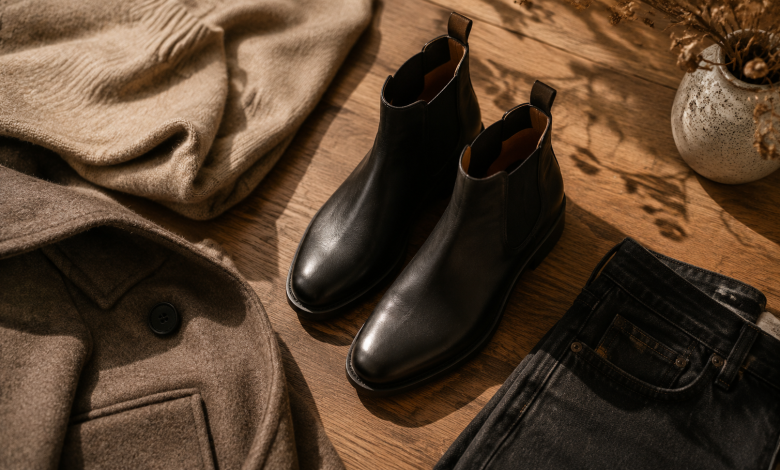
If there’s one style that has survived decades of trend cycling with its integrity intact, it’s the Chelsea boot. Pull-on, ankle-height, elastic-sided the silhouette is so resolved, so stripped of unnecessary detail, that it functions almost like a neutral in the way that a great white tee does. It doesn’t call attention to itself. It just makes whatever you’re wearing look like it was meant.
The best version for a minimalist wardrobe is narrow enough to tuck under a straight-leg trouser but substantial enough to ground a midi skirt. Suede in camel or chocolate brown gives you warmth without weight. Smooth leather in black gives you precision, a slightly more urban quality, the kind of quiet dress code fluency that reads as competent in a meeting and unfussy at a bar. Either works. The point is choosing one and committing.
What makes the Chelsea so strategically sound is how it handles the gap between smart and casual dressing. Wear it with tailored trousers and a merino rollneck and you look pulled together without trying. Wear the same boot with straight-leg denim and an oversized coat and you look intentional in a different register entirely. That range without any visible effort on your part is exactly what a minimalist is looking for.
The Knee-High Boot and the Question of Proportion
The knee-high is more of a commitment. It takes up real visual space, changes your silhouette in ways the ankle boot doesn’t, and has a longer history of cycling in and out of fashion consciousness. Some minimalists dismiss it on those grounds. That’s a mistake.
A well-proportioned knee-high boot in a simple, unembellished design no block heels pushed too aggressively, no exaggerated toes, no hardware that announces itself has a kind of structural elegance that actually serves the minimalist ethos better than some more ostensibly “simple” options. The form follows function argument works here. The boot covers the leg, manages weather, and creates a clean vertical line that works beautifully with shorter hemlines in fall.
The key is fit at the calf. This is where most knee-high boots fail, and why so many end up being worn once before retreating to the back of the closet. A boot that gaps or collapses looks unresolved, which undermines the entire point. Italian leather that molds to the leg over time, or a style that comes with a range of calf widths, is worth the investment. When it fits correctly, a knee-high in smooth black leather with a modest heel has a severity that pairs just as well with a slouchy crewneck sweater as it does with a wrap dress. That versatility, hiding in plain sight, is exactly the kind of thing minimalists should be hunting for.
What Makes a Boot Actually Last
There’s an argument minimalists need to make peace with: the better boots are more expensive, but they are not more expensive over time. A pair of Chelsea boots in full-grain leather, resoled once or twice over the years, will outlast three or four pairs of their cheaper counterparts while remaining more comfortable and visually consistent throughout. The sole wears evenly. The leather develops a patina that makes the boot look more considered, not less. The construction stays intact.
This isn’t a ringing endorsement of spending carelessly. It’s a pushback on the minimalist tendency to treat “fewer things” as an end in itself, rather than as a means to a life with less friction and waste. A cheaply made boot with clean lines is still a cheaply made boot. The minimalism is in the intention, the care, the long view not just the restraint.
Brands like Clarks, Thursday Boot Company, or Blundstone at the more accessible end, and makers like R.M. Williams or Tricker’s at the investment level, represent the kind of construction philosophy worth understanding. These aren’t fashion boots, and that’s precisely the point. Their value to a minimalist wardrobe is their stability they don’t date, they don’t demand to be replaced, and they hold their visual integrity across seasons and style shifts.
Color, Texture, and the One Decision That Matters Most
The question of what color to choose is, in practice, the most important decision and also the one most people overthink. The honest answer is that black and tan cover almost everything.
Black is the more formal of the two. It has an evenness, a flatness that allows it to disappear into an outfit when you want it to and create structure when you need it. It works in the city better than anywhere else, and in fall specifically, it has a natural seasonal coherence black wool coats, black cashmere, the particular dark palette of the season.
Tan, or camel, or a warm cognac all essentially variations on the same idea does something different. It introduces warmth, plays off autumn’s natural color story in a way that feels effortless rather than calculated. Against white or cream, tan boots have a quiet warmth. Against grey, they create a contrast that reads as considered. Against olive or rust, the tonal harmony is almost too easy.
If you’re starting with one pair, the case for black is slightly stronger purely on range. But if you already have something close to black in your rotation, the case for tan is compelling.
Texture adds one more layer of decision-making that’s worth thinking through. Suede reads softer, more tactile, and slightly more relaxed than smooth leather. It’s less forgiving in wet weather a real consideration for fall but its visual warmth is genuinely hard to replicate in other materials. Smooth leather is more durable, easier to maintain, and more tonally precise. Both are valid. Both are genuinely minimalist. The choice comes down to what the rest of your wardrobe is asking for.
The Trap of the Capsule Wardrobe Boot
There’s a version of minimalist style advice that says: buy the one perfect boot, the one that works with everything, the end. And while that’s directionally correct, it sometimes leads people toward the most generic, most inoffensive option rather than the most considered one.
The boot that works with everything is not the same as the boot that adds nothing. A boot with real presence, real material integrity, real design confidence even something as restrained as a well-made Chelsea brings a quality to an outfit that the “safe” choice doesn’t. Minimalism in fashion is not the same as design neutrality. It’s clarity of intention. Those two things look superficially similar but feel completely different when you’re actually wearing the clothes.
The best fall boot for a minimalist isn’t necessarily the safest one. It’s the one that reflects a clear point of view about quality, proportion, material and holds that view quietly, without asking for acknowledgment. That’s a standard worth holding.