Mixed Metals Are In: How to Wear Silver and Gold Together Fearlessly
The Rule That Never Really Was
Someone, at some point, decided that silver and gold should never touch. It became one of those unwritten style commandments passed down like family china rarely questioned, broadly accepted, and quietly suffocating. The logic, if you could call it that, suggested that mixing metals looked confused. Indecisive. Like you got dressed in the dark and grabbed from two different jewelry boxes without checking a mirror.
But here is what nobody told you: that rule was never rooted in aesthetics. It was rooted in fear. Fear of clashing, fear of looking like you tried too hard or not hard enough, fear of breaking some invisible code that fashion gatekeepers set decades ago to keep things neat and uncomplicated. Neat and uncomplicated, of course, being the enemy of anything genuinely interesting.
The truth is that mixed metals have always existed in high design. Byzantine mosaics paired gold leaf with silver tesserae. Art Deco jewelry from the 1920s married platinum and yellow gold in the same brooch without a second thought. Even your grandmother’s vintage rings the ones with the white gold setting around a yellow gold band were doing the work long before any trend piece declared it acceptable.
So we are not witnessing the birth of something new. We are witnessing permission finally catching up with instinct.
Why It Works: The Visual Logic Behind the Mix
Color theory offers a clean explanation. Gold sits in the warm spectrum it pulls toward honey, amber, candlelight. Silver lives in the cool family alongside steel, pewter, and morning frost. When you combine warm and cool tones in a single outfit, you create visual tension. Not the uncomfortable kind. The kind that makes someone’s eye linger a half-second longer. The kind that reads as intentional rather than accidental.
Think of it the way an interior designer thinks about a room. A space that is entirely warm all terracotta and brass and caramel leather can feel heavy, closed in on itself. Introduce one cool element, a marble countertop, a chrome fixture, a single silver-framed photograph, and suddenly the room breathes. Your body works the same way. A full gold stack on your wrist can look beautiful, but the moment you thread a single silver bangle through that lineup, you have introduced contrast. You have given the eye somewhere to travel.
This is not theory floating in abstraction. Look at the runways from the past three years. Bottega Veneta sent models out in gold chain necklaces layered over silver chokers. Celine paired brushed silvercuffs with thin gold hoops. These were not styling accidents or backstage mix-ups. They were deliberate choices made by teams who understand that sophistication lives in the tension between two things that supposedly do not belong together.
Starting Simple: The Low-Risk Entry Points
If you have spent years keeping your metals separated like feuding relatives at a dinner table, jumping into a full mixed-metal look overnight can feel disorienting. Fair enough. Start where the stakes feel low.
A watch is the easiest gateway. Two-tone watches have existed for decades precisely because the combination works at a functional, everyday level. A steel bracelet with gold accents, or a gold case on a silver mesh band these pieces do the mixing for you. Wear your usual silver rings alongside it, and you have already broken the rule without making a single dramatic choice.
Stacking rings offer another entry point with almost no risk. Wear a thin gold band on one finger, a silver signet on another, and let themcoexist without ceremony. The key is to avoid treating it like an event. The more casually you approach the mix, the more natural it reads. Overthinking it is what creates the costume effect people are afraid of.
Earrings present an interesting opportunity too. Mismatched earrings are having their own cultural moment, and a gold hoop in one ear paired with a silver huggie in the other is the kind of asymmetry that signals confidence rather than confusion. It says you made a choice, not a mistake.
The Layering Game: Where Mixed Metals Get Interesting
Once you are comfortable with the basics, layering is where this approach moves from acceptable to genuinely compelling. Necklaces are the obvious playground. A thin gold chain sitting at your collarbone, a longer silver pendant dropping to mid-chest, maybe a gold lariat falling even lower the cascade of metals creates depth in a way that a single-tone stack simply cannot replicate.
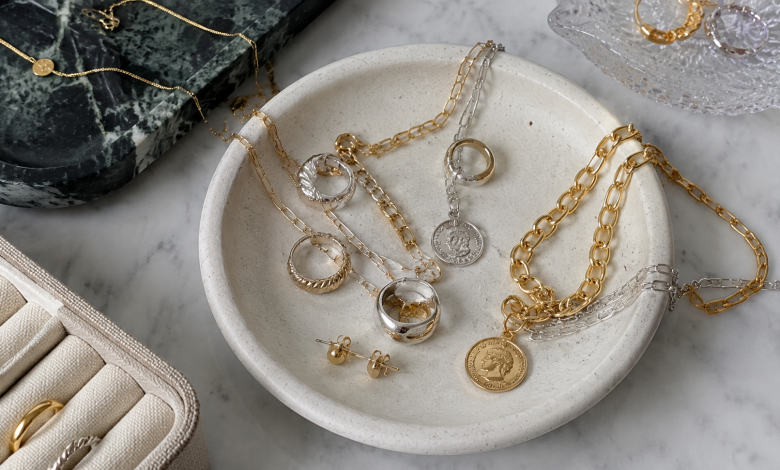
The trick, if there is one, is proportion. You want variety not just in metal color but in weight and texture. A chunky silver Cuban link next to a delicate gold paperclip chain creates a dialogue between the pieces. They are not competing. They are conversing. A thick gold rope necklace next to an equally thick silver rope necklace, on the other hand, can read as visually noisy because the pieces are too similar in everything except color. Give them different scales, different textures, different chain styles, and the mix becomes harmonious rather than chaotic.
Bracelets follow the same principle. A slim gold bangle, a beaded silver bracelet, a gold watch, a silver chain stack them with variety and they create a collected, lived-in quality. Like you have gathered these pieces over years and trips and relationships. That organic quality is exactly what makes mixed metals look expensive and personal, as opposed to matchy-matchy sets that can sometimes read as catalog-ordered.
The Confidence Piece: What Actually Holds It Together
Here is the part that no styling guide will say plainly enough: the thing that makes mixed metals work is not ratio, not balance, not any mathematical formula of sixty percent gold to forty percent silver. It is conviction.
People can sense hesitation in how you wear something. If you keep glancing at your wrist wondering if the silver bracelet clashes with your gold rings, that uncertainty transmits. Not loudly, not obviously, but in the way you fidget with your jewelry or subtly tuck a piece under your sleeve. Conversely, when you wear a combination with zero apology, it reads as a choice. And choices, even unconventional ones, always look better than accidents.
This is true across every domain of personal style. The person who wears a bold pattern with full confidence looks editorial. The person who wears the same pattern while tugging at their hem looks lost. Mixed metals are no different. Commit to the combination. Do not hedge it. Do not apologize for it with a self-deprecating comment about how you know it breaks the rules. Wear it like you have always worn it. Because, honestly, the people who have always mixed their metals are the ones who made the rest of us realize it was possible in the first place.
Where Skin Tone Fits In And Where It Does Not
You have probably encountered the advice that gold flatters warm skin tones and silver flatters cool ones. This is not entirely wrong, but it is wildly overstated. It was useful guidance in an era when people wore one metal exclusively and wanted to know which single option would complement their complexion. In a mixed-metal context, the question becomes irrelevant, because you are wearing both.
What you might notice is that one metal sits closer to your face and the other further away, or that you instinctively gravitate toward more of one than the other. That is your preference expressing itself, and it is fine. Let it guide you without letting it restrict you. A woman with deep warm undertones might find she wears seventy percent gold and threads silver through as an accent. A man with cool pink undertones might lean heavier on silver and let gold appear in a single ring or watch detail. Neither approach is wrong. Neither is a rule. They are just tendencies you can notice and lean into or deliberately push against.
The point is that skin tone should inform, not dictate. It is one variable among many the colors you are wearing that day, the setting you are dressing for, the mood you woke up in. Giving it veto power over your jewelry choices is giving it too much authority.
Letting the Mix Evolve
The most compelling thing about embracing mixed metals is what it does to your relationship with jewelry over time. When you are locked into one metal, every new purchase has to match. It limits what you can pick up at a flea market in Lisbon, what you can accept as a gift, what you can inherit from someone you loved. The moment you release that constraint, your collection opens. That vintage silver locket your aunt left you can finally live next to the gold chain you bought yourself on a birthday trip. They are not in conflict. They are in conversation.
And that conversation between old and new, warm and cool, inherited and chosen is really what personal style is about. Not adherence to a set of rules someone else wrote. Not a uniform. But a living, evolving expression of all the things you have gathered along the way and decided to carry with you.
Mix your metals. Wear them without explanation. Let someone ask about it, and just shrug.