How to Define Zones in a Tiny Outdoor Space
There’s a particular kind of frustration that comes with a small outdoor space. You stand at the edge of a narrow balcony or a postage-stamp patio and feel the pressure of wanting it to do everything be a dining room, a lounge, a garden, a sanctuary while knowing the square footage simply won’t cooperate. Most people respond to this by either overcrowding the space with furniture until it feels like a storage unit, or by doing almost nothing with it and calling the emptiness “minimal.”
Neither approach is wrong, exactly. But both miss something. The real problem isn’t the size. It’s the lack of spatial logic.
Defining zones in a small outdoor space isn’t about carving up territory the way you would in a large backyard. It’s about creating a sense that different parts of the space have different identities even if those parts are separated by two feet rather than twenty. Once you internalize that distinction, a lot of things start to make sense.
Why Zoning Matters More in Small Spaces
Counterintuitively, zoning is more important in compact spaces than in large ones. When you have a sprawling yard, the sheer physical distance between a fire pit area and a vegetable garden does the organizing work for you. In a small space, nothing does that work automatically. Everything bleeds into everything else, and the result is visual noise the eye doesn’t know where to rest, the body doesn’t know where to sit, and the whole space starts to feel cluttered even when it technically isn’t.
The psychology here is real. Humans read spaces through implied structure. Arug under a chair signals “this is where you sit.” A cluster of potted plants at a corner says “something intentional happened here.” Without these cues, a space reads as unresolved. That ambient sense of incompleteness is why small patios so often feel disappointing not because they lack room, but because they lack grammar.
Start With Function, Not Furniture
The instinct is to start shopping. That’s almost always a mistake. Before you buy a bistro table or a pair of folding loungers, you need to answer a more fundamental question: what do you actually want to do out there?
Not what you imagine doing in some idealized future version of your life. What do you realistically do, or want to do, in the next three months? Eat breakfast outside on weekday mornings? Have two or three friends over on a Saturday evening? Tend a small herb garden? Read in the late afternoon when the light is right?
Most small outdoor spaces can support two functions comfortably, maybe three if the layout is clever. Trying to accommodate five is how you end up with a crowded, purposeless mess. Pick your two. Make them work beautifully. Then see if there’s room for anything else.
Once you know the functions, you can start thinking about where each one lives in the physical space. This doesn’t require a tape measure or a design degree it requires standing in the space, looking at where the light falls, thinking about sightlines, and noticing where you naturally gravitate when you step outside.
The Role of Rugs, Levels, and Edges
In interior design, rooms are defined by walls. Outside, you have to build your own implied boundaries, and the tools for doing that are more subtle than most people expect.
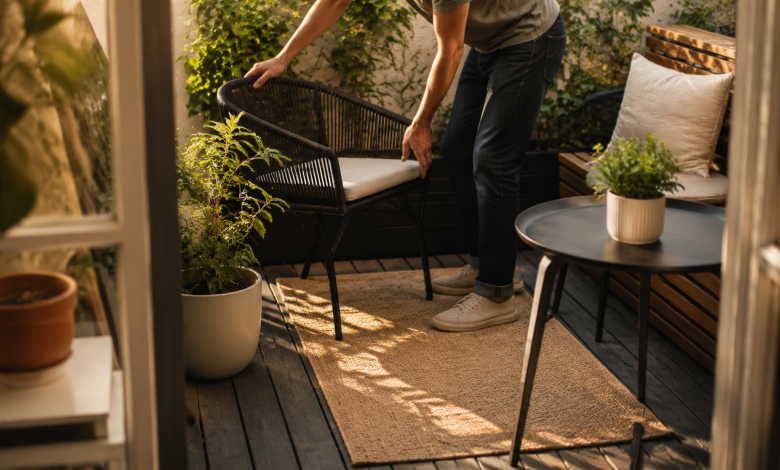
An outdoorrug is probably the most underestimated zoning device available. A rug beneath a pair of chairs and a side table immediately reads as a seating zone, even in an open space with no walls around it. The rug creates a ground plane that says “this area is intentional.” It doesn’t need to be large sometimes a small rug does the job better than a sprawling one, because it clarifies rather than dominates.
Levels work differently but just as powerfully. A raised planter bed on one side of a balcony creates a physical and visual boundary without blocking light or adding bulk. A low deck platform even just a few inches off the ground gives a seating area a distinct sense of place. The human eye reads elevation changes as spatial transitions, so even modest level differences can make two adjacent areas feel like separate zones.
Plants are the other major player. A row of tall, slender plants in narrow planters can define the edge of a space without closing it off. A single large plant a potted olive tree, a tall ornamental grass can anchor a corner and give it a sense of purpose. The key is thinking about plants not just decoratively but structurally: as dividers, anchors, and edges.
Zoning on a Balcony vs. a Ground-Level Patio
The strategies shift depending on what you’re working with. Balconies present particular challenges because the vertical dimension matters so much the railing is already doing visual work, and overhead space is often the only direction you can expand. A small balcony almost always benefits from one clear zone rather than two competing ones. Define a single purpose, build around it with precision, and let the edge of the railing do the rest of the boundary work.
Ground-level patios have more flexibility. You can use plants, furniture arrangements, and material transitions say, gravel on one side and pavers on the other to create genuine zone separation. Even on a very small patio, you can often carve out a sitting area on one end and a standing or grilling zone on the other, linked by a clear path between them.
The path is worth thinking about explicitly. Even if it’s just a foot and a half wide, a visual line through the space created by leaving a gap in the furniture arrangement or laying a line of stepping stones keeps the space from feeling static and helps each zone breathe.
Lighting as a Zone-Defining Tool
Lighting after dark can completely reconfigure how a space feels, and it’s one of the most affordable ways to reinforce zoning. String lights hung over a seating area create a canopy effect that encloses that zone without adding any physical structure. A small lantern or a solar stake light at the edge of a planting area draws the eye and signals “something is here.” Directional lighting a small spotlight aimed at a plant or a feature wall creates depth in spaces that often feel flat at night.
The goal isn’t just ambiance. It’s reinforcing the same spatial logic you established in the daytime. A seating zone that feels distinct at noon should feel equally distinct at nine in the evening.
When Less Really Does Mean More
There’s a version of zoning advice that ends with a long shopping list, and that would be exactly the wrong takeaway. The most successful small outdoor spaces aren’t the ones loaded with clever products. They’re the ones where every object has a reason to be there and everything else was left out.
A single outdoor chair with a side table, positioned in the corner with the best light, flanked by two or three plants that give it a sense of enclosure that is a zone. It’s complete. It doesn’t need four more chairs and a string of lights and a decorative screen to function as an intentional space. The discipline of restraint is actually harder than the discipline of decoration, and it produces better results.
The conversation about small outdoor spaces tends to be framed around what you can fit in. It’s more useful to think about what you’re trying to feel when you step outside and then build exactly enough to create that feeling, nothing more.