
How Machine Learning Learns Your Daily Habits to Keep You Cozy
The Invisible Roommate You Never Invited
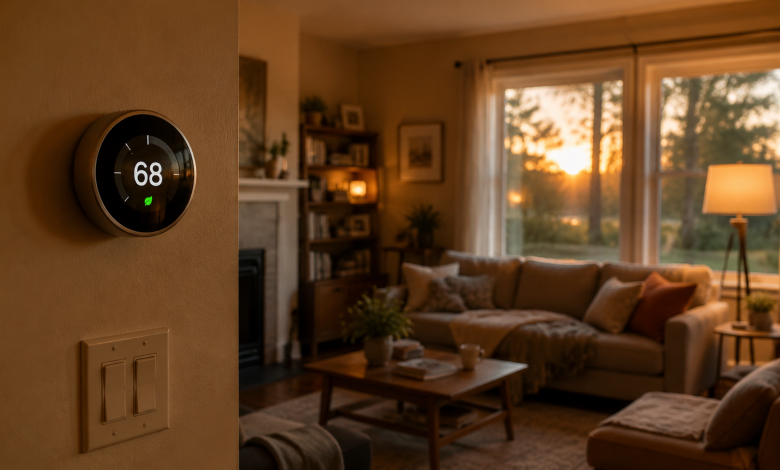
There’s something quietly strange about modern comfort. You wake up on a Tuesday, shuffle toward the thermostat, and notice it’s already set to 68°F exactly where you want it. You didn’t touch it the night before. Nobody did. Your smart home system figured it out sometime in the past few weeks, learning that you run cold on weekday mornings, that your bedroom needs a slightly different temperature than the living room, and that you sleep better when the humidity drops a notch around midnight.
That’s not magic. It’s machine learning doing something it turns out to be exceptionally good at: paying attention to you, consistently, without ever getting bored.
Most people imagine machine learning as a boardroom technology algorithmscrunching financial forecasts, powering self-driving cars, or beating grandmasters at chess. But one of its most intimate applications happens in the mundane rhythms of daily life. What time you brew your first cup of coffee. When you usually start your commute. Whether you tend to crank up the heat before a shower or after. These seemingly trivial signals, when collected long enough, form a remarkably accurate portrait of who you are and what makes you comfortable.
How the Learning Actually Happens
The technical foundation here is less exotic than it sounds. Most smart home and personal comfort systems rely on a branch of machine learning called reinforcement learning, sometimes layered on top of simpler pattern recognition. The system doesn’t start with a rulebook. It starts with observations.
Take a smart thermostat as the clearest example. In the first few days, it simply records what you do when you adjust the temperature, by how much, and under what conditions. It cross-references these actions against time of day, day of week, outdoor weather, and sometimes occupancy sensors that detect whether anyone’s actually home. From this data, it begins constructing a behavioral model. Not a rigid schedule, but a probabilistic map of your preferences.
After a few weeks, the model becomes confident enough to act on its predictions. It pre-heats before you typically wake up. It dials back when you usually leave for work. When you come home twenty minutes early on a random Wednesday, it notices and slowly incorporates that kind of deviation into its understanding of your schedule. The system isn’t just memorizing your routine; it’s learning the flexibility within your routine.
What makes this different from a simple timer-based schedule is the ability to generalize. A timer can’t adapt when you work from home on a snowy Friday. A machine learning model, given enough context signals, starts to recognize the pattern: snow in the forecast plus your phone’s location staying home typically means you’ll want the heat up by 8 a.m., not 9.
Beyond the Thermostat: Where Habit-Learning Spreads
Temperature is just the entry point. The same underlying logic has quietly migrated into a surprising range of everyday systems.
Streaming platforms have been doing habit-learning for years, though we’ve normalized it to the point of invisibility. Netflix doesn’t just track what you watch it tracks when you watch, how long you stay in one genre before shifting, whether you finish series or abandon them mid-season, and what combinations of mood and hour tend to draw you toward comfort rewatches versus new discoveries. The recommendation engine isn’t trying to show you what’s popular. It’s trying to show you what will feel right for you, at this particular moment, given everything it’s observed.
Smart lighting systems follow a similar logic. Philips Hue and comparable setups learn that you prefer cooler, brighter light during morning work hours but warmer, dimmer tones around dinner. Sleep tracking apps learn your typical wind-down window and can trigger gradual light dimming automatically. Your phone’s adaptive brightness isn’t just responding to ambient light it’s also building a model of when you prefer it brighter or dimmer regardless of ambient conditions.
Even grocery apps are getting in on it. Some major retailers now use purchase history and browsing behavior to anticipate reorder cycles, flagging that you probably need coffee pods in about three days based on how quickly you’ve gone through them in the past. Habit-learning, at that point, has crossed from comfort into logistics.
The Tension Between Personalization and Surveillance
Here’s where the conversation gets thornier. All of this learning requires data, and data means observation. For the system to know when you wake up, it has to track when you wake up. For it to know your comfort preferences, it has to record your behavior in intimate domestic spaces.
There’s a legitimate debate about where personalization ends and surveillance begins. Most users accept the trade-off implicitly convenience in exchange for behavioral data without fully engaging with what that exchange involves. The data collected by a smart home ecosystem over two years isn’t just a record of temperature preferences. It’s a detailed log of your sleep patterns, daily schedule, social habits, and physical presence at home. That information, depending on how it’s stored and who can access it, carries real privacy implications.
Companies have responded to this concern with varying degrees of seriousness. Some process habit data entirely on-device, meaning the learning happens locally and no behavioral profile ever leaves your home network. Others push data to the cloud, where it can be aggregated, analyzed at scale, and potentially used for purposes beyond what the user originally imagined. The technical capability to keep everything private exists. Whether it’s prioritized is a business decision, not an engineering one.
None of this means the technology is inherently sinister. But it does mean that comfort, when delivered through machine learning, comes packaged with a relationship and like any relationship, the terms matter.
What the System Gets Wrong, and Why That’s Interesting
One underrated aspect of habit-learning systems is how their failures reveal something true about human behavior.
Smart systems struggle with guests. When your partner’s family visits for a week and someone keeps adjusting the thermostat to 74°F, the model gets confused. It can’t distinguish a temporary anomaly from a genuine preference shift. High-end systems handle this by weighting recent data less heavily when it represents a sharp departure from established patterns, but it’s an imperfect solution.
They also struggle with emotional context. You might crank up the heat not because you’re cold, but because you’re sick, or anxious, or just came in from a run and your body’s thermoregulation is temporarily off. The machine sees the behavior, not the reason. Over time, this can create a system that’s slightly miscalibrated in ways that are hard to diagnose it knows what you do, but it doesn’t understand why, and the why turns out to matter more than we typically credit.
This limitation is actually philosophically interesting. Human comfort isn’t just physiological. It’s emotional, contextual, and often contradictory. We want warmth but also fresh air. We want quiet but not silence. Machine learning can approximate the quantifiable surface of these preferences with impressive accuracy, but the deeper texture of what makes a space feel like home resists clean algorithmic capture.
Comfort as a Conversation, Not a Setting
The most useful way to think about habit-learning systems isn’t as autonomous comfort managers, but as ongoing conversations between you and your environment.
The thermostat proposes; you confirm or correct. The playlist shuffles; you skip or let it play. Each interaction is a data point, and each data point nudges the model slightly closer to something that genuinely fits you. The system improves with use, but only because you keep engaging with it. Stop giving feedback by which I mean, stop living your life in it and the model stagnates.
There’s something unexpectedly human about that. The best relationships also improve through sustained, honest interaction. The people who know us best are the ones who’ve paid attention long enough to understand not just our stated preferences, but our actual ones the gap between what we say we want and what we consistently choose. Machine learning, in its own cold and statistical way, is doing exactly that.
It’s still strange that your thermostat knows you better than some of your acquaintances. But strange, in this case, is just another word for new.