
4 Closet Alternatives That Save Serious Square Footage
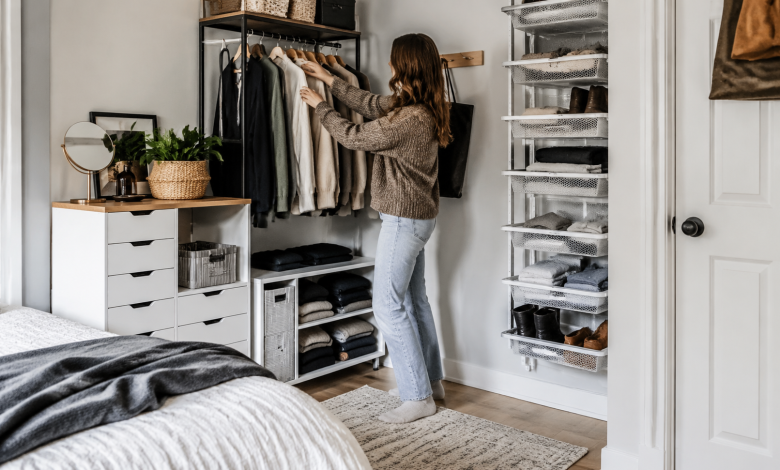
There’s a particular kind of frustration that comes with standing in a small bedroom, staring at a door-flanked wall and knowing that a traditional closet would swallow half the room whole. Most homes especially older construction, apartments, and the increasingly popular compact builds of the last decade were never designed with today’s wardrobe in mind. Somewhere between fast fashion hauls, work-from-home wardrobes, and seasonal gear that has nowhere to go, the standard six-foot closet became a relic that simply doesn’t scale.
But here’s the thing: the closet as we know it is a relatively modern invention. For most of human history, people stored clothing in chests, wardrobes, and on hooks along walls. The built-in closet only became a residential standard in the 20th century, largely because architects started treating it as a tax-exempt room addition. What we think of as “necessary” is actually just convention and convention is worth questioning when it’s eating three or four feet of depth out of every bedroom in your home.
The good news is that alternatives exist, and they’re not just functional stopgaps. Done right, they can make a room feel more considered, more layered, and frankly more interesting than a set of sliding doors ever could.
The Open Wardrobe System
Walk into any thoughtfully designed Scandinavian or Japanese-influenced interior and you’ll notice that clothing is often on display rather than hidden. Open wardrobe systems freestanding or wall-mounted rail configurations work on a principle that most closet evangelists resist: if your clothes are curated, there’s nothing to hide.
The square footage math is immediately compelling. A traditional closet needs roughly 24 inches of depth to function. An open rail system mounted to a wall can operate with as little as 14 to 16 inches of projection, and because it doesn’t require a dedicated enclosure, the visual footprint stays light. The room doesn’t shrink behind a wall of doors.
The practical upside goes beyond measurements. Open systems force a kind of ongoing editing. When your shirts are visible every morning, the ones you never reach for become obvious quickly. There’s no dark corner where forgotten pieces accumulate for years. What you own is what you see, and that constraint tends to produce a more functional, intentional wardrobe.
The common pushback dust, visual clutter is real but manageable. A linen curtain hung on a ceiling track can cover the full span of a rail system when you want the room to feel quieter. Baskets or low drawers underneath handle folded items and accessories. The result is a system that’s genuinely more flexible than any built-in, because you can reconfigure it when your needs change without touching a single wall.
The Armoire and the Case for Freestanding Furniture
The armoire has been solving the closet problem for centuries, and it deserves more credit in modern conversations about space efficiency. A well-chosen freestanding wardrobe occupies a defined rectangle of floor space, contains everything a small closet would, and does something a built-in never can: it moves.
That portability is underrated. In a rental apartment, a quality armoire travels with you. In a room you’re not ready to commit to remodeling, it buys time without sacrifice. In a guest room that needs to double as a home office, it can be positioned to define zones rather than sitting inert against a wall.
The key is proportionality. A six-door behemoth in a ten-by-twelve room creates the same visual heaviness as a bad built-in. But a narrower armoire even something36 to 40 inches wide with thoughtful interior organization can hold a surprising volume of clothing while reading as furniture rather than storage infrastructure. Pair it with a small chest of drawers and you’ve replicated full closet capacity without dedicating a single square foot to permanent construction.
Vintage and secondhand markets are particularly generous here. Mid-century and earlier armoires were built to last, often feature solid wood construction, and come in proportions that suit modern compact spaces better than many contemporary options. The patina of an older piece also adds something a closet door never does: character.
Under-Bed and Vertical Storage as a System
Treating under-bed storage as a closet alternative sounds like a compromise. It isn’t not if the approach is systematic rather than reactive. The space beneath a standard bed frame represents anywhere from 30 to 60 gallons of usable volume, and in a room where every square foot of floor space is in competition, that volume is too significant to leave to dust bunnies.
The shift in thinking required is vertical. Most people treat bedroom storage as a horizontal problem they think about floor space, wall runs, and the lateral spread of a closet rod. But a bedroom has ceiling height that almost always goes unused. Tall, narrow storage towers, wall-mounted shelving that runs from knee height to near the ceiling, and bed frames with integrated drawer systems all work on the same logic: store upward, not outward.
A platform bed with built-in drawers can absorb every out-of-season item, extra bedding set, and off-rotation pair of shoes that would otherwise require a secondary closet or overflow bin under the stairs. Four deep drawers under a queen bed can hold what most people would put in two dresser drawers and a shelf. The floor space used is exactly zero beyond what the bed already occupies.
Stack that strategy with vertical shelving and the math changes dramatically. A wall unit that runs84 inches high and 24 inches wide can hold more than a standard 5-foot closet section when properly organized and it projects only half the depth into the room.
The Converted Nook or Alcove
Most rooms have at least one architectural awkwardness a recessed wall, a chimney bump-out that creates a flanking nook, a corner that’s too narrow to furnish conventionally. These spots are often treated as liabilities, filled with a random chair or left empty. They’re actually the raw material for the best kind of closet alternative: one that uses space that wasn’t really usable in the first place.
An alcove 24 inches deep and 40 inches wide is too small for most furniture. But it’s the exact right dimension for a hanging rod, a shelf above, and a small drawer unit below. Add a curtain or a set of custom panels and it functions identically to a reach-in closet without claiming any additional floor space, because the floor space it uses was never in play.
The approach scales. Deeper recesses can take a full wardrobe configuration with hanging, shelving, and drawers organized to mirror whatever a built-in would provide. Shallow ones work beautifully for accessories, shoes, or folded items on open shelves. The visual effect, when the opening is framed thoughtfully, is of a room with more intention and craft than a standard plan would produce.
What makes nook conversions particularly valuable is that they sidestep the traditional closet’s core problem: the door swing. A standard hinged closet door needs clearance to open clearance that competes with beds, dressers, and pathways. A curtained alcove has no such requirement. The transition from closed to open happens in the space of a few inches, and the rest of the room stays usable.
There’s a broader principle at work across all four of these strategies. The traditional closet asks you to dedicate a box of finished space framed, drywalled, shelved to a single purpose. Every alternative here asks instead: what if storage and the room itself occupied the same space? What if organization was a layer of the room rather than a room inside the room?
That reframe is what makes the difference between a small bedroom that feels cramped and one that feels considered. Square footage is fixed. How you move through it is not.