
Why Your Small Bedroom Needs a Platform Bed, Not a Box Spring
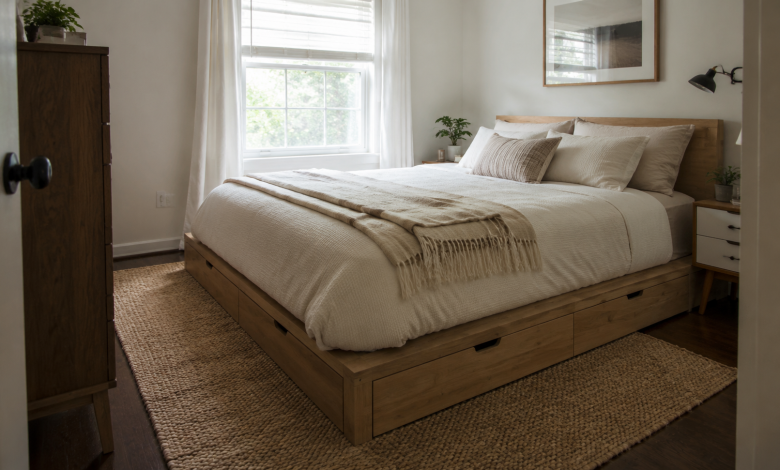
There’s a particular kind of frustration that comes with a small bedroom the feeling that no matter what you do, the space refuses to breathe. You push the dresser against one wall, angle the nightstand just so, and still the room feels like it’s closing in. Most people blame the square footage. But spend enough time thinking about bedroom design, and you start to realize the real culprit is usually sitting right in the middle of the room, raised up on a box spring, eating vertical space like it owns the place.
The box spring had its moment. For decades it was the default, the thing you bought because your parents bought one, because the mattress store bundled it in, because nobody questioned it. It made sense once when mattresses were thinner and needed thatcoil-on-coil bounce to feel comfortable. Today’s mattresses, especially memory foam and hybrid varieties, don’t need that mechanical assist. The box spring is largely a holdover. And in a small bedroom, holdovers cost you.
The Height Equation Nobody Talks About
Here’s something worth paying attention to: a traditional bed frame with a box spring typically puts your sleeping surface somewhere between 25 and 30 inches off the ground. A platform bed, depending on the design, lands between 12 and 18 inches. That gap often more than a foot of height does something specific to how a room reads visually.
Low furniture makesceilings feel taller. This isn’t a design myth; it’s basic spatial perception. When the dominant piece of furniture in a room sits closer to the floor, your eye travels upward rather than stopping at bed level. The room’s vertical space becomes part of the experience instead of being cut off by a tall, blocky mass. In a small bedroom, where every perceptual inch matters, this shift can feel transformative not just aesthetically, but physically. People routinely describe switching to a platform bed as making the room feel like it gained square footage it never actually had.
The box spring works against this logic entirely. It adds height that serves no visual purpose, creates a bulky silhouette that dominates whatever wall it sits against, and forces everything else in the room lamps, mirrors, art to calibrate around it.
Under-Bed Storage Is Not a Bonus Feature
In a small bedroom, storage isn’t optional. You need it desperately, and you need it hidden because visible clutter in a small space compounds the feeling of tightness instantly. This is where the platform bed earns its place not just aesthetically, but functionally.
The space beneath a platform bed frame, especially those with slat bases and clearance of 10 to 13 inches, becomes usable square footage. Flat bins for seasonal clothing, rolling drawers for extra linens, shoe organizers all of it slides neatly underneath and disappears. Some platform designs take this further, building in integrated drawers along the sides of the frame itself, turning the bed into a storage system that a small bedroom genuinely needs.
A box spring setup offers some under-bed clearance too, but the additional height means you’re storing things in an awkward zone not quite accessible, not quite hidden. And the visual weight of the setup above makes that storage feel clunky rather than intentional.
There’s also the matter of what you don’t have to fit elsewhere. Every sweater or spare pillow that lives under the bed is something that doesn’t need a drawer, a shelf, or a closet rod. In a small bedroom, that trade matters.
What the Room Actually Looks Like
Pull back and think about the visual composition of a small bedroom. The bed is the anchor it takes up the largest footprint, it’s the first thing you see when you walk in, and everything else arranges itself in relation to it. How that anchor presents itself visually determines whether the room feels curated or chaotic.
A platform bed, particularly one with a clean-lined frame in wood or upholstered fabric, reads as intentional. It sits flush to its environment. The lines are horizontal and grounded. Even a platform bed with a tall headboard doesn’t create the same visual bulk as a box spring setup, because the base stays low and the height is concentrated in one decorative element rather than distributed across the entire frame height.
Box spring setups tend to look provisional like the bed is still waiting to be properly installed. That extra height makes even a nice mattress look like it’s perched awkwardly, and the gap between frame and floor often creates a visual dead zone that’s neither useful nor attractive. Bed skirts exist almost entirely to solve this problem, and the fact that a product category had to be invented to hide the box spring’s aesthetic shortcomings says something.
The Structural Case, If You Still Need One
Some people hear “platform bed” and worry about support. It’s worth addressing directly: a quality platform frame with closely spaced wooden slats provides excellent, even support for modern mattresses. Many mattress manufacturers, particularly those making foam-based products, actually recommend or require a slat or solid base rather than a box spring, because the coil-on-coil setup can accelerate wear on materials that need firm, even pressure distribution.
The box spring was designed for innerspring mattresses with traditional construction. The world has largely moved past that, and the support argument for box springs has become almost entirely circular a justification built on decades of inertia rather than current material science.
What you get with a platform frame is a cleaner mechanical relationship: mattress meets base, base meets floor. No intermediary adding height and complexity for reasons that no longer apply.
Proportion and the Feeling of Enough
There’s a subtler point worth making, one that gets at something beyond storage and sight lines. Small rooms have a psychological weight to them. They can feel like a concession like you’re making do. The right furniture choices push back against that feeling, not by pretending the room is larger than it is, but by working with the space rather than fighting it.
A platform bed respects the proportions of a small room. It doesn’t try to dominate or compensate. It exists in the space honestly, leaving room for light to move around it, for the floor to show, for other elements to breathe. That quality call it spatial generosity is harder to achieve when your bed is elevated a foot higher than it needs to be, demanding attention and square footage that a small room can’t afford to give away.
People spend real money on small-space furniture, storage solutions, mirrors that make rooms feel larger. A platform bed accomplishes a version of all three at once: it opens up vertical perception, creates storage opportunity, and presents a cleaner visual footprint. The box spring doesn’t compete with that. It’s just height you don’t need, mass you can’t use, and a design logic that stopped being relevant a long time ago.