Vertical Gardening: The Ultimate Hack for Tiny Outdoor Areas
When Floor Space Runs Out, Look Up
There’s a particular frustration that comes with a small outdoor space. You have the desire to grow things herbs, flowers, vegetables, maybe something trailing and wild but the square footage simply refuses to cooperate. A narrow balcony. A concrete patio the size of a parking spot. A backyard that’s more of a corridor than a yard. For years, the conventional wisdom was to accept the limitation: plant a few pots, keep expectations low, move on.
Vertical gardening blows that thinking wide open.
The idea itself isn’t new. Humans have trained vines up walls and trellises for centuries, and the hanging gardens of ancient lore weren’t horizontal. But what’s changed is the intentionality behind it the shift from accidentally growing upward to deliberately designing a garden around a vertical axis. When you stop thinking of your garden as a floor plan and start treating every wall, fence, and railing as potential growing surface, the math changes entirely. A six-foot-tall, four-foot-wide fence panel suddenly offers twenty-four square feet of planting real estate that didn’t exist before.
The Physics of Small Space Thinking
Most people underestimate how much of a small outdoor space is wasted. Not wasted as in unused wasted as in spatially unconsidered. The vertical dimension from ankle height to eye level and above is almost always ignored, treated as dead air rather than productive territory. A balcony with three square feet of floor space might have sixty square feet of vertical surface if you count all four walls and the railing. That’s not a small space. That’s a misread space.
This reframe is where vertical gardening actually begins before you buy a single pocket planter or install a trellis. It’s a cognitive shift. Once you start looking at your outdoor area and asking “what can grow on that?” rather than “where can I put a pot?”, the options multiply fast.
Fences are probably the most obvious vertical canvas. A simple wooden privacy fence takes a pallet planter, a row of mounted pocket planters, or a stretch of wire trellis without complaint. Stucco walls are trickier but workable with the right anchoring hardware. Railings support hanging planters on the outside and climbing plants trained with simple hooks on the inside. Even a freestanding trellis placed strategically, not just shoved in a corner can divide a tiny space while doubling as a living wall.
Structures That Actually Work in Small Spaces
There’s a temptation, especially for newer gardeners, to overcomplicate the hardware. YouTube tutorials and garden center displays are full of elaborate modular systems, custom-built cedar frames, and precision-engineered pocket panels. Some of those are genuinely excellent. Most of them are overkill.
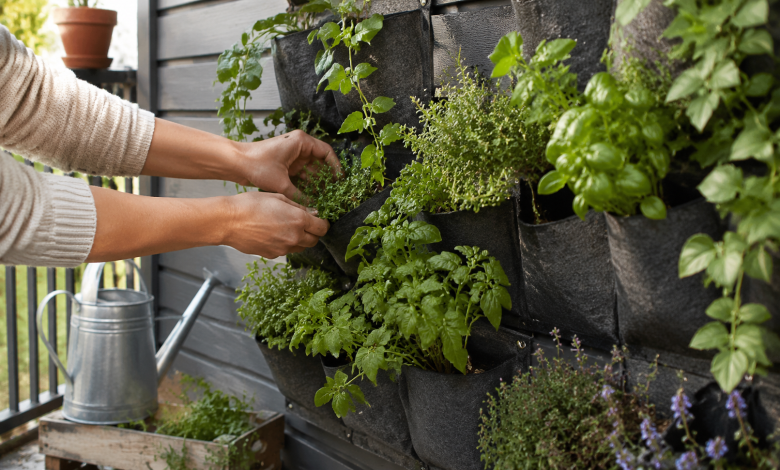
For a small patio or balcony, the tools that consistently perform best are the simple ones. A piece of galvanized steel wire grid the kind you’d find at a hardware store for a few dollars mounted flat against a fence or wall and planted with trailing herbs creates a functional, beautiful herb wall in a weekend. A single timber ladder leaning against a wall, fitted with a few cedar boards across the rungs, becomes a plant shelf that holds a dozen small pots without touching the floor except at two narrow points. Stackable felt pockets, the kind often sold for shoes in closet organizers, work surprisingly well for strawberries and small greens when hung from a fence hook.
The point isn’t the system. The point is that the structure exists at all that something is claiming vertical space and putting it to work.
Weight and water are the two engineering realities you can’t ignore. Vertical planters drain downward, which means the plants at the bottom of any stacked or pocketed system get more moisture than the ones at the top. Building in that expectation putting drought-tolerant plants at the top, moisture-lovers lower down saves a lot of frustration. Weight becomes a serious concern if you’re mounting anything to a rental apartment balcony railing or an aging fence. Wet soil is heavy. A large planter box mounted to a questionable fence board is a liability, not a garden feature. When in doubt, keep the installations lighter and more numerous rather than fewer and heavier.
Choosing What to Grow and What to Leave Alone
Not every plant is suited to vertical life, and part of the skill in making this approach work is learning which crops want to climb, which tolerate crowding, and which will struggle no matter how good your intentions are.
Herbs are almost universally excellent vertical garden candidates. Basil, thyme, oregano, mint, and chives all thrive in relatively small soil volumes and don’t develop the deep root systems that make them miserable in shallow pockets. Lettuce and other cut-and-come-again greens behave similarly they grow fast, stay compact, and reward regular harvesting rather than resentment the lack of legroom. Strawberries have been grown vertically for decades for exactly this reason; their shallow roots and trailing habit make them natural fits for pocket planters.
Climbing vegetables are the other obvious category, though they require a different approach. Pole beans, cucumbers, peas, and certain tomato varieties want to move upward, and giving them a trellis or wire frame to work with doesn’t just solve a space problem it actually improves yield by increasing sun exposure and airflow. A cucumber vine growing up a six-foot trellis against a south-facing fence in a twelve-square-foot patio will outperform the same plant sprawling across a raised bed. The constraint, counterintuitively, helps.
What doesn’t work well: large root vegetables, sprawling squash varieties, most fruiting trees even in dwarf form, and anything that needs to spread laterally to support its own weight. You can push some of these with creative container choices, but you’ll spend more time fighting the plant’s nature than gardening.
The Aesthetic Argument, Which Is Also Practical
Vertical gardens don’t just solve a logistics problem. They transform the visual experience of a small space in ways that are hard to fully convey until you’ve seen it happen.
A bare concrete wall reads as an endpoint it stops the eye and makes a space feel like what it literally is: a contained, limited area. Cover that same wall with cascading greenery and the eye doesn’t stop, it travels. The space doesn’t feel smaller for having more in it; it feels more dimensional, more alive. Green walls are one of the few design moves that simultaneously add function and make a compact area feel larger rather than more crowded.
There’s also a sound dimension that most people don’t anticipate. Dense plantings along walls and fences absorb ambient noise. A balcony garden thick with climbing plants along the railing provides a modest but real buffer from street noise, neighboring conversations, and the general texture of urban life. It’s not soundproofing, but it’s noticeable the difference between sitting in a hard, reflective box and sitting in something that has a bit of texture and absorption built into it.
Making It Last Beyond One Season
The most common failure mode for vertical gardens, especially in small urban spaces, is the enthusiasm gap. Someone installs a beautiful pocket planter wall in May, plants it up, keeps it going through June and July, and then the maintenance reality sets in. Vertical systems, because they hold less soil, dry out faster than ground beds or even large containers. In peak summer, a pocket planter wall in direct sun might need watering daily. That’s a commitment that not everyone calculates into their initial plan.
Drip irrigation is the most effective solution, and it’s more accessible than it sounds. A basic drip kit with a timer the kind that connects directly to a spigot or outdoor faucet costs less than most planter systems and eliminates the daily obligation entirely. Even a simple soaker hose threaded through a fence-mounted planter row can make the difference between a garden that survives August and one that doesn’t. If irrigation feels like too much infrastructure, at minimum choose a vertical system with a reservoir or self-watering mechanism built in. They exist at every price point.
Soil mix matters more in vertical situations than in ground planting. Standard garden soil is too heavy and compacts too quickly in containers. A mix with high compost content, some perlite or pumice for drainage, and coconut coir for moisture retention will stay loose longer, drain properly, and support plant health through repeated wet-dry cycles. It’s a minor adjustment that has an outsized impact on how often you’re replacing stressed plants.
The small outdoor space problem never fully disappears. But vertical gardening reframes it not as a limitation to manage but as a design constraint to work with creatively. Some of the most lush, productive, and genuinely beautiful garden spaces people have built are measured in single-digit square feet. They just happen to be very tall.