The Art of Neck Clashing: How to Layer Chains Without the Tangle
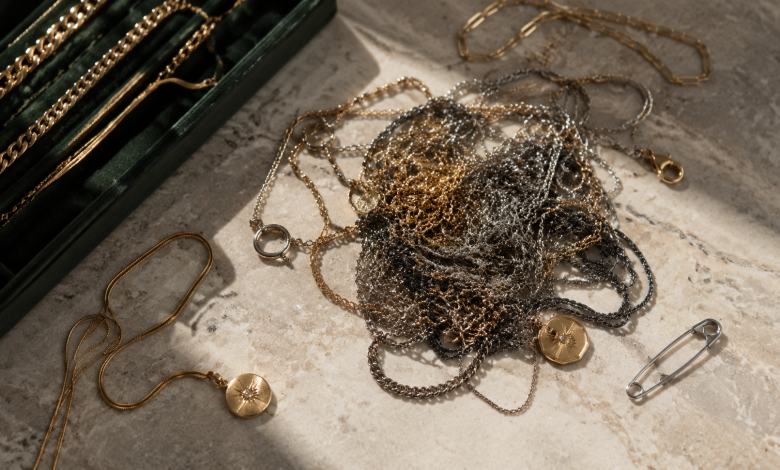
There’s a moment every chain lover knows. You reach into your jewelry box, pull out two or three necklaces you’re convinced will look incredible together, and fifteen minutes later you’re hunched over the bathroom counter with a safety pin, trying to separate what now resembles a metallic bird’s nest. The vision was editorial. The reality is a knot that requires the patience of a watchmaker and the fingers of a surgeon.
Layering chains has become one of those style moves that looks effortless on everyone else. Scroll through any fashion feed and you’ll see it done with the casual precision of someone who woke up that way. But behind every perfectly stacked neck situation, there’s either deliberate strategy or expensive purpose-built pieces doing the work invisibly. Most of us are operating somewhere in between, armed with good taste and a drawer full of tangled potential.
So let’s talk about how to actually pull this off. Not in a theoretical, “buy these five things” kind of way, but in the mechanical, practical, almost architectural sense of how metals hang against skin without becoming a disaster.
The Physics Nobody Talks About
Before we get anywhere near aesthetics, we need to acknowledge that chain layering is fundamentally a physics problem. Different chain weights respond to gravity differently. A delicate cable chain moves with your body like water. A thick curb link hangs with authority and barely sways. When you put those two on the same neck, they’re operating on completely different planes of motion, and motion is where tangles are born.
The culprit is almost always the clasp area. That’s where chains converge at the back of your neck, where the real estate is smallest and the links are most likely to thread through each other during the day. You twist to check a blind spot while driving, you pull a sweater halfway over your head, you absentmindedly touch your neck during a meeting. Every movement is an invitation for chains to interlock.
Understanding this changes the game. You stop thinking about layering as purely a visual exercise and start treating it as engineering. Which chains cancoexist peacefully based on their weight, link structure, and length differential? That question matters more than whether gold and silver can mix.
Length Differential Is Everything
The single most important variable in a successful layered look is the gap between each chain’s length. Two chains of identical length will tangle within the hour. It doesn’t matter how different they look or how careful you are. If they’re occupying the same vertical space on your chest, they will find each other and they will mate for life.
The general rule is a minimum two-inch gap between each layer. Some people push it to three or four inches for a more dramatic cascade. But two inches is the functional minimum where chains can move independently without their links catching on each other.
This means if your shortest piece is a 16-inch choker, your next layer should hit around 18 inches, and your third around 20 or 22. That staggered architecture gives each chain its own lane. They might brush against each other, but they won’t have the prolonged contact that leads to interlocking.
Here’s where it gets interesting, though. Not all length gaps are created equal. A two-inch difference between a thin chain and a thick chain works beautifully because their link sizes are so different that even when they do make contact, they slide past each other without catching. But two thin chains with a two-inch gap? They can still thread through each other’s delicate links if one has an open pendant bail or a textured link pattern. The finer the chain, the more length separation it needs from a similar chain.
Weight Pairing and the Anchor Principle
Think of your longest, heaviest chain as the anchor. It sits lowest, moves least, and provides the visual foundation that everything else is stacked above. This is your statement piece, the one with the pendant or the bold link structure. It stays relatively still because its weight keeps it in place.
Above that anchor, you build upward with progressively lighter chains. A mid-weight piece at the middle length, something with a bit of texture or a small charm. Then your lightest, most delicate chain at the top, sitting close to your collarbone where it catches light and frames your face.
This isn’t arbitrary hierarchy. It’s functional design. Heavy things at the bottom resist movement and create stability. Light things at the top can move freely without pulling anything else out of position. Reverse that order, put your heaviest chain closest to your throat and your finest chain dangling long, and you’ll watch the fine chain constantly swing into the heavier piece, wrap around it, and tangle within an hour.
The weight gradient also looks better visually, almost always. It creates a natural sense of order that the eye reads as intentional rather than chaotic. There’s a reason every jewelry brand that sells pre-made layering sets arranges them this way. The physics and the aesthetics are aligned.
Chain Type Compatibility
Not every chain plays well with others. Some link structures are essentially tangle machines when combined, and knowing which to avoid saves genuine frustration.
Box chains and cable chains are the workhorses of layering. Their links are smooth, closed, and uniform, which means they slide past other chains without catching. You can pair two cable chains of different weights and they’ll coexist peacefully as long as the length gap is there.
Figaro chains, with their alternating short and long links, are trickier. The longer links can act as hooks, catching the smaller links of a finer chain that brushes against them. They’re best paired with chains of equal or greater weight, where the links are too large to thread through.
Rope chains are the most problematic for layering. Their twisted structure creates tiny grooves that trap thinner chains like a finger trap. A rope chain layered with a delicate cable chain is almost guaranteed to tangle. If you love rope chains, layer them with other rope chains or with substantially heavier pieces that won’t get caught in the texture.
Herringbone and snake chains present their own issue. They’re flat, which means they don’t tangle easily with other chains, but they kink permanently if another chain gets caught under them and you pull. They demand the most careful handling and the widest length gaps from their neighbors.
The Clasp Problem and Its Solutions
Remember that clasp convergence zone at the back of the neck? There are real solutions for this beyond just hoping for the best.
The simplest is a layering clasp, those small connectors that hold multiple chains at a single point so they can’t twist around each other behind your neck. They work. They’re inexpensive. And they eliminate about seventy percent of tangling for most people. The trade-off is that they can limit how each chain falls in the front, making the arrangement slightly less organic looking.
A better long-term solution is intentional length planning that creates separation at the clasp level too. If your chains are 16, 18, and 22 inches, their clasps sit at different points along the back of your neck, which means they never share the same space even back there. This requires knowing your exact measurements rather than eyeballing it.
Some people solder their clasps shut on chains they never remove. It sounds extreme, but if you have a daily layered set that lives on your neck permanently, eliminating the clasp hardware removes the most common snag point entirely. Jewelers will do this for a nominal fee, and it also eliminates the risk of losing a chain when a lobster claw fails.
Material Mixing and the Tarnish Factor
The old rule about never mixing metals is dead. But there’s a practical consideration that replaced it: different metals tarnish at different rates and in different ways, and tarnish creates surface texture that increases friction between chains.
Sterling silver develops that familiar dark patina. Brass turns greenish. Plated pieces lose their coating at friction points. When a tarnished chain rubs against a polished one, the micro-texture of oxidation acts like velcro on a microscopic level. Chains that slid past each other beautifully when new start catching after a few months of mixed-metal wear.
The solution isn’t to avoid mixing. It’s to maintain your pieces or choose metals that resist tarnish. Solid gold, platinum, and quality stainless steel can live together permanently without developing grabby surface textures. If you’re mixing sterling with gold, clean the sterling regularly to keep its surface smooth.
Living With the Layer
There’s a final truth about chain layering that the perfectly styled images never show you. Some tangling is inevitable. Even with perfect length gaps, ideal weight gradients, and compatible chain types, the act of living in your jewelry means occasional chaos. You’ll sleep in them and wake up with a twist. You’ll pull on a jacket and shuffle the order. You’ll run and create momentum your careful planning didn’t account for.
The people who layer chains successfully aren’t the ones who never tangle. They’re the ones who’ve reduced tangling to a manageable rarity and learned to undo the occasional knot without panic. They know that a flat surface, a thin needle, and thirty seconds of patience fixes most problems. They know that the look is worth the minor maintenance.
Because when it works, when three or four chains are sitting in their perfect cascade, each catching light independently, each adding a layer of texture and intention to an otherwise simple outfit, there’s nothing in accessories that competes with it. It’s the kind of detail that makes people look twice without knowing exactly why. Not because any single piece is extraordinary, but because the composition is.
And composition, as it turns out, is just physics dressed up in gold.