The Absolute Best Way to Detangle Fine Hair Without Snapping It
Why Fine Hair Breaks So Easily And Why Most People Make It Worse
Fine hair is a different animal. Not just thinner than average, but structurally more vulnerable at every stage of the detangling process. The cortex the inner layer that gives hair its strength is narrower in fine strands, which means less protein mass holding things together when tension is applied. Add any moisture disruption, heat history, or chemical processing to the mix, and you’re working with hair that can snap under surprisingly low stress.
The frustrating part is that most detangling advice is written for hair in general, not for the specific biomechanics of fine strands. “Start from the ends and work your way up” is technically correct, but it’s table stakes. What fine hair actually needs is a much more deliberate approach one that accounts for its tendency to tangle more tightly, lose elasticity when wet, and respond badly to the wrong tools.
Here’s the thing most people don’t hear until they’ve already caused the damage: the moment you feel resistance is not the moment to push through. It’s the moment to stop, reassess, and change your method.
The Foundation: Wet or Dry Getting the Timing Right
There’s a persistent myth that fine hair should always be detangled dry. The logic makes surface-level sense wet hair has lower tensile strength and stretches before it snaps. And that part is true. Wet fine hair is more elastic in a way that can be deceptive; it doesn’t break immediately, it stretches past its recovery point and then breaks.
But here’s where the myth falls apart: dry fine hair, especially fine hair that’s been slept on or towel-dried roughly, is oftencoiled into knots that are physically impossible to remove without applied slip. Without moisture or product, you’re essentially trying to untangle dry thread the friction is too high and the knot tightens before it loosens.
The answer isn’t wet or dry it’s damp with product. Specifically, fine hair detangles best when it’s been lightly dampened with a spray bottle (not soaked), then coated with a detangling product that reduces friction without weighing strands down. The goal is to hit a moisture level that restores flexibility without triggering that dangerous over-elasticity that makes wet hair prone to snapping.
Choosing the Right Detangling Product for Fine Hair
This is where a lot of people go wrong without realizing it. They reach for a detangling spray designed for thick or curly hair something rich, creamy, heavily silicone-loaded and then wonder why their fine hair looks flat and limp for three days. The weight of those formulas is actively working against you.
For fine hair, you want a detangling product with two key properties: enough slip to allow knots to release smoothly, and a formula light enough that it doesn’t coat the shaft and cause buildup. Lightweight leave-in conditioners with a mostly water base, or detangling sprays that list humectants like glycerin or panthenol early in the ingredients list, tend to work well. Some people with very fine, easily weighed-down hair find that applying a tiny amount of regular conditioner to problem areas the nape, the ends and rinsing it minimally before detangling in the shower is actually their best option.
What to avoid: anything marketed as “deeply moisturizing” or “rich” for the purpose of detangling. Coconut oil, castor oil, and similar heavier oils might work wonders for coarser textures but they deposit too much on fine strands, leading to greasiness and paradoxically, more tangling between washes.
The Tool Question Brush, Comb, or Fingers First
No brush is going to save you if you skip the manual pre-detangling step. This is the part that gets skipped most often, and it’s probably the single biggest cause of unnecessary breakage in fine-haired people.
Before you introduce any tool, use your fingers to gently separate the largest sections of tangled hair. Think of it as breaking one large problem into several smaller ones. Your fingers can feel resistance in a way that acomb cannot, which means you can stop the instant a knot starts to tighten rather than pulling through it blindly. Work through the ends first always, without exception before moving toward the roots.
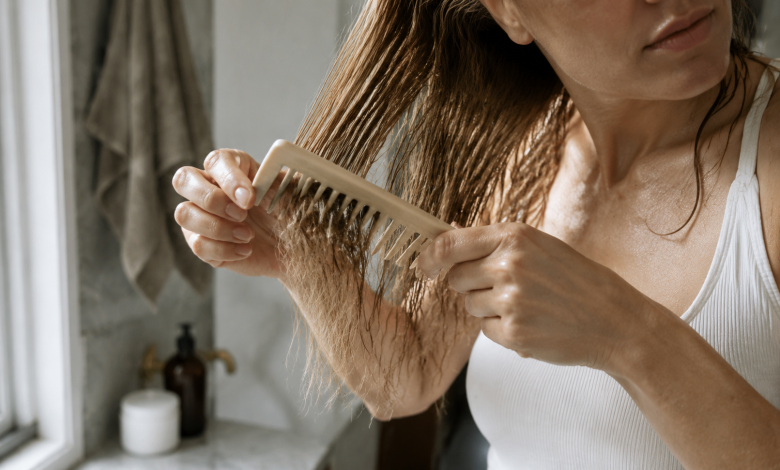
Once the major knots are loose, a wide-tooth comb is your best friend. Not a fine-tooth comb, not a paddle brush yet, and definitely not a boar bristle brush on tangled hair. Wide-tooth combs allow strands to move between the teeth without being forced, which is the entire mechanical principle you want here. Start at the ends, hold the section firmly between your fingers a few inches above where you’re combing (this distributes tension so it doesn’t travel straight to the root), and work in short, patient strokes upward.
The Wet Brush and similar flexible-bristle detangling brushes have become popular for good reason the bristles flex on contact with a knot rather than dragging through it. For fine hair, these work particularly well in the shower while conditioner is applied, when slip is at its maximum. Use them in the same bottom-up pattern, and keep the pressure light. You should never feel like you’re forcing anything.
Section Work: The Step Most People Skip When They’re in a Hurry
Trying to detangle fine hair as one undivided mass is a losing battle. The knots in the under-layer interact with the knots in the top layer, creating compound tangles that seem to regenerate as fast as you clear them.
Dividing hair into four to six sections before you start clipping the sections you’re not working on out of the way changes the entire experience. Suddenly the problem is manageable. You can actually see what you’re doing, you can apply product precisely where it’s needed, and you can track your progress. Each section gets the focused attention it needs.
This is especially true for the nape of the neck, which on fine hair tends to develop the tightest, most friction-based knots. That area specifically benefits from extra product and the slowest, most deliberate approach.
After Detangling: The Drying Phase Matters More Than People Think
Getting through the detangling process successfully doesn’t mean the risk is over. How fine hair is dried after detangling directly affects how badly it retangles before the next wash, and whether the ends always the most fragile section survive the cycle intact.
Rough towel drying is the enemy. Terry cloth creates enormous friction against the cuticle and causes fine strands to wrap around each other before they’re even styled. A microfiber towel or a clean cotton t-shirt, used with a gentle pressing and squeezing motion rather than rubbing, removes water without lifting the cuticle aggressively.
If you’re air drying, loosely finger-combing while the hair is still damp keeps strands parallel as they dry, which dramatically reduces the knot formation you’d otherwise have to deal with at the next detangling session. If you’re blow-drying, a round brush or a wide-tooth comb attachment on a diffuser works far better than forcing a fine-tooth brush through hair that’s drying too quickly to have proper slip.
The whole cycle prep, product, tool, technique, dry is a system. Fine hair doesn’t respond well to shortcuts taken at any point in that chain, and it will tell you exactly where you cut corners. But when you respect the process, what you’re left with is hair that moves easily, loses far fewer strands per session, and retains the kind of softness and body that fine hair, at its best, is actually capable of.