5 Tailoring Tricks That Will Completely Transform Your Silhouette
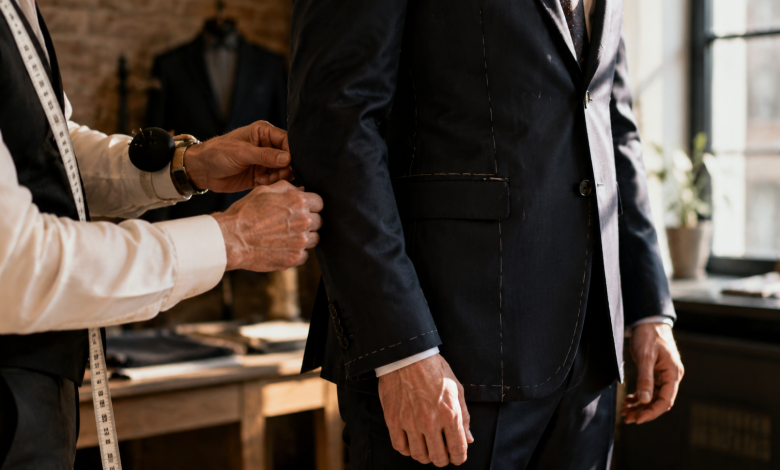
There’s a particular kind of envy that strikes when you watch someone walk into a room and simply look right. Not because their clothes are expensive, and not because they were born with the proportions of a Greek statue. It’s something quieter than that. The jacket sits where it should. The trousers fall cleanly. Nothing strains, nothing puddles, nothing fights against the body underneath. Most people assume this is luck or money. It’s almost always tailoring.
The truth that the fashion industry would rather you didn’t dwell on is that fit beats price every single time. A two-hundred-dollar suit cut precisely to your frame will outshine a two-thousand-dollar one hanging off you like a borrowed costume. And the gap between those two outcomes is usually a handful of small, deliberate adjustments. Here are the five that move the needle most.
The Shoulder Decides Everything Before You Even Button Up
If you remember nothing else, remember this: the shoulder is the one thing a tailor cannot easily fix, which is exactly why it matters most. Everything else on a jacket flows downward from that seam. Get it wrong and no amount of clever nipping at the waist will save you.
The seam where the sleeve meets the body should land right at the edge of your shoulder bone, where the flat plane of your shoulder breaks and begins to curve down into your arm. Not an inch past it, hanging into space. Not short of it, biting into the muscle. When it sits correctly, the fabric drapes off your frame the way water runs off a roofline, smooth and uninterrupted.
You’ll know it’s wrong when you see those telltale ripples. A divot or dimple just below the collar usually means the shoulder is too big and the fabric has nowhere to go. Horizontal wrinkles pulling across the upper back often mean it’s too tight. Reworking a shoulder means dismantling and reconstructing the entire top of the garment, which is expensive and risky, so the smarter move is to buy for the shoulders first and let a tailor handle the rest. Think of it as the foundation of a house. You can repaint the walls all day, but you cannot pour a new foundation under a building that’s already standing.
Suppression at the Waist Is the Difference Between a Sack and a Shape
Walk into any department store and try on an off-the-rack jacket, and there’s a good chance the body of it will fall straight down from your chest like a paper bag. Manufacturers cut for the widest possible range of bodies, which means they leave a generous amount of fabric through the midsection. The result reads as bulk, and bulk reads as larger, softer, and shapeless.
This is where waist suppression comes in, and it’s one of the cheapest, highest-impact alterations available. A tailor takes in the side seams and the center back seam, drawing the fabric in gently below the chest to trace the natural taper of your torso. Done well, it creates a subtle hourglass effect, broad through the chest and shoulders, narrowing at the waist. Suddenly you don’t just look thinner. You look athletic, intentional, alive.
The same principle works on dress shirts, where it tends to be even more dramatic. A standard shirt billows at the sides, and when tucked in, all that excess gathers into a doughy ring around your midsection. Two darts sewn vertically down the back, or a quick take-in along the side seams, pulls that fabric flush against your back and erases the puff entirely. People who do this for the first time often describe the change as losing ten pounds without setting foot in a gym. The number on the scale hasn’t moved. The silhouette has.
Length Is a Language, and Most People Are Speaking the Wrong One
Proportion is the invisible engine behind how tall, balanced, and put-together you appear, and length controls proportion more than almost anything else. There are three lengths worth obsessing over, and each one rewards a little patience.
Sleeve Length and the Quarter-Inch Rule
A jacket sleeve should end right at the wrist bone, that knob on the side of your wrist, allowing roughly a quarter to half an inch of shirt cuff to peek out beneath it. That sliver of linen orcotton does something almost magical. It frames the hand, signals attention to detail, and adds a faint vertical rhythm to the whole arm. Too long, and the jacket swallows your hands and makes you look like a kid in a hand-me-down blazer. Too short, and the proportions tip into something fussy and self-conscious.
The Trouser Break, and Why Less Is Usually More
The break is the fold of fabric that forms where your trouser hem meets your shoe. For decades the default was a full break, with the fabric pooling and crumpling over the laces. It looks dated now, and worse, it visually chops your leg in half and shaves height away. A slight break, where the hem just grazes the top of the shoe and creates one soft, gentle ripple, is the modern sweet spot. It keeps the leg line long and clean. If you’re shorter or simply want to look taller, a no-break hem that ends just at the shoe with no fold at all can add the illusion of inches.
Jacket Length and the Cover Rule
A jacket that’s too long drags your whole frame down and stumps your legs; one that’s too short looks like a shrunken afterthought. The reliable test is that the hem should fall around the point where your fingers curl when your arms hang naturally at your sides, and it should cover the curve of your seat. Get this right and your legs appear to start higher, which lengthens the entire lower half of your body.
Tapering the Trouser Turns Sturdy Legs Into a Clean Line
Here’s a quiet tragedy of menswear and womenswear alike: people spend on a good jacket and then let baggy, column-shaped trousers undo all of it. A trouser that runs wide and straight from hip to ankle hides the leg, and hiding the leg almost always makes it look heavier than it is.
Tapering is the fix. A tailor narrows the trouser gradually from the knee down to the hem, following the natural shape of your calf and ankle. The goal is not to strangle the leg into a skinny silhouette, which can look just as unflattering in the other direction. The goal is a gentle, continuous line that mirrors your actual shape. When the trouser tapers properly, it draws the eye downward in one unbroken stroke and makes you look longer and leaner from the waist down.
This pairs beautifully with attention to the rise, the distance from the crotch seam to the waistband. A rise that sits at or slightly above the hip bone elongates the leg and keeps the proportions balanced. A rise that sags low, on the other hand, drops the visual midpoint of your body and makes your legs look stubby no matter how good the taper is. The two work as a team.
Darts, Take-Ins, and the Art of Following the Body
The final trick is less a single alteration than a philosophy, and it’s the one that separates clothes that fit from clothes that look custom. Our bodies are not flat. We curve, we slope, we round in some places and hollow in others. Mass-produced clothing pretends none of this is true andcuts in straight, generous planes. Tailoring is the act of reintroducing the curves.
A dress shirt across a broad chest and trim stomach needs darts to follow that transition. A dress sitting on a defined waist needs to be brought in so the fabric traces the body rather than tenting away from it. Even a humble pair of jeans can be slimmed through the thigh and seat so they flatter instead of bunch. None of these moves are dramatic on their own. A dart here, a half-inch there. But they compound.
Think of a sculptor working in clay. No single press of the thumb creates the figure. It’s the accumulation of small, intentional adjustments, each one removing a little of what isn’t needed, until the form underneath finally emerges. Tailoring works the same way. You are not buying new clothes. You are revealing the shape that was always there, hidden under fabric that was never cut with you in mind.
That, in the end, is what unsettles people the first time they really commit to it. They expect a transformation of the body and instead get a transformation of perception. The mirror shows the same person, just finally seen clearly. And once you’ve felt the difference, walking around in poorly fitted clothes starts to feel a little like mumbling when you know you could be speaking plainly. The clothes were never the point. They were only ever a way of telling the truth about the body inside them.