How to Layer Vitamin C and Sunscreen for Maximum Radiance.
How to Layer Vitamin C and Sunscreen for Maximum Radiance
Why This Combination Deserves More Than a Passing Mention
Walk into any dermatologist’s office and ask what two products they’d keep if they could only choose two. Chances are, vitamin C serum and SPF will come up every single time. Not because the beauty industry manufactured that answer, but because decades of clinical research have backed it. These two products, when used together correctly, form what many skin experts quietly refer to as the most effective daytime skin protection duo available without a prescription.
The problem is that most people are using them wrong. They’re layering in the wrong order, choosing incompatible formulas, or applying at the wrong time and then wondering why their skin looks dull instead of radiant, or why their sunscreen seems to pill up no matter what they do. Getting this pairing right isn’t complicated, but it does require understanding what each product is actually doing on your skin.
What Vitamin C Actually Does (and Why It Matters in the Morning)
Vitamin C, in the context of skincare, usually means L-ascorbic acid the most bioavailable and research-backed form. It’s an antioxidant, which means its job is to neutralize free radicals. Those are the unstable molecules generated by UV exposure, pollution, stress, and oxidation. Left unchecked, free radicals degrade collagen, accelerate pigmentation, and quietly age the skin over time.
Here’s the part that surprises people: vitamin C doesn’t block UV light. It doesn’t function as a sunscreen at all. What it does is intercept the downstream damage that UV rays cause. Think of it less like a shield and more like a cleanup crew that arrives before the mess fully forms. That’s why timing matters. Applied in the morning, before sun exposure, vitamin C is positioned to do exactly that work.
There’s also the brightening side of the equation. Vitamin C inhibits tyrosinase, an enzyme involved in melanin production. Over consistent use, this translates to a more even skin tone, reduced dark spots, and that particular kind of luminosity that looks like skin working well from the inside not glow from highlighter.
The Sunscreen Side: Chemical, Mineral, and Why It Changes Everything
Sunscreen is where things get nuanced, and where a lot of the confusion about layering comes from.
Mineral sunscreens use zinc oxide or titanium dioxide as their active ingredients. These minerals sit on the surface of the skin and physically deflect UV rays. They don’t absorb into the skin in the same way chemical filters do, they’re generally stable across different pH ranges, and they tend to play well with vitamin C formulas without any notable interaction concerns. If you’re using a high-potency vitamin C serum anything above 15% L-ascorbic acid a mineral SPF is often the safer pairing, particularly for sensitive skin.
Chemical sunscreens work differently. They absorb UV radiation and convert it into heat, which the skin then releases. These formulas often feel lighter, spread more easily, and work better under makeup. But here’s where chemistry matters: many chemical UV filters, particularly avobenzone, can undergo photodegradation they break down when exposed to light. Some research suggests that certain antioxidants, including vitamin C, may help stabilize these filters and extend their efficacy. That’s actually an argument for using them together, not against it.
The real issue people encounter isn’t compatibility it’s texture and pH. L-ascorbic acid is effective at a low pH, typically between 2.5 and 3.5. Many sunscreens have a higher pH. Layer them in the wrong order without allowing time for the skin to adjust, and you may reduce the absorption of both products.
The Correct Order, and the Logic Behind It
Skincare layering follows one consistent principle: thinnest to thickest. The products most dependent on actual skin absorption go first, followed by those that work more on the surface.
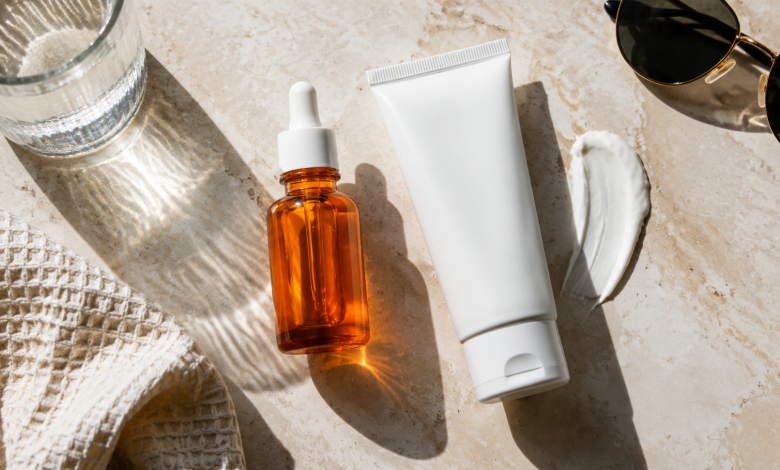
Vitamin C serum goes on before sunscreen. Every time, without exception.
After cleansing and any toner or essence you use, apply your vitamin C serum directly to dry skin. Press it in gently you don’t need to rub aggressively and then wait. This waiting period is probably the most overlooked step in the entire routine. Give it at least three to five minutes. This isn’t fussiness; it’s allowing the acidic formula to absorb and the skin’s surface pH to normalize before you add anything else on top. Rush this step, and you’ll likely find your sunscreen pilling or applying unevenly.
If you use a separate moisturizer, it goes on next. Then sunscreen goes on last, as the final layer before you step outside. Sunscreen needs to stay close to the skin’s surface to function burying it under heavy creams or treatments can compromise its efficacy.
A practical note on amount: a nickel-sized amount of serum and a quarter-teaspoon of SPF, roughly, for the face. Most people underuse sunscreen significantly, which undermines the entire point of wearing it.
Formulas That Work Well Together
Not all vitamin C products are equal, and the same goes for SPF. Pairing a highly oxidized (read: already-turning-orange) vitamin C serum with any sunscreen won’t give you the antioxidant benefit you’re looking for oxidized vitamin C has degraded and isn’t providing the same protection. Fresh, light-yellow serums in opaque or airtight packaging are what you want.
Some formulas have done the work for you by combining vitamin C and SPF into a single product. These can be convenient, but they come with a tradeoff: the concentration of vitamin C is usually lower than in a standalone serum, and the efficacy may not match what you’d get from layering dedicated products separately. For someone new to the combination or with a minimal routine, they’re a reasonable starting point. For anyone who wants real results, separate products remain the standard.
Water-based vitamin C serums pair most easily with both mineral and chemical SPF formulas. Oil-based vitamin C products which are more stable but less studied typically work better under heavier moisturizers and may not absorb as cleanly under lightweight sunscreens.
The Skin Types That Benefit Most, and the Nuances Worth Knowing
Dull, uneven, hyperpigmented skin responds most dramatically to this pairing. People dealing with post-inflammatory hyperpigmentation the dark marks left behind after acne often notice visible improvement within six to eight weeks of consistent morning use.
Sensitive skin types can absolutely use vitamin C, but they may need to start with a lower concentration (around 10% or below) and a derivative form of the vitamin, such as sodium ascorbyl phosphate or ascorbyl glucoside, which are gentler and more pH-neutral. These forms are less potent than L-ascorbic acid but far less likely to cause irritation, and still offer meaningful antioxidant benefit.
For anyone using vitamin A derivatives like retinol or tretinoin, the pairing is simple: vitamin C in the morning, retinol at night. They don’t need to share the same routine, and keeping them separate prevents potential irritation without sacrificing either product’s benefit.
Reapplication, Realistic Expectations, and the Long Game
One detail that rarely gets addressed honestly: sunscreen needs to be reapplied every two hours during sun exposure. Your morning vitamin C and SPF routine is not a set-it-and-forget-it situation if you’re spending time outdoors. For reapplication, you don’t need to redo your vitamin C serum a SPF spray or powder over makeup is practical enough for midday touch-ups.
The radiance people associate with this routine isn’t overnight. Real improvements in skin texture, tone, and that lit-from-within quality take consistent use over weeks and months. But unlike trends that come and go, this combination is built on sound biochemistry. Vitamin C intercepting free radical damage while SPF prevents UV injury used together, every morning is one of the few skincare habits with a strong enough evidence base to be considered genuinely foundational.