Designing a Family-Friendly Yard When Space is at a Premium
The Myth of the Sprawling Backyard
There’s a particular image burned into the American imagination: a wide green lawn stretching out behind a house, a swing set in one corner, a patio with room for a full dining table, maybe a vegetable garden along the fence. Kids chase each other through the sprinklers. Adults sit back and watch from comfortable chairs. It’s a picture that sells homes in real estate listings, and it quietly sets a standard that most families simply cannot meet.
The reality for a growing number of households is a narrow side yard, a townhouse patio measured in feet rather than acres, or a shared outdoor space that technically belongs to everyone and practically serves no one. Urban density keeps climbing. Lot sizes keep shrinking. And yet the need for a functional, safe, genuinely enjoyable outdoor space doesn’t shrink with them.
The challenge isn’t square footage. It’s the thinking that square footage is the only resource that matters.
Start With How the Space Is Actually Used
Before you buy a single planter or research swing set dimensions, spend a week simply observing. Where do the kids naturally gravitate the moment they go outside? Where do you stand when you’re trying to keep an eye on them while also doing something else? What corners feel wasted? What parts of the yard are avoided because they’re uncomfortable too exposed to sun, too close to the neighbor’s fence, too loud from the street?
Most design mistakes in small yards happen because someone skips this step and defaults to convention. They plant grass because that’s what yards have. They install a standard rectangular patio because that’s what patios look like. But in a space that offers little margin for error, every square foot that isn’t pulling its weight becomes a problem.
A small yard designed around actual behavior patterns can outperform a larger yard designed around assumptions. If your kids are between three and seven, they don’t need sprawling open space as much as they need varied sensory environments a patch of loose gravel to dig in, a raised platform to climb on, a spot tucked slightly out of sight where they feel like they’ve found something secret. The yard doesn’t need to be big. It needs to feel layered.
The Vertical Dimension People Forget
Ground-level planning is instinctive. It’s how we walk through space, so it’s how we tend to design space. But a yard with a tight footprint gains enormous potential the moment you start thinking about what’s happening at four feet, at six feet, at ten feet.
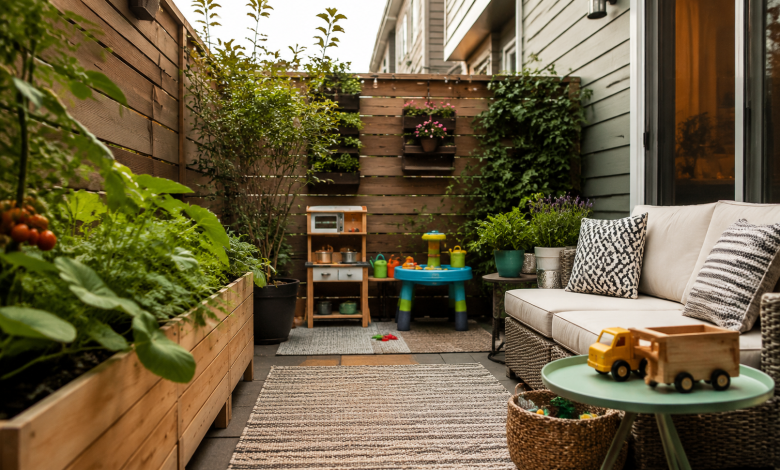
A fence that simply marks a boundary is a missed opportunity. The same structure, fitted with pocket planters or a mounted herb wall, becomes both a privacy screen and a kitchen garden. A pergola or shade sail doesn’t consume yard space so much as it creates a distinct zone within it suddenly you have a defined outdoor room that makes the whole yard feel more intentional and more generous. Children read elevated structures as adventure. Even a modest raised platform, eighteen inches off the ground, transforms how a small yard feels to a six-year-old. It becomes a fort, a ship, a lookout post. The play value is disproportionate to the cost or footprint.
Vines on a trellis can soften a wall that would otherwise feel oppressive. A canopy of climbing plants along one edge of a tight patio creates the psychological sensation of enclosure without actually closing anything off and psychological comfort matters more than most people realize when it comes to how much time families actually spend in their outdoor spaces. An uncomfortable yard is an empty yard.
Designing for Multiple Ages Without Creating Chaos
Family-friendly doesn’t mean designing exclusively around children, though it can feel that way when you have young kids. The honest tension in any shared outdoor space is that a toddler’s needs and an adult’s needs rarely overlap neatly. What a four-year-old considers the best possible surface loose sand, mud, water is usually what adults find exhausting to manage. What adults want a clean table, a functional grill, somewhere to sit that doesn’t involve stepping over scattered toys can make a yard feel sterile to children.
The answer in a small space isn’t to compromise everything into uselessness. It’s to zone clearly, even at a small scale.
A 400-square-foot backyard can reasonably accommodate a six-by-eight play zone with a ground-level water table and digging area, a narrow paved pathway connecting spaces so the yard is navigable in all weather, a small dining surface that folds or stacks when not in use, and a border planting along at least one edge that gives adults something green and living to look at. None of this is lavish. All of it is purposeful.
The trick with multi-age design is identifying which elements genuinely age out and which ones don’t. Climbing structures with low ground clearance work from ages two through roughly eight. A raised garden bed works for a curious four-year-old and a twelve-year-old doing a school project. A fire pit works for adults and captures the complete attention of every child old enough to sit safely near it. Prioritize elements with long useful lives.
Grass Is Optional
This is where a lot of families hesitate, because the mental image of a yard still defaults to green lawn. But grass is expensive to maintain, requires irrigation, and in a very small space, it usually ends up as a narrow strip that looks thin and tired, compacts easily under foot traffic, and provides none of the actual benefits grass offers in larger quantities.
Decomposed granite, pea gravel, rubber mulch over compacted ground, artificial turf, or even a poured concrete surface with strategic cracks left for ground cover can all give children safe, durable surfaces to play on while dramatically reducing maintenance overhead. Mixed hardscape and softscape part paved, part planted often works better in tight yards than any all-or-nothing approach.
The families who end up loving their small yards tend to be the ones who let go of the grass obligation early. Once you stop allocating square footage to lawn, the options multiply quickly.
Safety as Design, Not Afterthought
In a compact yard, the proximity of different elements means that safety considerations interact in ways they wouldn’t in larger spaces. A fire pit two feet from a play structure is a problem. A water feature without clear visual separation from a gate is a problem. Tripping hazards between a running child and a hard edge are problems that a more spacious layout might absorb by accident, but a small yard needs to address on purpose.
The families who design small yards well tend to run a simple mental exercise: walk through the space imagining a child moving at full speed with zero spatial awareness. Where would that child fall? What would they fall into? Can a toddler reach the gate latch? Is there a blind corner where an adult can’t see what’s happening?
Good safety design in a small yard doesn’t make it feel like a padded room. It makes it feel like the adults who built it actually thought about how children exist in space chaotically, joyfully, and with no concept of consequence.
The Longer Game
A small yard designed well when your kids are young doesn’t need to be torn apart when they’re teenagers. The best investments are the ones that transition. A sandbox with a lid becomes a planter. A play platform becomes outdoor seating. A gate that kept toddlers contained eventually just becomes part of the garden’s structure. Thinking about each element’s second life, or at least not designing yourself into a corner, is what separates a yard that serves one chapter of family life from one that keeps working across many.
Small spaces reward intentionality. They punish improvisation. But they also when done with clarity and a bit of courage to abandon conventions that were never really serving anyone have a way of becoming the kind of yard that gets used every single day.