Smart Baby: Simple Activities to Boost Newborn Brain Development
The Brain That Builds Itself in the Dark
Before a baby ever opens their eyes in a delivery room, their brain has already been quietly under construction for months. By the time they arrive screaming, wrinkled, astonishing they carry roughly 100 billion neurons. That number sounds impressive until you learn that the real work hasn’t started yet. Neurons alone don’t do much. What matters is the connections between them, the synapses, and in the first years of life those connections form at a pace that will never happen again. We’re talking about a million new neural connections per second in early infancy.
That figure is worth sitting with for a moment. Not because it should make parents anxious, but because it reframes something important: the ordinary moments of caring for a newborn feeding, talking, holding, playing are not just acts of love. They are, quite literally, acts of brain construction.
Why “Stimulation” Is the Wrong Word
Somewhere along the way, infant brain development got tangled up in the language of productivity. Flash cards. Educational videos. Structured “enrichment programs” for babies who can’t yet hold their own heads up. The word stimulation gets thrown around as if the goal is to push more data through a small system faster.
The science tells a different story. What newborn brains respond to most powerfully isn’t novelty or intensity it’s relationship. It’s contingency, the experience of cause and effect between a baby and a caregiver. When a baby coos and a parentcoos back, when an infant reaches and someone responds, the brain registers something profound: my signals matter. My world is responsive. That foundational sense of safety and predictability is what allows all other learning to happen.
Simple doesn’t mean passive. It means human.
Talk to Them Like You Mean It
One of the most well-replicated findings in developmental neuroscience involves something almost embarrassingly low-tech: talking to your baby. Not narrating mechanically “Now I am putting on your sock. Now I am picking up the sock you just kicked off” but genuine, warm, responsive verbal exchange.
Parents naturally slip into what researchers call child-directed speech, or “motherese.” The higher pitch, the exaggerated intonation, the slower pace. Babies are wired to attend to it. Their heart rates change. Their pupils dilate. Their brains light up in language regions that are still months away from producing a single intelligible word.
What you say matters less than the fact that you’re saying it to them, watching their face, pausing for their response, and treating their wiggles and gurgles as a real turn in the conversation. This back-and-forth is called serve and return, and pediatric researchers consider it one of the most important brain-building activities available to any family, free of charge, at any hour of the day.
The Intelligence of Touch
There’s a famous set of studies, troubling to read, that documented the developmental outcomes of children raised in severely under-resourced orphanages where physical contact was minimal. The results were stark delays in cognition, language, emotional regulation, even physical growth. The takeaway wasn’t just about deprivation in extreme circumstances. It pointed toward something fundamental about how mammalian brains develop: touch is not comfort. Touch is information.
For newborns, skin-to-skin contact the kind that happens when a parent holds a baby against their bare chest regulates body temperature, stabilizes heart rate, reduces cortisol, and supports the development of neural circuits involved in stress response. Kangaroo care, as it’s called in NICU settings, was originally developed for premature infants but the research on its benefits extends well into full-term newborn care.
Gentle massage is another practice with a surprisingly solid evidence base. Studies out of the Touch Research Institute at the University of Miami found that regular gentle massage in infants improved weight gain, sleep patterns, and motor development. The mechanism is partly neurological: tactile stimulation activates the vagus nerve, which in turn influences the systems governing digestion, immune function, and emotional calm. You don’t need a technique. You just need your hands and your attention.
The Case for Doing Very Little, Very Well
Here’s where a lot of well-meaning parenting advice goes sideways: it implies that more is better. More activities, more toys, more exposure to different sensory inputs. The infant brain does not work this way. It works by depth, not breadth.
A newborn’s visual system, for instance, can only focus clearly at about eight to twelve inches roughly the distance to a caregiver’s face during feeding. Their world is naturally limited, and that limitation is a feature, not a bug. Overstimulation loud environments, rapidly changing visual inputs, too many different faces and voices activates the stress response and shuts down the exploratory learning state.
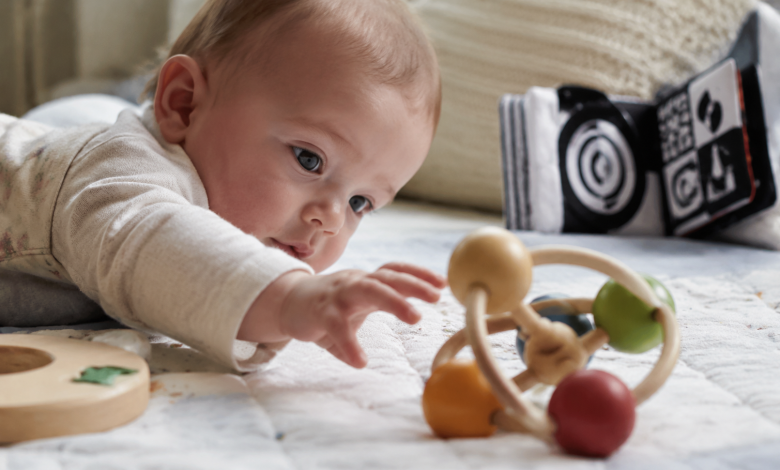
The activities most consistently associated with healthy newborn brain development share a common quality: they are calm, repetitive, and responsive. A parent singing the same lullaby every night. A slow walk where you narrate what you see. Tummy time on a quiet floor while you lie down at eye level and make faces. None of this looks impressive on an Instagram grid, but it’s doing the quiet heavy lifting of neural development.
Reading Before They Can Read
Board books for a two-week-old can feel slightly absurd. They can barely track movement with their eyes. And yet the habit of reading aloud to infants even from the earliest weeks turns out to matter for reasons that have nothing to do with the content of the book.
What matters is the shared attention. The warmth in a parent’s voice. The rhythm of language delivered in an intimate, focused way. When pediatricians began recommending reading aloud from birth part of the Reach Out and Read program, now active in thousands of pediatric clinics the evidence bore out remarkable gains in language development and school readiness years later.
You can read a grocery list to a newborn and accomplish some of the same neurological goal. The point isn’t the vocabulary or the story. It’s the experience of being talked to as though you matter, as though your attention is worth holding, as though the world has interesting things in it and someone is committed to sharing them with you.
On Music and the Rhythmic Brain
The human brain has a deep relationship with rhythm that predates birth. Fetuses respond to music in the third trimester. Newborns show a measurable preference for musical patterns they were exposed to in utero. This isn’t a quirk it reflects something about how timing and pattern are woven into neural development from the beginning.
Music, especially live music made by caregivers, activates multiple brain systems simultaneously: auditory processing, emotional regulation, motor anticipation, social bonding. A parent humming while rocking a baby is doing something neurologically sophisticated without thinking about it. Research from McMaster University found that babies exposed to interactive musical play showed earlier development of both communication skills and social development markers compared to control groups.
You don’t need to sing well. Off-key and earnest reaches the same part of the infant brain as a trained voice. What matters is the live, present, human quality of it the warmth that recorded music can approximate but never quite replicate.
Presence as the Ultimate Brain-Booster
If there’s one thing the research keeps circling back to, it’s this: the quality that most consistently predicts healthy brain development in infancy is not the type of activity or the number of toys or the sophistication of the environment. It’s sensitive, responsive caregiving.
That phrase sounds clinical. What it means in practice is: notice your baby. Respond when they signal. Follow their gaze. Match their mood. Put down the phone not because technology is evil but because your face, your voice, your smell, your warmth these are the richest developmental environment your baby will ever encounter.
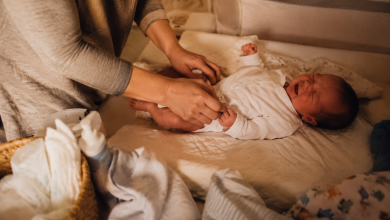
The good news embedded in all of this is that the activities that build newborn brains are not burdensome or expensive or time-consuming in a structured way. They are the texture of ordinary care, done with intention. A diaper change where you make eye contact and talk softly. A feeding where you’re actually there, not scrolling. A fussy evening that you meet with calm presence instead of panic.
Neurons wire together through experience. The experiences that matter most, it turns out, are the ones that say: you are seen, you are safe, and you are not alone in this world.