3 Things I Wish I Knew Before Popping My First Cystic Pimple.
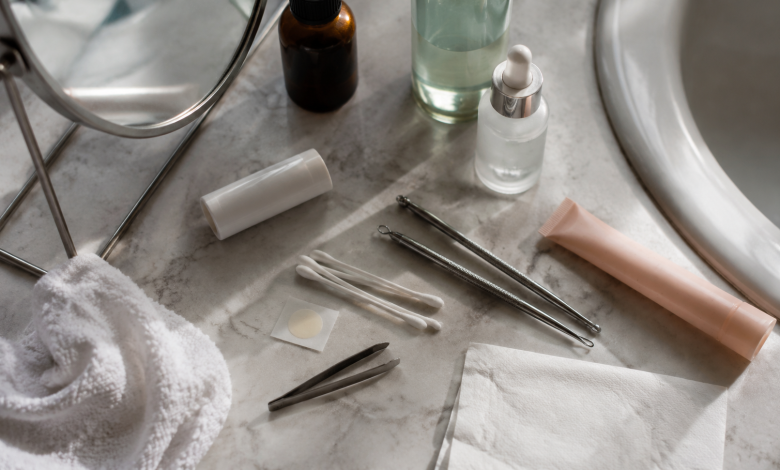
I remember the exact moment. I was 19, standing in front of the bathroom mirror at 11pm, staring at this deep, angry, almost architectural lump sitting on my jawline. It had been there for five days. It wasn’t a regular pimple no white head, no visible exit point, nothing satisfying to look at. Just this hard, throbbing mass living underneath my skin like it had signed a lease. And I, with all the patience of a teenager who had absolutely none, decided tonight was the night I was going to deal with it.
What happened next was not a quick fix. What happened next was three weeks of damage control, a hyperpigmented scar that stayed on my face for close to a year, and a genuinely humbling education in skin biology I never asked for. So if you’re standing at that same mirror right now or if you’ve done what I did and you’re currently applying ice to your face in quiet regret here’s what I wish someone had told me.
Cystic Acne Doesn’t Live Where You Think It Does
The single most important thing to understand about a cystic pimple is its depth. Regular surface breakouts form in the upper layers of the skin, which is why they eventually come to a visible head. Cystic acne is different. It originates deep in the dermis, sometimes close to the subcutaneous fat layer, forming when a hair follicle becomes so blocked and inflamed that the infection can’t travel upward. It has nowhere to go. That’s what makes it feel so pressurized, so painful when you touch it, so stubbornly invisible from the surface.
When I pressed down on mine that night, I wasn’t releasing anything. I was compressing a sealed, infected cavity deeper into surrounding tissue. The infection didn’t come out through my pores it spread laterally beneath the skin. Think of it like squeezing a water balloon from the bottom. The contents don’t escape; they just redistribute under more pressure. By morning, what had been one concentrated bump had become a swollen, red, inflamed area spanning nearly an inch across my jaw. I had turned a singlecyst into what looked like a minor collision with a doorframe.
This is the fundamental misunderstanding most people carry into that bathroom moment. We’ve been conditioned by years of satisfying extractions the kind that pop cleanly and disappear overnight to believe that pimples respond to pressure. Cystic acne is not that. It’s a different category of breakout, playing by entirely different rules, and treating it like a standard whitehead is where most of the real damage starts.
The Inflammation Is the Problem, Not the Pus
Even if a cystic pimple eventually develops a head which some do, over time the pus itself is almost secondary to the larger issue. What makes cystic acne so persistent and so scar-prone is the inflammation. The surrounding tissue is already in crisis mode. Immune cells are flooding the area. The skin is irritated at a level you can’t see. And when you add manual trauma on top of that fingers, nails, a comedone extractor used incorrectly you’re essentially pouring gasoline on a fire that was already struggling to go out.
I had no framework for this at 19. I thought inflammation was just another word for “swollen” and that once I’d popped it, the swelling would go down. What I didn’t understand is that inflammation is an active biological process, and disrupting it physically doesn’t stop it it escalates it. My body had to restart the entire healing cascade from scratch, now with a fresh wound on top of the original infection. The recovery time didn’t shorten. It tripled.
Dermatologists often describe the inflammatory response to cystic acne as a kind of cellular war zone. The bacteria involved, primarily Cutibacterium acnes, triggers an immune overreaction where the collateral damage to surrounding tissue is actually what causes scarring not just the pimple itself. You can have a cystic breakout heal without scarring if the inflammation resolves gradually. You almost guarantee a scar when you physically rupture that environment before it’s ready.
This is also why the actual over-the-counter advice most people default to benzoyl peroxide, salicylic acid, sulfur works fine for surface acne but barely touches a true cyst. These ingredients work at or near the skin’s surface. The infection is nowhere near the surface. You’d need active anti-inflammatories to have any real effect, which is why a dermatologist’s go-to treatment for a severe cyst is often an intralesional cortisone injection a direct anti-inflammatory delivered exactly where the inflammation is. It doesn’t extract anything. It calms the immune response down so the body can resolve the cyst on its own timeline.
That single injection can flatten a cyst within 24 to 48 hours with zero scarring. Compare that to what my bathroom mirror produced. The difference in outcome is almost incomprehensible in retrospect.
What You Do in the Next 72 Hours Matters More Than the Pop Itself
Here’s the thing nobody tells you even if you’ve already made the mistake: the window after the pop matters enormously. I made a bad decision at 11pm on a Tuesday. But the decisions I made for the next three days made everything significantly worse.
I kept touching it. I applied every targeted treatment I owned in the same24-hour period a decision that burned and stripped the skin barrier right when it needed to be intact and functioning. I used a pore strip nearby two days later because there was still congestion in the area, which pulled at healing tissue. I skipped SPF because it was cloudy. Every one of these choices compounded the original damage in ways that didn’t show up immediately but became very visible over the following weeks.
What the skin actually needs after a traumatizedcyst whether you popped it or itruptured on its own is the opposite of aggression. It needs a working moisture barrier. It needs protection from UV, because post-inflammatory hyperpigmentation (the dark mark that lingers for months) deepens dramatically with sun exposure. It needs anti-inflammatory support, which can come from something as simple as a ceramide-based moisturizer, a gentle niacinamide serum, or just leaving it entirely alone. And it needs time, which is the resource none of us want to allocate to a pimple.
The scar I carried for nearly a year wasn’t the scar from the cyst itself. It was the scar from everything I did afterward. A clean wound, properly tended, heals. A repeatedly aggravated wound becomes a longer story.
If I could go back to that bathroom, I wouldn’t just stop myself from popping it. I’d hand myself a tube of hydrocolloid patches, a broad-spectrum SPF 50, and the address of a dermatologist. I’d say: this is not a problem you can solve with your hands tonight. Some things require patience, the right tools, or someone who actually went to school for this.
And then I’d turn the bathroom light off.