
The Exact Words to Use When Your Toddler Starts Screaming in Public
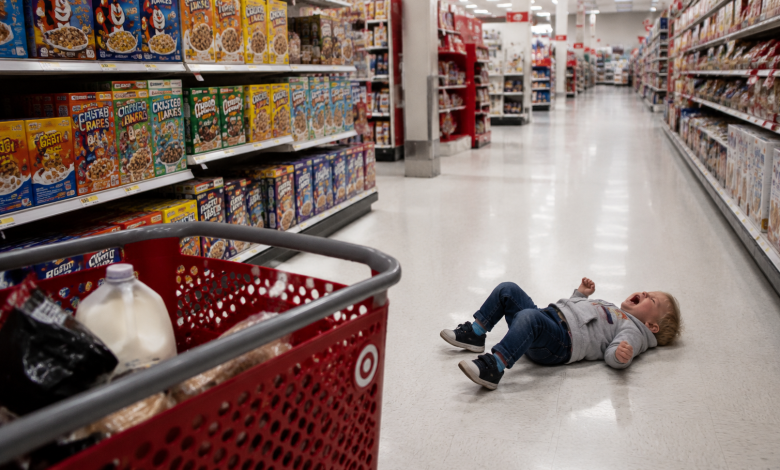
You’re standing in the cereal aisle of Target. Your cart has maybe six things in it. You had a plan in and out, fifteen minutes tops. And then it starts. Not a whimper, not a request. A full-body, top-of-the-lungs scream that seems to bounce off every surface in the store. People turn. You feel heat rise to your face. Your brain goes completely blank.
This moment this specific, excruciating moment is something almost every parent of a toddler knows. And yet no one really prepares you for it. Not the parenting books that talk about “connection before correction,” not the Instagram reels about gentle parenting, and certainly not your own childhood memories. When it’s happening, in real time, with strangers watching, you need words. Actual words. Not philosophy.
So let’s talk about those words.
Why the Wrong Words Make Everything Worse
Before getting to what works, it’s worth understanding why the instinctive responses tend to backfire so reliably. The most common parental reactions “Stop it right now,” “You’re embarrassing me,” “I’m going to leave you here,” “There is nothing to cry about” all share one thing in common: they’re addressed to a brain that cannot currently process them.
A toddler in full meltdown has flooded their prefrontal cortex. The part of the brain responsible for logic, consequence, and language comprehension is essentially offline. You are, in that moment, negotiating with a person whose reasoning center has left the building. Telling them to calm down is like telling someone mid-sneeze to stop sneezing. The biology simply doesn’t cooperate.
Worse, phrases like “you’re embarrassing me” introduce shame into the equation and shame doesn’t shrink meltdowns, it extends them. The child now has their original distress plus the new confusion of feeling bad about feeling bad. You’ve doubled the problem.
The First Thirty Seconds: Get Low, Get Quiet
The single most counterintuitive move and the one that actually works is to lower your voice instead of raising it. When you match your child’s escalating energy, you add fuel. When you go quiet and slow, you create a contrast their nervous system can actually respond to.
Get down to their eye level. This isn’t just symbolic. It removes the physical dynamic of a large person looming over a distressed small person, which is genuinely frightening even when that large person is someone they love.
The first words you want are simple and factual:
“I see you. I’m right here.”
That’s it. You’re not solving anything yet. You’re not bribing, threatening, or explaining. You are just naming your presence. For a toddler whose distress has essentially made the world feel chaotic, a calm anchor a physical, visible, verbal anchor is the first interruption to the spiral.
Some kids need a beat of silence after this. Some need you to gently place a hand on their back. Follow their cue. Don’t rush to the next sentence.
Naming the Feeling Without Negotiating With It
Once there’s even a sliver of connection eye contact, a pause in the screaming, any micro-signal that they’re registering you you move to naming what they’re feeling. Not asking. Naming.
“You’re really upset right now.”
“You wanted that thing and I said no, and that feels so hard.”
“You’re tired and we’re still in the store and that’s too much.”
The key here is that you’re not asking “what’s wrong?” because a two-year-old in crisis cannot tell you what’s wrong. You’re also not saying “I understand” which, to a toddler, is abstract noise. You’re putting language to the specific physical state they’re in, and that language does something neurologically real: it activates the parts of the brain responsible for self-awareness and helps regulate the emotional surge.
Dan Siegel, the neuropsychiatrist who coined the phrase “name it to tame it,” has spent decades documenting this mechanism. It’s not a parenting trend. It’s how brains work.
What you’re emphatically not doing in this phase is bargaining. No “if you stop crying I’ll get you a cookie.” That’s a lesson in a different subject entirely and it’s a lesson that will graduate into a much larger power struggle at a time you don’t want it.
The Transition Phrase That Buys You Both Time
After you’ve named the feeling, there’s often a suspended moment. The child hasn’t fully calmed, but they’ve registered that you’re not fighting them. This is where a lot of parents make the second mistake: they pivot too quickly to logistics. “Okay, now we need to finish shopping.” Too fast. You’ve broken the spell.
Instead, try: “We don’t have to do anything right now. Let’s just breathe for a second.”
This phrase does several things at once. It removes the time pressure that was likely part of their overwhelm. It models what calming looks like without ordering them to do it. And it gives both of you a moment to reset without abandoning the situation orcaving to the original demand.
If your child is old enough to take a few deep breaths with you even performatively do it together. Make it slow and obvious. The physical act of a controlled exhale genuinely activates the parasympathetic nervous system. You’re not performing for the other shoppers. You’re doing something that works.
When Nothing Works and You Just Need to Leave
Sometimes the meltdown has its own momentum and no phrase is going to interrupt it in the middle of a public place. This is not failure. This is biology.
In those cases, the right move is calm, physical exit. Not as punishment explicitly not framed as punishment but as practical regulation support. “You’re having such a big feeling. We’re going to go somewhere quieter.”
Pick them up if you can. Go to the car, to the lobby, to a corner of the store that’s less stimulating. You are not abandoning your errands as a reward for screaming. You are removing the sensory overload that is making their nervous system unable to regulate.
Once you’re in a calmer space, the sequence above becomes much more effective. “I see you. You’re really upset. Let’s breathe.” The environment matters enormously for toddlers they don’t have the internal resources to filter out the fluorescent lights, the cart noise, the stranger sounds, and also manage a big emotion. They need the external environment to do some of the regulation work.
What You Say to Yourself Matters Too
There is a parallel conversation happening during a public meltdown that no one talks about: the one inside your own head. “Everyone is judging me. I’m failing at this. My kid is a disaster. I should have known better than to bring them here.”
That internal script matters because it changes how you sound. Shame and panic leak into your voice no matter how carefully you choose your words. The parent who genuinely believes “this is developmentally normal and we’re going to get through it” speaks with a steadiness that their child can actually feel.
The truth is: most of the people watching have either been there themselves or they don’t have kids and therefore don’t get a vote. The stranger in the next aisle is not your audience. Your child is.
Remind yourself and this is worth saying quietly out loud if you need to “This is hard for them, not bad of them.” The difference between hard and bad is the entire emotional subtext of how you respond. Hard calls for comfort. Bad calls for correction. In the middle of a sensory and emotional storm, your toddler needs the former.
After the Storm: The One Conversation You Shouldn’t Skip
When things have calmed not five minutes later, not while they’re still sniffling, but genuinely later, possibly at home there’s a short, low-stakes conversation worth having. Not a lecture. Not a consequence review. Just a brief reconnection.
“Earlier at the store, you got really upset. That was a hard moment. We got through it together.”
That’s almost the whole script. You’re not relitigating what happened. You’re creating a narrative that includes both the difficulty and the resolution. You were upset. We got through it. Those two facts, held together, become the foundation of what psychologists call “narrative repair” the child’s developing sense that hard emotions have endings, and that you are someone who stays through them.
That story, told simply and without drama, is more powerful than any consequence or reward you could attach to a grocery store meltdown. It tells your kid something they need to know for the next twenty years: feelings are survivable, and you don’t have to face them alone.