How to Choose the Perfect Necklace Length for Your Neckline
You’ve stood in front of the mirror, holding a necklace up to your chest, tilting your head, squinting. Something feels off but you can’t name it. The pendant sits at an awkward spot, or the chain disappears into your collar, or the whole thing just looks like it belongs to someone else. Most of the time, the issue isn’t the necklace itself. It’s the conversation happening between the chain length and whatever neckline you’re wearing. Get that pairing wrong and even a beautiful piece of jewelry falls flat. Get it right and the effect is almost architectural, like the necklace was designed specifically for that dress, that blouse, that exact square inch of skin.
This isn’t about rules carved in stone. It’s about understanding proportion, negative space, and the visual rhythm that happens when metal meets fabric meets body.
Why Length Matters More Than You Think
Most jewelry advice fixates on style, metal tone, gemstone meaning. Those things matter, sure. But length is the structural decision. It determines where the eye lands, how much skin is framed, and whether the necklace complements or competes with your clothing. A 16-inch choker and a 30-inch opera length create completely different visual effects on the same person wearing the same outfit. One draws attention to the jawline and collarbones. The other elongates the torso and creates vertical movement.
Think of it like hanging a painting. The artwork might be stunning, but if you mount it too high or too low on the wall, the whole room feels slightly wrong. Necklace length works the same way. It’s placement. It’s spatial awareness. And it shifts depending on what frame you put around it, which in this case is your neckline.
The Language of Necklines
Before matching lengths to necklines, it helps to understand what each neckline is actually doing. Every neckline creates a shape, an opening, a frame of exposed skin. Some are wide and horizontal. Some plunge deep and narrow. Some sit high and close. Each one leaves a different canvas for jewelry to occupy.
A crew neck, for instance, creates a small circular boundary close to the throat. There’s very little exposed skin to work with. A V-neck, on the other hand, draws a downward arrow, naturally guiding the eye toward the center of the chest. A square neckline offers a geometric frame. A strapless top or dress leaves the entire upper chest and shoulders bare, which is essentially an open field with no boundaries at all.
Once you start seeing necklines as shapes rather than just style names, the pairing logic becomes almost intuitive.
Crew Necks and High Necklines
High necklines are tricky because the fabric itself occupies the space where a necklace would typically sit. Layering a short chain over a crew neck can look cluttered, like two things fighting for the same real estate.
The move here is to go longer. A pendant falling between20 and 26 inches drops below the neckline entirely, creating a vertical line that adds dimension to what might otherwise be a flat, fabric-heavy expanse. The necklace becomes an accent piece floating in its own space rather than competing with the collar.
Alternatively, if you want to stay short, wear the necklace over the fabric. A bold choker or collar-length piece worn on top of a turtleneck can look intentional and editorial. This works best when the necklace has enough visual weight, something chunky or textured, so it reads as a deliberate styling choice rather than a mistake.
V-Necks and the Mirror Principle
V-necklines are the most forgiving canvas for necklaces, partly because they create a natural arrow pointing to exactly where a pendant wants to sit. The classic advice here is to mirror the angle of the V with the necklace, and honestly, that advice holds up.
A pendant on a chain that falls to roughly the same depth as the V creates a satisfying visual echo. The neckline says “look here” and the necklace confirms it. The two shapes work in harmony rather than pulling attention in different directions.
Where people get tripped up is going too short. A choker with a deep V-neck leaves a large empty triangle of skin between the necklace and the point of the V. That gap can feel unfinished, like something is missing. You either want to fill the space the neckline creates or sit just above it. Landing in the middle of that open area tends to look accidental.
For a subtle V, a princess length of about 18 inches works beautifully. For a deeper plunge, consider 20 to 24 inches, letting the pendant sit comfortably within the frame without crowding the lowest point of the neckline.
Square and Boat Necklines
Square necklines have strong horizontal and vertical lines. They’re geometric. They’re structured. And they respond well to necklaces that either echo that geometry or consciously contrast it.
A shorter necklace that follows the line of the collarbone, somewhere around 16 to 18 inches, tends to complement the angular nature of a square neck. It runs parallel to the top edge of the neckline and reinforces the clean, architectural feeling. Round pendants or curved chains can soften the look if the square feels too rigid, but either approach works.
Boat necklines, which run wide across the shoulders with minimal depth, present a similar situation. There’s very little vertical space between the neckline and the throat. Chokers work here because they sit above the fabric line rather than trying to exist within a narrow strip of skin. Longer pieces also work, since they bypass the neckline entirely and create their own vertical territory further down the chest.
What tends to fail is a mid-length chain, around 18 to 20 inches, that lands right at the top edge of a boat neck. It collides with the fabric, gets caught, bunches awkwardly. You want to stay clearly above or clearly below.
Strapless and Off-Shoulder
When there’s no neckline to speak of, when the fabric starts at the bust or below the shoulders, you have maximum freedom and maximum risk. Everything is visible. There’s no frame to guide the eye, which means the necklace has to create its own structure.
This is where statement pieces shine. A bib necklace or a layered arrangement can fill the open space and serve as the visual anchor that the neckline doesn’t provide. Without something substantial, a bare upper chest with a thin, delicate chain can look underwhelming, as though you forgot to finish getting dressed. That’s not a universal truth, some people pull off minimalism here effortlessly, but the proportions need to be considered.
For strapless necklines, 16 to 18 inches works when you want the necklace to hug the base of the neck and act as a standalone focal point above all that bare skin. If you want something longer, 22 to 24 inches can create a lovely drape, but the piece itself should have enough visual presence to justify occupying that much open space without looking lost.
Scoop Necklines and the Goldilocks Zone
Scoop necks are curved, soft, and usually fall somewhere between a crew neck and a V-neck in terms of depth. They’re common. They’re comfortable. And they pair well with almost everything, which is both their gift and their curse, because “almost everything” can lead to decision paralysis.
The safest bet is a princess or matinee length, 18 to 22 inches, that follows the curve of the scoop. The necklace essentially traces a similar arc to the neckline, creating a layered, concentric effect. It feels natural because the shapes agree with each other.
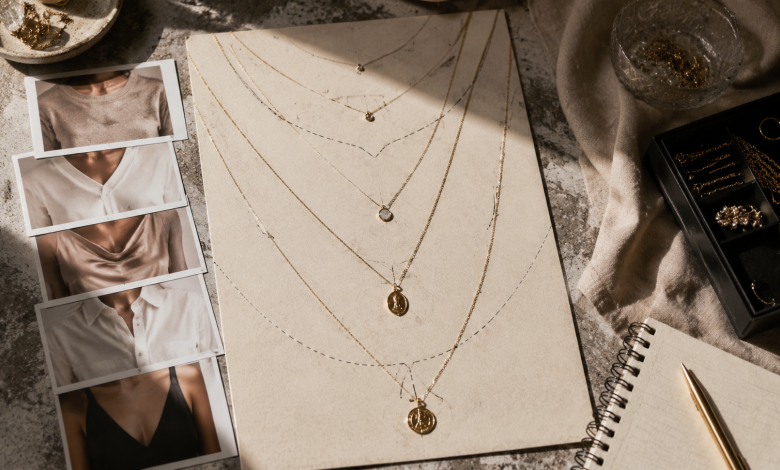
Where scoop necks invite experimentation is in layering. Because the curve is forgiving and the depth is moderate, stacking two or three chains of varying lengths can fill the space beautifully without overwhelming it. Start with something close to the throat, add a mid-length chain, drop a pendant a bit lower. The scoop provides enough room for all three without any of them colliding with fabric.
Beyond the Neckline: Body Proportion and Chain Weight
Neckline is the primary variable, but it’s not the only one. Your neck length, shoulder width, and bust size all influence how a particular chain length reads on your body. Someone with a longer neck can pull off chokers without feeling constricted. Someone with a shorter neck might find that anything above18 inches sits uncomfortably or visually shortens an already compact area.
Similarly, chain weight and thickness interact with neckline proportions. A delicate thread chain gets visually lost against a heavy knit sweater, regardless of length. A chunky chain can overwhelm a thin silkcamisole. The necklace and the garment need to be in the same visual weight class, or the mismatch will read louder than either piece individually.
The real skill here isn’t memorizing a chart of necklines and corresponding lengths. It’s developing an eye for how shapes interact in the space between your chin and your chest. Stand in front of a mirror. Hold the necklace at different heights. Watch where it creates tension and where it creates ease. Trust that feeling more than any guide, including this one. The mirror doesn’t lie, and your instincts about proportion are probably sharper than you give them credit for.