No More Tears: A Stress-Free Guide to Baby’s Very First Bath
No More Tears: A Stress-Free Guide to Baby’s Very First Bath
The Fear Nobody Talks About
You’ve done the prenatal classes. You’ve assembled thecrib. You’ve folded and refolded those tiny onesies more times than you’d like to admit. And then the hospital sends you home with a seven-pound human who smells faintly of milk and mystery, and somewhere in the back of your mind a quiet dread begins to form: I’m going to have to bathe this thing.
It’s a surprisingly universal anxiety for new parents. The baby is so small, so slippery, so alarmingly fragile-looking. The thought of holding a wet, squirming newborn over a tub while trying to remember which soap goes where it rattles even the most composed among us. The good news is that the fear almost always exceeds the reality. First baths, done right, can actually be calm, even tender, moments. Getting there is mostly a matter of knowing what you’re doing before you start.
Before the First Drop of Water: Timing Is Everything
Here’s something the baby books don’t emphasize enough your newborn doesn’t need a full bath right away. In fact, the World Health Organization recommends waiting at least 24 hours after birth, and ideally 48, before giving a baby their first bath. The white, waxy coating called vernix that covers a newborn’s skin is not just a quirk of biology. It’s an active moisturizer and antimicrobial barrier that the skin absorbs over the first day or two. Rushing to wash it off is, biologically speaking, counterproductive.
Once you’re home and past that initial window, there’s still no need to establish a daily bathing routine. Newborns aren’t getting dirty in any meaningful way. Two to three sponge baths a week is plenty for the first several weeks, until the umbilical cord stump falls off typically somewhere between one and three weeks after birth. Until then, submerging your baby in water is off the table. You’re working with a warm, damp cloth and a gentle touch.
This matters for stress management too. If you’re dreading the bath, knowing you only have to do it every few days takes some of the pressure off. You’re not signing up for a daily ordeal.
Setting the Stage: What You Actually Need
There’s a minor industry built around convincing new parents they need specialized baby bath equipment. Most of it is optional. What you genuinely need is pretty simple.
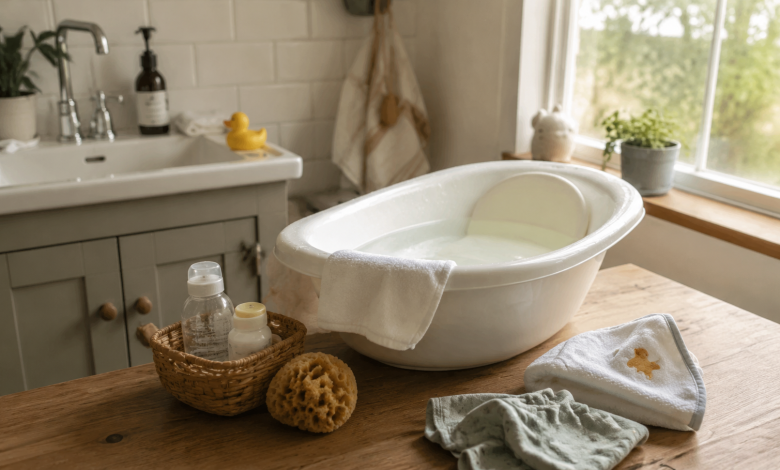
A clean, flat surface at a comfortable height a changing table, a countertop with a non-slip mat, or the floor. A small basin or baby bathtub if you’re ready to move past sponge baths. Two or three soft washcloths. A gentle, fragrance-free baby wash and shampoo formulated for newborns. A clean, dry towel with a hood if you have one. A fresh diaper and clean clothes laid out nearby, within arm’s reach, so you’re not scrambling once the baby is wet.
The temperature in the room matters more than most people expect. Babies lose body heat fast. A bathroom or wherever you’re bathing the baby should be warm around 75°F is a reasonable target. Cold air on wet skin is one of the most reliable ways to make a baby scream during a bath, and that sound alone is enough to make a new parent feel like they’ve failed some fundamental test.
Water temperature is the other variable that trips people up. You’re aiming for warm but not hot roughly 100°F, which you can check with your elbow or wrist rather than your hand, since those spots are more sensitive to heat. If it feels comfortably warm on your inner wrist, it’s probably right for the baby.
The Sponge Bath: A Step-by-Step That Actually Flows
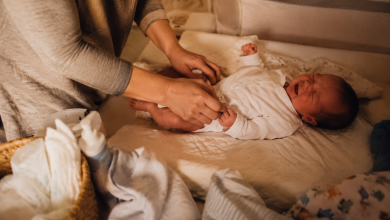
Lay your baby on their back on the padded surface. Keep them wrapped loosely in a towel and expose only the area you’re cleaning at any given moment. This keeps the baby warmer and, perhaps more importantly, calmer. The feeling of being uncovered and exposed is unsettling for newborns. Containment, even loose containment, helps.
Start with the face. Use a damp cloth no soap and wipe from the inner corner of each eye outward. Use a fresh section of cloth for each eye to avoid transferring anything between them. Wipe around the ears, not inside them. Clean the neck folds gently but thoroughly; milk has a way of pooling there and causing rashes if left unattended.
Move to the scalp. A small amount of gentle baby wash, worked in softly with your fingertips, is all you need. There’s a persistent nervousness among new parents around the fontanelle, the soft spot at the top of the skull. You can touch it. It’s covered by a tough membrane and won’t be harmed by normal washing. Just keep your movements gentle, as you would everywhere on this small person.
The body comes next chest, arms, hands, legs, feet. Pay particular attention to all those skin folds: the wrists, the thighs, behind the knees. Moisture and milk residue collect there. Rinse your cloth thoroughly between areas. Save the diaper area for last, and always wipe front to back.
If the umbilical cord stump is still present, work around it. Keep it dry. The current guidance from most pediatricians is to simply leave it alone and let it dry out and detach on its own. Avoid anything that would keep it moist or covered.
When the Crying Starts
Some babies hate every second of their first bath. Others are surprisingly neutral about the whole thing. A few actually seem to enjoy it from the start. There’s no predicting which kind you have until you’re in it.
If your baby is crying, it doesn’t mean you’re doing something wrong. It often just means they’re cold, or startled, or expressing their general position on change and novelty, which most newborns find deeply objectionable. Keep your voice low and steady. Talk to them throughout the whole process narrate what you’re doing, sing something, hum. Your voice is one of the most familiar things in their world, and it works as a genuine anchor even when nothing else does.
Moving efficiently matters too. Not rushed efficient. Every extra minute of an uncomfortable baby being held over a basin is a minute of crying you could have avoided by being prepared in advance. That’s the whole argument for the laid-out clothes, the towel already open, the clean diaper ready. The bath itself might take four minutes. Your ability to get the baby warm and dry again quickly is what turns a dramatic experience into a manageable one.
After the Bath: The Ritual That Matters More Than the Bath Itself
Here’s where the real opportunity lives. Wrapping a clean, warm, freshly-bathed baby in a soft towel, holding them close, patting them dry this is one of those moments that tends to stick in the memory. The crying, if there was any, usually stops fast once the warmth kicks in. What you’re left with is a baby who smells extraordinary and a quiet room and the particular satisfaction of having gotten through something that seemed harder than it turned out to be.
Moisturizer is worth applying while the skin is still slightly damp, particularly in dry climates or winter months. A fragrance-free baby lotion does the job. Keep the routine simple enough that you can replicate it without stress every couple of days.
The bath, over time, tends to become one of the more grounding parts of early parenthood. It has a beginning, a middle, and an end. It produces a visible result. In a season of life where most of what you’re doing feels invisible or unquantifiable, there’s something quietly satisfying about that.
The first one is always the hardest. After that, you’ll know what you’re doing and more importantly, so will the baby.